Moving Guide to Idaho (2026): Inside the Treasure Valley Boom

For five straight years, Idaho has been one of the fastest-growing states in the country — and over the 2020-to-2025 stretch, it was the single fastest, expanding 10.4% to a population just past 2.03 million. The engine isn’t births; it’s people. Net migration accounted for roughly 76% of the state’s 2025 growth, some 22,000 new residents, and about nine in ten of them came from other U.S. states. They are arriving from Seattle, from Salt Lake City, from California, and from across the Mountain West, drawn by a combination that has become genuinely rare: a real job market, a four-season outdoor lifestyle, and home prices that — while no longer cheap — still undercut the coastal metros most newcomers are leaving. If you’re weighing the move, this guide covers what you need to know to do it well.
Here’s what you need to know at a glance:
Quick Answers
- Median home price: ~$476,000 statewide (Boise ~$500K, Meridian ~$520K, smaller markets well below)
- Average long-distance move cost: $5,500 – $15,000 (2–4 bedroom home, from out of state)
- State income tax: Idaho flat 5.3% (down from prior years, with a 0% bracket on the lowest income)
- Anchor industries: Semiconductors and technology (Micron, HP), healthcare, agriculture and food, outdoor recreation
- Best for: Tech and engineering professionals, families seeking value and safety, remote workers, and outdoor-oriented households leaving higher-cost Western metros
This guide takes a practical approach to relocating to Idaho — why the migration is happening, how the Treasure Valley differs from the rest of the state, the semiconductor-driven job market, what your housing dollar actually buys, cost of living and the flat tax, the honest trade-offs of a fast-growing state, and how to plan a long-distance move that arrives smoothly. Because most people move to Idaho from somewhere more expensive, it helps to read this alongside our guides to planning an interstate move and long-distance relocation.
Why People Are Moving to Idaho
Idaho’s appeal rests on a balance that most growth states have already priced away. The state pairs a genuinely strong and diversifying job market with a cost of living that sits almost exactly at the national average — its 2025 cost-of-living index was 99.3, with the United States set at 100 — and home prices that, while they have climbed sharply, remain a fraction of the California, Washington, and Colorado markets sending so many of its new residents. The migration is overwhelmingly working-age: families, engineers, healthcare workers, and remote professionals, not a retirement wave. That distinction matters, because it means the people moving in are also filling the jobs that keep the economy expanding.
The geography of the inflow tells the story. Research on relocation interest found that roughly a quarter of people looking to move to Boise were searching from the Seattle area and another fifth from Salt Lake City, with California a persistent third source. These are residents trading a high-cost, high-density metro for a mid-sized city where a professional salary still buys a house, a yard, and a fifteen-minute commute. For a household leaving a $900,000 starter home in the Bay Area or a cramped Seattle condo, the math on a $500,000 Boise house with no state capital-gains complications and a flat 5.3% income tax is compelling.
Beyond economics, Idaho sells a way of life. The state is built around the outdoors — skiing at Bogus Basin and Sun Valley, whitewater on the Salmon and Snake rivers, mountain trails minutes from downtown Boise, and lakes across the northern panhandle. It consistently ranks among the safest states in the country, with low violent-crime rates that families notice immediately. The pace is slower, the politics are stable and predictable, and the sense of community in places like Meridian, Eagle, and Coeur d’Alene is something transplants frequently cite as the reason they stayed. For many, the combination of opportunity, affordability relative to the coast, and access to nature is simply unavailable anywhere they could previously afford.
The Treasure Valley: Boise, Meridian, and Nampa
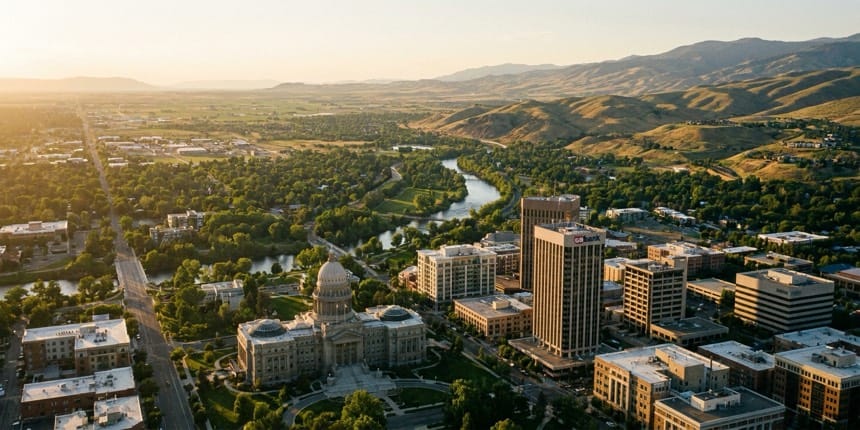
The center of gravity for almost everyone moving to Idaho is the Treasure Valley — the broad basin of Ada and Canyon counties anchored by Boise and stretching west through Meridian, Eagle, Nampa, and Caldwell. This is where the jobs, the airport, the universities, and the bulk of the new construction are, and it is where the growth is most visible: the valley added more than fifty residents a day in 2025, and the Boise metro ranked as the thirteenth-fastest-growing market in the country and the second-fastest in the West, trailing only St. George, Utah.
Boise itself is the state capital and economic core — a city of roughly 240,000 with a walkable, leafy downtown, a thriving food and brewery scene, a greenbelt that runs for miles along the Boise River, and the foothills rising immediately to the north for hiking and biking. The North End and East End neighborhoods offer historic homes and the most urban feel; the Boise Bench and Southeast Boise blend value with proximity; and the foothills communities command a premium for their views and trail access. The citywide median home price sits around $500,000, with established close-in neighborhoods running well above that.
Meridian, just west of Boise, has become the valley’s family magnet and one of the fastest-growing cities in the entire country. It is newer, more master-planned, and more suburban than Boise — abundant new construction, strong schools through the West Ada district, and a median home price near $520,000 that buys substantially more square footage and yard than the same money in Boise’s core. Eagle, to the northwest, is the valley’s upscale enclave, with larger lots, custom homes, and a small-town downtown. Nampa and Caldwell, in Canyon County, are the value end of the valley — longer commutes into Boise but noticeably lower home prices, which is why so much of the region’s growth has pushed west. For a relocating household, the Treasure Valley decision is essentially a trade-off between Boise’s urban energy, Meridian’s family-oriented newness, Eagle’s premium, and Canyon County’s affordability.
Idaho’s Other Markets: Idaho Falls, Coeur d’Alene, Twin Falls, and Pocatello
Idaho is far larger and more varied than the Treasure Valley, and a meaningful share of newcomers land elsewhere — often for a specific job, a lower price point, or a particular landscape. Understanding the regional differences is essential, because the climate, economy, and culture of northern Idaho are quite distinct from the south.
Coeur d’Alene, in the northern panhandle near Spokane, Washington, is the state’s resort and lifestyle market — built around a stunning lake, surrounded by forested mountains, and increasingly popular with remote workers, retirees, and Washington and California transplants. It is the closest thing Idaho has to a luxury-recreation market, and prices reflect the demand. Idaho Falls, in the east near the Wyoming border, anchors a region built around the Idaho National Laboratory — a major federal research facility employing thousands of scientists and engineers — along with healthcare and agriculture; it offers a notably lower cost of living and easy access to Yellowstone and the Tetons. Twin Falls, in the south-central Magic Valley, is an agricultural and food-processing hub with a striking canyon setting and some of the most affordable housing in the state. Pocatello, home to Idaho State University, rounds out the southeast as a smaller, education-and-healthcare-driven market. Each of these cities offers a real discount to the Treasure Valley, and for buyers who can work remotely or whose career fits the local economy, they can be the smarter financial move.
The Job Market and the Micron Boom
Idaho’s economy has quietly become one of the most interesting in the Mountain West, and the single biggest story is semiconductors. Micron Technology, the memory-chip giant, is headquartered in Boise and is in the middle of a historic expansion — adding two high-volume fabrication plants in the Boise area and driving an estimated 17,000-plus total new jobs, direct and indirect, across the state as it ramps capacity to serve surging demand from artificial-intelligence computing. For a relocating engineer, technician, or supply-chain professional, that single investment has reshaped the region’s hiring outlook for the rest of the decade. HP Inc. maintains a substantial Boise presence as well, and a deep ecosystem of suppliers, startups, and established tech firms has grown up around the two anchors.
Technology is far from the whole picture. Healthcare is the largest employer base by headcount, led by St. Luke’s Health System — the state’s biggest employer — and St. Alphonsus. Albertsons, the national grocery chain, has been headquartered in Boise since 1939 and remains a major corporate employer alongside the employee-owned grocer WinCo Foods. Boise State University and the West Ada School District anchor education employment, and agriculture and food processing remain economic pillars statewide, particularly in Canyon County, the Magic Valley, and the east. The practical takeaway for a newcomer is diversification: the Treasure Valley is no longer a one-sector economy, unemployment has stayed low, and a technical or healthcare career has genuine room to grow here. Salaries still trail the largest coastal metros in absolute terms, but adjusted for Idaho’s housing costs and flat tax, take-home buying power is frequently higher.
Cost of Living and the Tax Picture
Idaho’s overall cost of living sits right at the national average — the 2025 index of 99.3 means a household spends about what it would in a typical American metro, with housing the main swing factor. Median rent statewide runs around $1,383, comfortably below the national median of roughly $1,639, and groceries, utilities, and transportation track close to national norms. The median household income of about $77,800 stretches further here than in the high-cost states most newcomers leave, particularly once taxes enter the equation.
The tax picture is a meaningful draw. Idaho levies a flat income tax of 5.3%, applied above a small zero-rate bracket on the lowest earnings — a rate the legislature has cut repeatedly in recent years. Because it is flat rather than graduated, higher earners are not pushed into escalating brackets the way they are in California, where the top marginal rate exceeds 13%, or even in Oregon next door. Idaho also has no estate or inheritance tax, and its property taxes are moderate, with a homeowner’s exemption that reduces the taxable value of an owner-occupied primary residence. The combined effect for a household relocating from California, Washington (which has no income tax but high housing and a capital-gains tax on large gains), or a high-tax Northeastern state is often several thousand dollars a year in tax savings layered on top of the housing discount.
The honest caveat is that Idaho is not the bargain it was a decade ago. Ada County’s median home price has risen roughly 300% from its 2011 trough to about $541,000 in early 2026, and rapid in-migration has pushed rents and prices up faster than local wages. The state remains a strong value relative to the coast, but newcomers expecting “cheap Idaho” prices from a few years ago will need to recalibrate.
The Housing Market: What Your Money Buys
Housing is where the Idaho decision is really made, and the picture varies dramatically by market. The statewide median sits near $476,000, but that single number conceals an enormous range. In Boise’s established close-in neighborhoods — the North End, the East End, the foothills — buyers routinely pay $600,000 and well beyond for character homes and view lots. In Meridian and Eagle, newer master-planned construction trades around $500,000 to $700,000 and up, with the premium reflecting square footage, schools, and amenities rather than location alone. Push west into Nampa and Caldwell, and the same family budget buys a noticeably larger or newer home, which is precisely why Canyon County has absorbed so much of the region’s growth.
Outside the Treasure Valley, the discounts deepen. Idaho Falls, Twin Falls, and Pocatello offer median prices well below the Boise metro, and for a remote worker or a professional whose job sits in those local economies, the value proposition is strong. Coeur d’Alene is the exception in the other direction — its lake-and-mountain setting and Washington-transplant demand have pushed prices to among the highest in the state. The broad rule for newcomers is that proximity to Boise, newness of construction, and access to recreation each carry a premium, and that the largest dollar savings come from buying a few miles farther out or in a smaller market. Working with an agent who knows the valley’s micro-markets pays for itself, because the line between an overpriced listing and a fair one can be a single subdivision.
Best Places to Live in Idaho for Your Situation
Because Idaho’s markets differ so much, the right landing spot depends heavily on who you are and what your move is for. The following table maps the major options to the households they suit best.
| Area | Character | Typical home price | Best for |
|---|---|---|---|
| Boise (North End / East End) | Historic, walkable, urban | $600K–$1.2M+ | Professionals wanting city life |
| Boise (Bench / SE Boise) | Established, central, value | $450K–$650K | First-in-state buyers, commuters |
| Meridian | New, master-planned, family | $480K–$700K | Families, strong schools |
| Eagle | Upscale, larger lots | $700K–$2M+ | Executives, custom-home buyers |
| Nampa / Caldwell | Value, growing fast | $380K–$520K | Budget-focused families |
| Coeur d’Alene | Lake-and-mountain resort | $550K–$1.5M+ | Remote workers, retirees, recreation |
| Idaho Falls | Affordable, science-anchored | $350K–$500K | INL employees, value buyers |
| Twin Falls | Agricultural, lowest-cost | $320K–$450K | Maximum affordability |
Data: Idaho real estate market reports, Redfin, Zillow, early 2026.
A professional moving for a Micron or HP role almost always lands in the Treasure Valley, with the Boise-versus-Meridian choice coming down to urban character versus newer suburban value. A family prioritizing schools and space gravitates to Meridian, Eagle, or the better Nampa subdivisions. A remote worker chasing lifestyle often chooses Coeur d’Alene or a Boise foothills home. And a household whose primary goal is maximum affordability finds it in Canyon County or the smaller southern markets. There is no single “best” Idaho — there is the right Idaho for your job, your budget, and your appetite for commute and climate.
Schools and Higher Education
For families, schools frequently determine the neighborhood, and Idaho’s options have improved alongside its growth. In the Treasure Valley, the West Ada School District — the state’s largest, serving Meridian and parts of Boise — is the most sought-after, which is a major reason families have flocked to Meridian and Eagle. The Boise School District serves the capital with a strong mix of traditional and magnet programs, and the city’s established neighborhoods feed some of the most desirable schools in the state. As everywhere, quality varies by school within a district, so families typically research feeder patterns and attendance boundaries carefully before committing to a home.
Idaho also offers a growing roster of school-choice options, including public charter and magnet schools that draw applications from across the valley. On the higher-education side, Boise State University has become a nationally visible institution with strong engineering and business programs feeding the local tech economy; the University of Idaho in Moscow anchors the north; and Idaho State University in Pocatello is a regional draw in the southeast, particularly in health sciences. For relocating families, the combination of improving public schools, expanding choice, and a credible state university system removes one of the common hesitations about moving to a smaller state.
Climate, Outdoor Life, and Daily Living
Idaho is a four-season state, and the seasons are real — but they vary sharply by region. The Treasure Valley sits in a high-desert basin with hot, dry summers (highs often in the 90s), crisp falls, and cold winters that bring some snow but far less than the mountains or the panhandle. Northern Idaho around Coeur d’Alene is wetter, greener, and snowier, with a true mountain-and-lake climate; eastern Idaho near Idaho Falls runs cold and high-altitude. Newcomers from mild coastal climates should expect genuine winters and should budget for snow tires and a few weeks of cold each year, while those from the Midwest or Northeast will generally find Idaho’s winters comparable or milder.
The compensation is the outdoors, which is woven into daily life in a way few states match. Boise’s foothills put hiking and mountain-biking trails minutes from downtown; Bogus Basin offers night skiing a short drive up the hill; Sun Valley, McCall, and the central mountains deliver world-class skiing and lake recreation within a few hours; and the Salmon, Snake, and Payette rivers draw rafters and anglers from across the country. Daily life is car-oriented, as in most of the Mountain West, but Treasure Valley commutes are dramatically shorter than what newcomers leave behind — a fifteen-to-twenty-five-minute drive is typical, and the valley’s grid and freeway system keep congestion manageable even as the population climbs. For households leaving Seattle traffic or Bay Area gridlock, the recovered hours are frequently cited as the single biggest quality-of-life upgrade.
How Idaho Compares to the States People Leave
Most people don’t move to Idaho in a vacuum — they move from somewhere more expensive, and the comparison is what makes the decision. The table below sets Idaho against the three states that send it the most residents.
| Metric | Idaho | California | Washington | Colorado |
|---|---|---|---|---|
| Top income tax rate | 5.3% (flat) | 13.3% (graduated) | 0% (no income tax) | 4.4% (flat) |
| Median home price (early 2026) | ~$476K | ~$870K+ | ~$620K | ~$560K |
| Cost-of-living index | ~99 | ~138 | ~115 | ~105 |
| Typical Boise-metro commute | 15–25 min | 30–60+ min | 30–60+ min | 25–45 min |
Data: state tax agencies, Zillow, cost-of-living indices, 2025–2026.
The pattern is consistent: Idaho’s housing costs a fraction of California’s and meaningfully less than Washington’s or Colorado’s, its flat income tax avoids the punishing top brackets of California, and its commutes are a fraction of what big-metro transplants are used to. Washington’s lack of an income tax is the one place the comparison narrows — but Washington’s housing, its capital-gains tax on large investment gains, and Seattle congestion still tilt most relocating households toward Idaho once total cost and quality of life are weighed together. The deeper point is that the move usually isn’t a downgrade dressed up as savings; for the right household, it’s more house, more time, and more access to the outdoors for less money.
What a Move to Idaho Costs and How to Budget
A full-service interstate move of a two-to-four-bedroom home to Idaho generally runs $5,500 to $15,000, shaped by distance, shipment weight, time of year, and the services you choose. Geography is a major factor: Boise sits roughly 430 miles from Seattle, 340 from Salt Lake City, 640 from the Bay Area, and well over 800 from Southern California — and because so many movers come from the West Coast, transportation distance is a real line item. Weight is the single largest cost driver, so decluttering before the move directly lowers the bill; a household that sheds a garage of accumulated belongings before loading can save meaningfully on a long-haul move.
Timing matters too. Summer is peak moving season across the industry, when demand and pricing rise because of school schedules and weather, and Idaho’s summer is also its busiest in-migration window — so a move scheduled for the fall or winter, mid-week, is typically less expensive for the identical shipment. The most reliable budget comes from a survey-based estimate built on your actual belongings rather than a generic online figure, and our moving cost calculator provides an early ballpark before you book. For households relocating from California specifically, our guide on where to move from California puts Idaho in context against the other common landing states.
Timing Your Idaho Move and the First 90 Days
The strongest interstate moves start six to eight weeks ahead, which gives you time to secure a reputable mover before peak-season calendars fill, declutter so you aren’t paying to ship what you won’t keep, and handle the administrative side without a scramble. New Idaho residents have 90 days to obtain an Idaho driver’s license and register a vehicle after establishing residency, and you’ll file a state income tax return the following year at the flat 5.3% rate. If you’re buying, line up a local agent early — the valley’s better listings move quickly, and out-of-state buyers who arrive without representation often lose homes to faster, better-prepared offers.
In the first weeks, plan to transfer or establish utilities before move-in, update your address with the USPS along with your bank and employer, register to vote, and — for families — handle school enrollment early, since Idaho districts require proof of residency and the most popular West Ada and Boise schools fill their boundaries. Beyond the paperwork, the early weeks are when the payoff becomes tangible: a shorter commute than the metro you left, more home for the money, the foothills or the lake a few minutes away, and a flat, modest state income tax. Households that plan the logistics in advance get to enjoy that payoff rather than scramble through it.
What to Know Before You Commit
The trade-offs are worth naming honestly. Idaho’s growth has, in places, outpaced its infrastructure: Treasure Valley traffic — while still light by big-city standards — has worsened noticeably on the main arteries, and the rapid arrival of new residents has strained housing supply and pushed prices well above where they sat a few years ago. Public transit is minimal outside a basic Boise bus system, so the state is firmly car-dependent. Newcomers expecting the rock-bottom prices Idaho was known for a decade ago will find a more expensive, more competitive market than the reputation suggests.
The climate is a genuine adjustment for some: real winters with snow and cold, hot dry summers in the valley, and wildfire smoke that can settle into the basin during the worst weeks of late summer. Idaho is also a smaller, more politically and culturally homogeneous state than the large metros many newcomers leave, which suits some households and not others — it’s worth an honest look before committing. And while the job market has diversified impressively, it is still smaller in absolute terms than a major coastal economy, so professionals in narrow specialties should confirm their field has depth here before relocating. None of these outweigh the case for most movers, but knowing them in advance is the difference between a smooth transition and an expensive surprise.
Planning Your Move to Idaho
A move to Idaho from out of state is a long-distance relocation, frequently from the West Coast, and the quality of your moving company shapes the entire experience. When a furnished family home travels hundreds or thousands of miles across mountain passes and through summer heat, professional packing, an accurate inventory, transit visibility, and a single accountable point of contact are what separate a smooth arrival from weeks of recovering from damage and delay.
This is the work Nelson Westerberg was built for. As one of Atlas Van Lines’ top agents, we handle full-service interstate relocations regularly — including the technology and engineering moves Micron’s and HP’s hiring generates, the corporate transfers that follow a major expansion, and the family relocations Idaho’s schools and lifestyle attract. We understand the expectations of both the relocating professional and the corporate relocation programs that frequently coordinate these moves. Our guide to choosing a white-glove moving company explains what to look for in a long-distance mover, and our guide to planning an interstate move walks through the full sequence from first survey to final delivery. Start six to eight weeks ahead, and the most demanding part of the move — getting your household safely across the West — becomes the part you worry about least.
Frequently Asked Questions
How much does it cost to move to Idaho?
A full-service, long-distance move to Idaho typically costs between $5,500 and $15,000 for a two-to-four-bedroom home from out of state. The final figure depends on the weight of your shipment, the distance, the time of year, and add-on services such as professional packing, vehicle shipping, or temporary storage. Moves from California or the East Coast fall at the higher end of the range, while a shorter haul from Seattle or Salt Lake City costs less.
What is the cost of living in Idaho?
Idaho’s cost of living sits almost exactly at the national average, with a 2025 cost-of-living index of about 99.3 against a U.S. benchmark of 100. Median rent runs around $1,383 a month, below the national median, and groceries, utilities, and transportation track close to national norms. Housing is the main variable: the Treasure Valley is the most expensive market, while Idaho Falls, Twin Falls, and Pocatello are considerably cheaper.
Does Idaho have a state income tax?
Yes. Idaho levies a flat income tax of 5.3% for 2026, applied above a small zero-rate bracket on the lowest earnings, and the rate has been cut repeatedly in recent years. Because it is flat rather than graduated, higher earners avoid the escalating top brackets found in states like California. Idaho also has no estate or inheritance tax and offers a homeowner’s exemption that reduces the taxable value of a primary residence.
What are the best places to live in Idaho?
For professionals wanting city life, Boise’s North End, East End, and foothills lead. For families seeking newer homes and strong schools, Meridian and Eagle are the top Treasure Valley choices, while Nampa and Caldwell offer the best value. Outside the valley, Coeur d’Alene is the premier lake-and-mountain market, Idaho Falls anchors science and research employment in the east, and Twin Falls offers the lowest housing costs in the state.
What is the job market like in Idaho?
Idaho’s economy is anchored by a major semiconductor expansion: Micron Technology, headquartered in Boise, is adding two new fabrication plants and an estimated 17,000-plus total jobs across the state, with HP Inc. maintaining a large local presence as well. Healthcare is the biggest employer base, led by St. Luke’s Health System, and Albertsons and WinCo Foods anchor the grocery sector. Boise State University, education, agriculture, and food processing round out a diversified and low-unemployment economy.
When is the cheapest time to move to Idaho?
The most affordable time to move is during the fall and winter, roughly October through April. Summer — June through August — is peak moving season nationally and Idaho’s busiest in-migration window, so demand and pricing both rise. Booking several weeks ahead and choosing a mid-week, off-season date typically secures the best rates, and it also avoids the worst of the Treasure Valley’s summer heat during the move itself.
What salary do you need to live comfortably in Idaho?
A single professional can generally live comfortably in Idaho on $60,000–$75,000, while a family of four typically needs $110,000–$140,000 depending on the market and housing. The Treasure Valley and Coeur d’Alene sit at the higher end, while Idaho Falls, Twin Falls, and Canyon County require less. Idaho’s flat 5.3% income tax and below-coastal home prices stretch those salaries further than in the high-tax, high-cost states most newcomers leave.
Is Idaho a good place to move from California?
For many California households, yes. Idaho offers home prices roughly half of California’s statewide median, a flat 5.3% income tax against California’s 13.3% top rate, far shorter commutes, and immediate access to the outdoors. The trade-offs are real winters, a smaller job market in absolute terms, and a less urban, less diverse environment than California’s largest metros. Households leaving the Bay Area, Los Angeles, or Sacramento for a Treasure Valley tech or healthcare role tend to find the move pencils out strongly on both cost and quality of life.
Conclusion
Idaho’s growth is no accident: a semiconductor-anchored economy expanding faster than almost any in the region, a flat and modest state income tax, home prices well below the coastal markets sending its new residents, and an outdoor lifestyle that turns weekends into something people build their lives around. The Gem State has become one of the West’s premier destinations for relocating professionals and families alike — and while it’s no longer the bargain it once was, the combination of opportunity, value relative to the coast, and access to nature continues to draw people by the thousands each year.
The move itself is what you control. A long-distance relocation to Idaho, handled by a full-service professional partner rather than improvised, is what turns a major cross-Western transition into a smooth one. Whether you’re an engineer relocating for a role at Micron, a family chasing the schools and space of Meridian, or a remote worker drawn to the lake at Coeur d’Alene, the right preparation makes the difference between a stressful month and a confident new start. With the right planning and the right partner, getting to Idaho can be the easy part of your move to the Gem State.
Related Articles
New York City vs. Austin (2026): What Your Paycheck Really Buys
Few city comparisons produce a gap as wide as New York City versus Austin. By one widely cited 2026 estimate, it takes roughly $11,500 a month in New York to sustain the same standard of living that $6,900 buys in Austin — a difference so large it reshapes not just a budget but a life. […]
Read MoreChicago vs. Charlotte (2026): The Queen City at a Fraction of the Cost

For a Chicago household weighing a move south, Charlotte presents an unusually clean comparison: a real city, with a genuine corporate economy and four mild seasons, at a fraction of Chicago’s cost — and, most strikingly, a fraction of its property-tax burden. A Chicago homeowner paying the metro’s effective property-tax rate near 1.98% on a […]
Read More

Table of Contents

Atlas Van Lines, Inc. U.S. DOT No. 125550 (TM & © 2026 AWGI LLC.) | G.P.S.C. 4917 | IL C.C. 4246 | NJPC 00104 | Cal-T 110193
© 2026 Nelson Westerberg, Inc. All Rights Reserved Worldwide.