Moving Guide to Jacksonville (2026): Your Complete Relocation Handbook

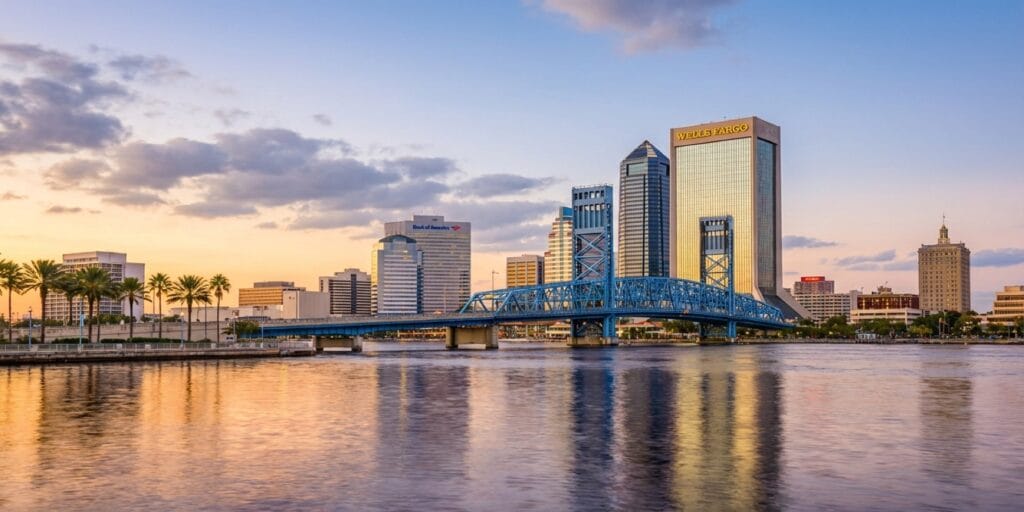
If you’re considering relocating to Florida, Jacksonville deserves more attention than it typically receives. While Miami and Tampa dominate the headlines, Jacksonville quietly crossed the one million resident threshold in 2024—becoming only the third Florida city to reach that milestone. The National Association of Realtors just designated it a 2026 Hot Spot, projecting 14% sales growth and 4% price appreciation. And with a median home price of $304,000—roughly half of Miami’s and $100,000 below Orlando’s—Jacksonville offers something increasingly rare in Florida: genuine affordability in a major metro.
Here’s what you need to know at a glance:
Quick Answers
- Average move cost: $2,000 – $5,500 (from Northeast)
- Median home price: $304,000
- Median rent (1BR): $1,250/month
- Cost of living: 5-7% below national average
- Best for: Value-seekers, military families, healthcare and fintech professionals, anyone priced out of South Florida
This guide takes a different approach than most Jacksonville resources. Rather than treating the city as an afterthought to Miami or Tampa, we’ll explore why smart relocators are increasingly choosing Jacksonville—and help you determine whether its unique combination of affordability, career opportunity, and coastal access makes sense for your situation.
Why Jacksonville Is Florida’s Underrated Powerhouse
Jacksonville occupies a peculiar position in Florida’s hierarchy. It’s the largest city by land area in the contiguous United States, the most populous city in the state outside South Florida, and one of the fastest-growing metros in the nation—yet it rarely appears in “best places to live” listicles dominated by trendier destinations. That disconnect creates opportunity for relocators willing to look beyond the obvious.
The Growth Nobody’s Talking About
The numbers tell a compelling story. Jacksonville added 16,365 new residents between July 2023 and July 2024, ranking 10th among all U.S. cities for population increase. The metro area absorbed 31,700 net in-migrants in 2024 alone, with another 20,500 expected by the end of 2025. Northeast Florida is gaining more than 100 new residents every single day.
But here’s what makes Jacksonville’s growth different from the rest of Florida: it’s projected to continue at the fastest rate of any major Florida metro through 2028. Oxford Economics forecasts 11% population growth over that period—outpacing Miami, Tampa, and Orlando. The region expects more than 97,000 net in-migrants through 2029.
What’s driving this surge? A combination of factors that other Florida metros can’t match: genuinely affordable housing, a diversified job market that doesn’t depend on tourism, military stability from one of the nation’s largest naval installations, and business-friendly conditions that have attracted major corporate operations.
The Economy Beyond the Beach
Jacksonville’s economy has diversified far beyond the port and military base that historically defined it. Today, the region operates as a hub for healthcare, financial technology, and logistics—industries that provide stable, well-paying employment regardless of tourist season.
Healthcare anchors the professional job market. Baptist Health employs over 14,000 people across its Jacksonville facilities. Mayo Clinic’s Florida campus employs 8,000 and continues expanding its specialty services. These aren’t just jobs—they’re careers with advancement potential that doesn’t require relocating.
Financial services and fintech have established Jacksonville as a quiet powerhouse. Bank of America maintains a workforce of 7,000+ locally. Fidelity National Information Services (FIS), headquartered here, employs 5,000+. Deutsche Bank, Citi, and numerous insurance carriers have built significant operations in the region, attracted by lower costs and access to talent.
Logistics and distribution leverage Jacksonville’s strategic position. CSX Corporation is headquartered here with 4,000 employees. Amazon operates fulfillment centers employing 4,000+. The port of Jacksonville—JAXPORT—continues expanding, driving warehouse and distribution employment.
Military and defense provide unmatched stability. Naval Air Station Jacksonville employs over 23,000 military and civilian personnel, making it the region’s largest employer by a significant margin. This military presence creates a steady economic foundation that insulates Jacksonville from the boom-bust cycles that can affect tourism-dependent metros.
The result is an unemployment rate that tracks below national averages and a job market that consistently adds positions across multiple sectors—not just hospitality and retail.
What It Actually Costs to Move to Jacksonville
Jacksonville’s affordability extends to the moving process itself. The shorter distance from Northeast population centers and competitive market conditions keep costs manageable.
Full-Service Moving Costs by Origin
Moving Cost by Home Size (Full-Service, Including Packing):
- Studio/1BR (2,000-3,500 lbs): $960-$2,500 from Northeast; $1,800-$3,500 from Midwest
- 2BR (5,000-7,000 lbs): $2,000-$4,200 from Northeast; $2,800-$5,000 from Midwest
- 3BR (8,000-11,000 lbs): $3,400-$5,500 from Northeast; $4,200-$6,500 from Midwest
- 4BR+ (12,000+ lbs): $4,500-$6,500+ from Northeast; $5,500-$8,000+ from Midwest
Based on industry data for full-service interstate moves, January 2026
What Affects Your Final Cost
Your actual moving cost depends on several factors:
Shipment weight drives most of the cost. The average 2-bedroom apartment weighs 5,000-7,000 pounds; a 3-bedroom home typically runs 8,000-11,000 pounds. Every item you declutter before moving saves money.
Distance matters, but Jacksonville’s position offers an advantage. At approximately 940 miles from New York City—shorter than the haul to Miami or Tampa—moves from the Northeast often come in lower than expected. The I-95 corridor provides efficient transit that keeps transportation costs competitive.
Timing significantly impacts pricing. Peak moving season runs May through September, when rates climb 20-30% above off-season levels. If you have flexibility, booking a mid-month, mid-week move in October through March can yield substantial savings.
Additional services add up quickly. Vehicle shipping runs $700-$1,200 depending on origin. Temporary storage (if needed) costs $100-$250 per month for climate-controlled units—notably cheaper than South Florida. Full packing service adds 15-25% to your base moving cost but saves significant time and stress.
The Hidden Costs Nobody Mentions
Beyond the moving truck, budget for these Jacksonville-specific expenses:
Security deposits and first month’s rent: Most Jacksonville apartments require first month plus deposit (often equal to one month’s rent). For a $1,300/month apartment, that’s $2,600 upfront before you’ve unpacked a single box—still significantly less than you’d pay in Tampa or Orlando.
Utility setup: JEA (Jacksonville’s municipal utility) handles electric, water, and sewer for most of the city. New customers typically face deposits of $100-$250 depending on credit history. Having your previous utility company provide a letter of good standing can reduce or eliminate this requirement.
Insurance considerations: Florida’s property insurance market has experienced significant disruption statewide, with premiums running $2,000-$4,500+ annually for homeowners. Jacksonville’s position away from the immediate coast can provide some premium relief compared to South Florida, though coverage remains essential. Renters should budget $200-$400 per year for comprehensive coverage including hurricane protection.
Vehicle re-registration: Florida requires vehicle registration within 10 days of establishing residency. Budget $225-$450 depending on your vehicle’s value, plus any applicable sales tax differential.
Toll considerations: Unlike Tampa or Orlando, Jacksonville’s highway system relies less heavily on toll roads for daily commuting. I-95, I-10, and I-295 provide toll-free access across the metro, reducing your monthly transportation costs compared to toll-dependent cities.
Choosing a Professional Moving Company
Jacksonville’s rapid growth has attracted moving companies at every level of quality and professionalism. Understanding how legitimate carriers operate—and what distinguishes them from operations that create problems—is the best investment you can make before requesting a single quote.
What You’re Actually Paying For
Moving services span a wider range than most people realize before they start comparing quotes. Full-service moving means professionals handle every physical aspect: packing your belongings, disassembling and wrapping furniture, loading the truck, driving to Jacksonville, unloading, and reassembling. You show up and find everything in place. The premium reflects that you’ve genuinely outsourced the entire ordeal.
Partial service lets you handle your own packing while professionals manage the physical labor and transportation—a balance that saves meaningful money while still removing the hardest parts of the process. Labor-only service exists for those using pods or rental containers who simply need capable hands at both ends. Reputable movers offer the full range rather than forcing you into a single option.
The Estimate Game
The structure of your estimate determines whether your final bill looks like what you expected—or surprises you when the truck arrives.
A binding estimate locks your price based on a thorough survey of your belongings. Provided you haven’t added items or requested new services, that figure is what you pay. Full stop.
Non-binding estimates project costs based on expected shipment weight, with final billing determined by what the scale reads. They can favor you if you’ve decluttered; they can also produce an unwelcome conversation at delivery.
The best option for most movers is a binding not-to-exceed estimate: your cost will never exceed the quote, but can come in lower if your shipment weighs less than projected. Carriers who favor this approach do so because it creates trust rather than negotiation at the worst possible moment.
Separating Legitimate Movers from Problems
Federal law requires every interstate mover to register with the Federal Motor Carrier Safety Administration and carry a valid U.S. DOT number. This takes thirty seconds to verify online. If a company can’t produce a DOT number or shows a troubled FMCSA record, end the conversation there.
The warning signs that persist across the industry: large deposits required before moving day, quotes provided without actually seeing your belongings, prices dramatically below all other estimates, unmarked trucks, reluctance to provide references. Moving scams target people in exactly the condition relocation creates—time pressure, emotional stress, and decisions made quickly. A small investment in verification protects you from months of consequences.
Understanding What’s Protected—and What Isn’t
Interstate movers are required to offer two liability coverage levels. The difference between them is substantial.
Released value protection costs nothing and covers almost nothing: $0.60 per pound per item. A 45-pound flatscreen worth $1,500 is covered for $27. A full bedroom set, perhaps $60. This tier satisfies regulatory minimums and nothing more.
Full value protection (FVP) is Nelson Westerberg’s premium coverage option, providing up to $6 per pound for lost or damaged items — a meaningful improvement over the $0.60 per pound released value minimum. For COD moves, Nelson Westerberg provides up to $75,000 in full value protection at a $0 deductible, at no additional charge. It’s calculated against total shipment weight, with add-on options for high-value pieces. For any meaningful long-distance move, the cost of genuine coverage is proportionate to what’s actually at risk.
The Jacksonville Riverfront and Military Base Factor
Jacksonville has two logistical realities that catch incoming movers off-guard. The first: downtown riverfront condos and the emerging Southbank district increasingly require a Certificate of Insurance before permitting moving crews building access. This document proves your carrier holds adequate liability coverage to protect the building itself, separate from your belongings insurance. Professional movers maintain this paperwork and generate it routinely.
The second reality is specific to Jacksonville: the city has a substantial military population. NAS Jacksonville, Naval Station Mayport, and related installations all have their own protocols for moving vehicles accessing base housing—advance registration, vehicle credentials, scheduled access windows. Movers unfamiliar with military base logistics create delays. Those who have handled Jacksonville military relocations hundreds of times have these processes down.
Why Nelson Westerberg for Your Jacksonville Move
Nelson Westerberg brings specific experience with the logistics that make Jacksonville relocations different from other Florida moves. That means familiarity with the St. Johns River waterfront buildings and their COI requirements, with the Southbank and Riverside neighborhoods and their unique access considerations, and with the military installation protocols that govern a meaningful segment of Jacksonville moves.
When your belongings are traveling I-95 south from the Northeast or I-10 east from the Midwest, you want a company that’s made this exact approach into Jacksonville—with all its specific complexities—many times before. Binding not-to-exceed pricing, same-day COI documentation, full value protection, and one point of contact from the first call to the final box. Nelson Westerberg has been making Jacksonville moves work since before the city’s current growth wave.
Jacksonville Neighborhoods: Finding Your Fit
Jacksonville’s 875 square miles—the largest footprint of any city in the contiguous United States—means neighborhoods vary dramatically in character, price, and lifestyle. The city’s scale can feel overwhelming initially, but it also means you’ll find an area that fits your specific needs.
For Young Professionals: Urban Energy
San Marco consistently ranks as Jacksonville’s most desirable walkable neighborhood. Tree-lined streets, boutique shops, theaters, and restaurants create a neighborhood that feels closer to a college town than sprawling Florida. The area centers on San Marco Square, where weekend farmers markets and outdoor dining give residents reasons to leave their cars behind. Victorian-era homes and modern condos share space along the St. Johns River. Home prices range from $400,000-$700,000 for single-family, with condos and apartments offering more accessible entry points around $1,500-$2,000/month for one-bedrooms.
Murray Hill has emerged as Jacksonville’s eclectic, trendy district—think breweries, vintage shops, and locally-owned eateries. The neighborhood attracts creatives and young professionals seeking authenticity over polish. First Friday art walks, parks with playgrounds, and a genuine community feel distinguish Murray Hill from generic suburban development. Best of all, median home prices remain around $250,000-$350,000, making homeownership achievable for young buyers priced out of other metros.
Downtown Jacksonville offers high-rise living for those who want maximum urban convenience. Condos along the St. Johns River provide walkable access to restaurants, the arts district, and the Jacksonville Landing entertainment area. Rents for one-bedrooms run $1,400-$1,900, notably lower than comparable downtown living in Tampa or Orlando. The area continues developing, with new residential construction adding options for city-lifestyle seekers.
For Families: Schools and Space
Southside has become Jacksonville’s fastest-growing family destination—and the numbers explain why. The area boasts highly-rated schools, major highway access (I-95 and Butler Boulevard), shopping at St. Johns Town Center, and a mix of homes and apartments at various price points. Niche.com gives Southside an A-grade, and families appreciate the combination of convenience and community. Home prices range from $350,000-$550,000 for single-family, with newer developments offering modern amenities.
Ponte Vedra Beach represents Jacksonville’s luxury tier for families who prioritize top schools, beach access, and upscale community amenities. Home prices push $700,000-$1,500,000+, but families get access to some of Florida’s best public schools, world-class golf courses, and a coastal lifestyle that rivals South Florida at a fraction of the cost. The community maintains a small-town feel despite its proximity to Jacksonville’s employment centers.
Deerwood offers premium family living with excellent central location—15 minutes to the beach, 15 minutes to the airport, and direct access to major employers at the Town Center. The A+ Niche grade reflects top schools and low crime. Home prices range from $450,000-$700,000, positioning Deerwood as an achievable step up for families seeking quality without Ponte Vedra’s premium.
Atlantic Beach and Neptune Beach provide family-friendly coastal living with tight-knit community character. These beach communities offer access to the ocean, parks, kayaking, and a lifestyle oriented around outdoor activity. School quality runs high, and the small-town atmosphere attracts families seeking genuine community. Home prices range from $500,000-$900,000 depending on proximity to the water.
For Budget-Conscious Relocators: Maximum Value
Arlington offers some of Jacksonville’s most affordable housing stock with improving infrastructure and community investment. The neighborhood’s proximity to downtown and NAS Jacksonville makes it practical for commuters, while prices starting around $200,000-$300,000 for single-family homes provide genuine homeownership opportunity. The area continues developing, and early buyers may benefit from appreciation as investment continues.
Secret Cove delivers surprising value with strong schools and convenient location. Just 15-20 minutes to beaches, shopping, and entertainment, the neighborhood earns an A-grade from Niche while maintaining median home prices around $300,000-$400,000. For families seeking quality without premium pricing, Secret Cove deserves serious consideration.
Orange Park and Clay County communities south of Jacksonville offer the region’s most affordable suburban family options. Schools rank well, crime rates run low, and home prices start around $250,000-$350,000 for newer construction. The trade-off is a 30-45 minute commute to downtown Jacksonville employment centers—acceptable for remote workers or those employed in the southern suburbs.
Jacksonville vs. Other Florida Metros
If you’re considering Florida broadly, Jacksonville’s value proposition becomes even clearer when compared to alternatives. Miami offers international energy and beach lifestyle, but at median home prices approaching $580,000 and cost of living 17-21% above the national average. Tampa provides waterfront living and a growing job market, but homes now average $408,000 with rising costs. Orlando delivers the fastest metro growth, but you’re still paying $400,000 median for housing.
Jacksonville undercuts all of them while offering comparable job opportunities, beach access, and Florida’s tax advantages. The trade-off? Less nightlife, fewer international connections, and a city that’s still developing its cultural identity. For relocators prioritizing value and career stability over scene and prestige, that trade-off works beautifully.
The Financial Picture: What Jacksonville Really Costs
Beyond the moving expenses, understanding Jacksonville’s ongoing cost of living helps you budget realistically and appreciate just how far your dollar stretches.
Housing: The Biggest Advantage
Jacksonville’s median home price of $304,000 represents genuine affordability rare among major Florida metros. That’s $100,000+ less than Orlando or Tampa and nearly $280,000 less than Miami. For a family relocating from the Northeast, where median prices in suburban New York or New Jersey often exceed $500,000-$700,000, Jacksonville’s housing market feels almost too good to be true.
For renters, expect the following monthly ranges:
Rent by Neighborhood (1BR):
- San Marco: $1,500-$2,000
- Downtown: $1,400-$1,900
- Southside: $1,300-$1,600
- Murray Hill: $1,100-$1,400
- Beaches (Atlantic/Neptune): $1,600-$2,100
- Arlington: $1,000-$1,300
- Orange Park/Clay County: $1,100-$1,400
The metro average of $1,250 for a one-bedroom runs approximately 20% below the national average—and significantly below what you’d pay in any other major Florida city.
Beyond Housing: The Monthly Reality
Jacksonville’s non-housing costs track 5-7% below national averages, compounding the housing savings into genuine lifestyle improvement.
Utilities run reasonable by Florida standards. JEA provides electricity, water, and sewer for most Jacksonville residents. Electric bills average $120-$170 monthly for a 2-bedroom apartment—lower than South Florida thanks to slightly more moderate summer temperatures. Water and sewer add another $40-$60 monthly. Budget $180-$250 total for utilities in a typical apartment.
Groceries run approximately 2-3% below the national average. Publix, Winn-Dixie, and Walmart provide options across price points, with Aldi expanding its Jacksonville footprint for budget-conscious shoppers.
Transportation costs provide another Jacksonville advantage. Unlike Orlando’s toll road dependency or Miami’s traffic congestion, Jacksonville’s highway system (I-95, I-10, I-295) remains largely toll-free. Gas prices track Florida averages (typically below national average). Auto insurance runs $110-$180 monthly depending on driving record and vehicle—lower than Miami or Tampa.
Healthcare access proves excellent given Jacksonville’s major hospital systems. Baptist Health, Mayo Clinic, and UF Health operate comprehensive networks throughout the metro. The concentration of healthcare employers creates competitive pricing for services and strong insurance networks.
The Tax Picture
Florida’s tax structure creates particular advantages for Jacksonville residents:
No state income tax means your full salary stays in your pocket. For relocators from New York (up to 10.9% state tax), California (up to 13.3%), or New Jersey (up to 10.75%), this represents the single largest financial benefit. A $120,000 salary keeps roughly $6,000-$10,000 more annually compared to high-tax states.
Sales tax runs 7.5% in Duval County (6% state plus 1.5% local discretionary)—higher than some Florida counties but competitive nationally.
Property taxes average approximately 0.86% of assessed value in Duval County—below both the Florida and national averages. A $304,000 home generates roughly $2,600 in annual property taxes, far less than comparable properties in Northeastern states.
Homestead exemption provides Florida residents up to $50,000 in property tax exemption on their primary residence—a meaningful benefit that reduces your annual tax burden by $300-$500 depending on local millage rates.
Planning Your Move to Jacksonville
A successful long-distance relocation requires planning. Here’s your timeline for a smooth transition to Florida’s underrated powerhouse.
8-12 Weeks Before Moving Day
Research neighborhoods extensively. Jacksonville’s scale means neighborhoods vary dramatically. What works in San Marco doesn’t match the lifestyle in Orange Park. Visit if possible—drive potential areas during commute hours to understand traffic patterns. Check school ratings through GreatSchools or Niche if that matters for your situation.
Set your budget and stick to it. Factor in moving costs, deposits, and the first few months of expenses in Jacksonville. Having 3-6 months of expenses saved provides crucial cushion during the transition—though Jacksonville’s lower costs make this target more achievable than in pricier metros.
Start gathering moving quotes. Aim for at least three estimates from licensed interstate carriers. Be wary of quotes that seem dramatically lower than others—that’s often a red flag for hidden fees or service issues. Companies like Nelson Westerberg specialize in long-distance relocations and can provide comprehensive, transparent pricing.
6 Weeks Before
Book your moving company. Once you’ve compared quotes and verified credentials, lock in your moving date. Peak season (May-September) requires earlier booking—6-8 weeks minimum. Off-season moves offer more flexibility.
Begin decluttering aggressively. Every pound you don’t move saves money. Sell, donate, or discard items you no longer need. Pay special attention to heavy items with low utility—old books, redundant furniture, equipment for hobbies you no longer pursue.
Start packing non-essential items. Off-season clothes, decorative items, and rarely-used kitchen equipment can go into boxes now. Label everything clearly by room and contents.
4 Weeks Before
Notify important parties of your move. Employers, banks, insurance companies, subscription services, and medical providers all need your new address. Set up mail forwarding through USPS (can be done online at usps.com).
Research Jacksonville utilities and set up accounts. JEA (jea.com) handles electric, water, and sewer for most of the city. Some areas fall under different providers—verify based on your specific address. Contact your preferred internet provider to schedule installation for move-in day.
Gather important documents. Have birth certificates, car titles, insurance documents, and medical records accessible—not packed in boxes.
2 Weeks Before
Confirm all moving details with your carrier. Verify the pickup date, delivery window, and total cost. Understand what happens if there are delays.
Cancel or transfer utilities at your current address. Schedule final readings for the day after your move to ensure everything is covered.
Arrange travel plans. If driving, the I-95 corridor provides the most direct route from the Northeast—approximately 10-14 hours depending on origin. Plan rest stops and consider breaking the drive into two days for safety.
Moving Week
Pack essentials separately. Toiletries, medications, phone chargers, a few days of clothes, important documents, and basic kitchen items should travel with you—not on the moving truck. Assume your belongings might arrive a few days after you do.
Do a final walkthrough. Check every closet, cabinet, and storage area. Photograph the condition of your current home for deposit purposes.
Supervise loading and get your inventory sheet. Count and document every item that goes on the truck. Take photos of high-value items.
Settling Into Jacksonville Life
Once you arrive, these priorities will help you establish yourself in Florida’s first coast.
First Week Essentials
Unpack systematically—bedrooms first (you need sleep), then kitchen (you need food), then everything else. Locate your nearest grocery store, pharmacy, and urgent care facility. Test all utilities and report any issues to JEA immediately.
Explore your immediate neighborhood. Jacksonville’s neighborhoods have distinct personalities, and understanding your area helps you feel at home faster. The city’s scale means you’ll likely need to drive for most errands, so identify your go-to spots for groceries, gas, and coffee early.
First 30 Days: Critical Tasks
Driver’s license: Florida requires you to obtain a Florida driver’s license within 30 days of establishing residency. Visit a Florida DHSMV office with your current license, proof of identity (passport or birth certificate), proof of Social Security number, and two proofs of Florida residency (lease, utility bill, bank statement). Budget $48 for the license fee.
Vehicle registration: You have 10 days to register your vehicle in Florida. This requires your current title, Florida insurance (must be in effect before registration), and payment of applicable fees and taxes. If you have a loan on your vehicle, coordinate with your lender—they’ll need to send the title to the Florida DHSMV.
Voter registration: Register at registertovoteflorida.gov or at the DHSMV when getting your license.
Local services: Establish relationships with essential providers—primary care physician, dentist, veterinarian if applicable. Baptist Health, Mayo Clinic, and UF Health operate extensive networks of primary care and specialty practices throughout the metro.
Understanding Jacksonville Culture
Jacksonville’s culture reflects its unique position as a large city that doesn’t feel like one. The military presence creates a transient population that makes newcomers welcome—many residents arrived as service members or military families and stayed. The Southern hospitality runs genuine, and the pace feels more relaxed than South Florida’s intensity.
The city’s size creates distinct sub-communities. Beach residents orient their lives around the ocean. Southside families focus on schools and shopping. Downtown dwellers embrace urban convenience. Murray Hill and San Marco cultivate their own neighborhood identities. Finding your Jacksonville means identifying which community matches your lifestyle.
Professional culture skews business casual with healthcare, finance, and corporate operations setting the tone. The major employers attract talent from across the country, creating a more cosmopolitan professional environment than you might expect from a city outside the “usual” Florida destinations.
What Nobody Tells New Jacksonville Residents
The city is huge—plan accordingly. At 875 square miles, Jacksonville sprawls like no other city in the contiguous U.S. A trip from the Southside to the beaches takes 25-30 minutes with no traffic. Choose your neighborhood based on where you’ll work and play, not just housing prices, because commutes add up.
Hurricane season requires preparation. Running from June through November, hurricane season demands respect. Jacksonville’s position on Florida’s northeast coast means it can catch storms that cross the state or come down the Atlantic seaboard. Your first season, take it seriously: stock emergency supplies, understand whether you’re in an evacuation zone, and have a plan.
The beach vibe is different here. Jacksonville’s beaches feel more relaxed and local than South Florida’s scene-y shores. Atlantic Beach, Neptune Beach, and Jacksonville Beach offer genuine coastal community rather than tourist spectacle. That’s a feature, not a bug, for most residents.
Summer humidity is real but manageable. Jacksonville’s summer humidity runs high, though not quite as oppressive as South Florida. Outdoor activities shift to morning or evening from June through September. The ocean breeze helps, especially in beach communities.
The city is still developing its identity. Jacksonville lacks the established cultural reputation of Miami or the hipster cred of Tampa’s emerging scene. For some, that’s a drawback. For others, it’s an opportunity to help shape what the city becomes. New restaurants, breweries, and cultural venues continue opening, and longtime residents appreciate newcomers who contribute rather than compare.
Frequently Asked Questions
How much does it cost to move to Jacksonville from New York?
A full-service move from New York to Jacksonville typically costs between $2,000 and $5,200 for a 2-3 bedroom home. This estimate covers packing, loading, transportation (approximately 940 miles), and unloading. Your final cost depends on total shipment weight (average 2-3BR is 5,000-10,000 lbs), time of year (summer months command 20-30% premium rates), and additional services like vehicle shipping ($700-$1,200) or temporary storage. Jacksonville’s position on I-95 makes it one of the most accessible Florida destinations from the Northeast.
Is Jacksonville cheaper than Tampa or Orlando?
Jacksonville is significantly more affordable than both Tampa and Orlando across most categories. The median home price in Jacksonville runs approximately $304,000 compared to Tampa’s $408,000 and Orlando’s $400,000—savings of roughly $100,000. Monthly rent for a one-bedroom apartment averages $1,250 in Jacksonville versus $1,800+ in Tampa and $1,576 in Orlando. Overall cost of living in Jacksonville tracks 5-7% below the national average, while Tampa runs 2-6% above. All three cities benefit from Florida’s zero state income tax.
What salary do I need to live comfortably in Jacksonville?
To live comfortably in Jacksonville, a single person should earn at least $45,000-$55,000 annually, while a family of four typically needs $75,000-$95,000 or more. Jacksonville’s cost of living runs 5-7% below the national average, making it Florida’s most affordable major metro. Housing costs—typically the largest expense—run significantly lower than other Florida cities. A household that feels stretched in Tampa or Orlando often finds genuine breathing room in Jacksonville at the same income level.
What are the best neighborhoods in Jacksonville for families?
The top family neighborhoods in Jacksonville include Southside, Deerwood, Ponte Vedra Beach, and Atlantic Beach. Southside offers highly-rated schools, major highway access, and shopping at St. Johns Town Center, with median home prices around $350,000-$550,000. Deerwood provides premium location with A+ schools at $450,000-$700,000. Ponte Vedra Beach delivers luxury coastal living with top public schools at $700,000-$1,500,000+. For more affordable family options, Secret Cove ($300,000-$400,000) and Orange Park ($250,000-$350,000) offer strong schools with lower price points.
Is Jacksonville a good place for young professionals?
Jacksonville offers strong opportunities for young professionals, particularly in healthcare, financial services, and technology. Major employers including Baptist Health, Mayo Clinic, Bank of America, and FIS provide career paths that don’t require relocating. Neighborhoods like San Marco and Murray Hill offer walkable, urban-adjacent lifestyles with restaurants, breweries, and community events. The combination of career opportunity, affordable housing (homeownership is achievable in your 20s-30s here), and Florida’s zero state income tax makes Jacksonville increasingly attractive. The trade-off: nightlife and cultural scene lag behind Miami or Tampa, though both are developing.
Why is Jacksonville called a “2026 Hot Spot”?
The National Association of Realtors designated Jacksonville a 2026 Hot Spot based on projected real estate performance. The designation anticipates home prices rising approximately 4% and existing-home sales increasing 14% in 2026. Factors driving this outlook include Jacksonville’s strong job market (ranked second nationally), affordable housing relative to demand, continued population in-migration, and economic diversification across healthcare, fintech, and logistics sectors. For buyers, this suggests entering the market before anticipated appreciation; for sellers, it indicates favorable conditions ahead.
What is the weather like in Jacksonville?
Jacksonville averages 220 sunny days per year with a humid subtropical climate that’s slightly more moderate than South Florida. Summers (June-September) bring hot, humid conditions with average highs in the low 90s°F and frequent afternoon thunderstorms. Winters are genuinely mild—average highs of 60-68°F with lows occasionally dipping into the 30s-40s°F (notably cooler than Miami or Tampa). Hurricane season runs June through November, with Jacksonville’s northeast position making it vulnerable to both Gulf-crossing and Atlantic storms. The most pleasant weather occurs from October through May, with fall and spring particularly enjoyable for outdoor activities.
Your Jacksonville Move Starts Here
Jacksonville offers something that’s becoming increasingly difficult to find in Florida’s competitive real estate market: genuine affordability in a city with real economic substance. With median home prices $100,000+ below Orlando and Tampa, a diversified job market anchored by healthcare and financial services, and the designation as a NAR 2026 Hot Spot, Jacksonville rewards relocators who look beyond the obvious choices.
The city isn’t flashy. It won’t compete with Miami for nightlife or Tampa for waterfront dining. But for families seeking affordable homeownership near excellent schools, professionals building careers in growing industries, or anyone priced out of South Florida’s premium markets, Jacksonville delivers value that the headline cities simply can’t match.
The key to a successful relocation is choosing the right moving partner for your long-distance journey. Whether you’re relocating from New York, New Jersey, or anywhere along the East Coast, Nelson Westerberg’s experienced team handles the logistics so you can focus on discovering what makes Jacksonville Florida’s underrated powerhouse.
Related Articles
New York City vs. Austin (2026): What Your Paycheck Really Buys
Few city comparisons produce a gap as wide as New York City versus Austin. By one widely cited 2026 estimate, it takes roughly $11,500 a month in New York to sustain the same standard of living that $6,900 buys in Austin — a difference so large it reshapes not just a budget but a life. […]
Read MoreChicago vs. Charlotte (2026): The Queen City at a Fraction of the Cost
For a Chicago household weighing a move south, Charlotte presents an unusually clean comparison: a real city, with a genuine corporate economy and four mild seasons, at a fraction of Chicago’s cost — and, most strikingly, a fraction of its property-tax burden. A Chicago homeowner paying the metro’s effective property-tax rate near 1.98% on a […]
Read More

Table of Contents

Atlas Van Lines, Inc. U.S. DOT No. 125550 (TM & © 2026 AWGI LLC.) | G.P.S.C. 4917 | IL C.C. 4246 | NJPC 00104 | Cal-T 110193
© 2026 Nelson Westerberg, Inc. All Rights Reserved Worldwide.