Moving to Newark, NJ: The Complete 2026 Relocation Guide

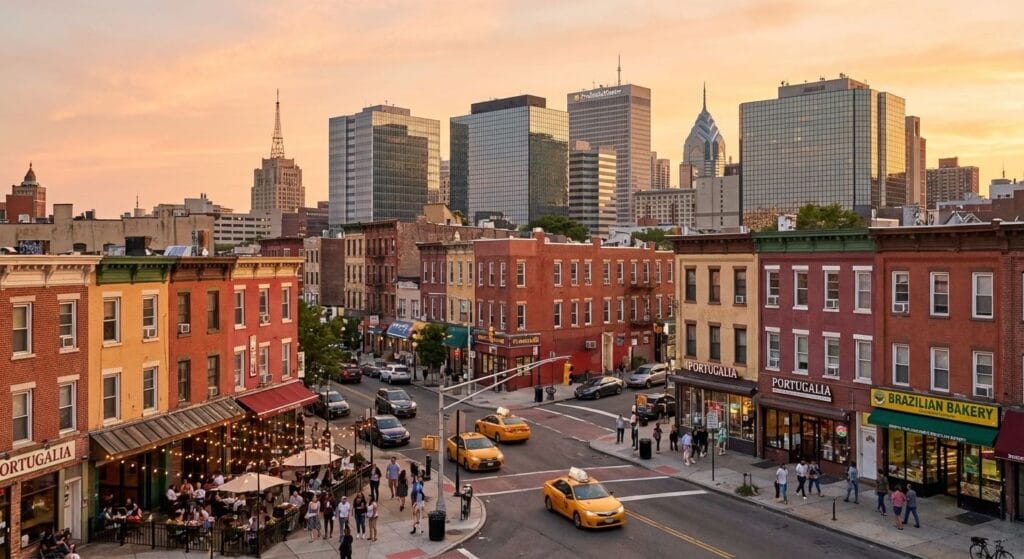
Newark, New Jersey is adding thousands of new residents every year — and the data finally explains why. With a median one-bedroom rent of roughly $1,995 per month and a New York City commute of under 20 minutes by NJ Transit, Newark offers a combination of urban energy and practical affordability that few cities in the Northeast can match. A $336 million arts and transit district is rising around NJPAC. Three new residential towers are opening in 2026. And for anyone serious about living close to New York without paying New York prices, Newark has quietly become one of the most compelling relocations in the entire state.
New Jersey’s complete relocation guide covers the full spectrum of Garden State living, but Newark deserves its own deep treatment — because this is a city in genuine transformation, with a culture and character you won’t find anywhere else in the state. Whether you’re relocating from Manhattan, transferring for work near Newark Liberty International Airport, or simply seeking more space for your dollar in an authentically urban environment, this guide covers everything you need to know before you sign a lease or close on a home.
Quick Answers
Average move cost (from NYC): $800 – $2,500 | From out of state: $2,000 – $5,500
Median rent (1BR): $1,547 – $2,109/month | 2BR: $1,900 – $2,800/month
Median home price: $430,000 – $550,000 (downtown/established neighborhoods)
Cost of living: 14% above national average
NYC commute: 20 minutes via NJ Transit from Newark Penn Station
Best for: NYC commuters, young professionals, artists, families seeking urban value
Why Newark Is Having Its Moment
Newark has never lacked for character. What it’s gaining right now is investment — at a scale the city hasn’t seen in decades.
The most visible transformation is happening around the New Jersey Performing Arts Center, where a $336 million mixed-use redevelopment broke ground in 2024. The NJPAC District is adding a 53,000-square-foot arts education center, outdoor performance spaces, 12,600 square feet of retail, and 350 new rental units — 20 percent of them affordable — scheduled to complete in 2027. It’s the kind of anchor development that announces a neighborhood’s arrival rather than just its potential.
Downtown, the Broad and Market Transit Village covers a half-mile corridor stretching toward Penn Station, the Ironbound, and University Heights. The plan authorizes 6,407 new housing units, with 24 percent designated affordable and rent increases capped at five percent annually. The first of three residential towers — collectively adding more than 1,000 units — opened in early 2026 after construction delays. The Mulberry Commons Pedestrian Bridge, a $110 million span linking Penn Station to the Prudential Center and the Ironbound, is transforming what was once a disconnected stretch into a genuine walkable corridor.
Then there’s the 2026 FIFA World Cup. Newark has positioned itself as a hub for fan activity, with the Newark Alliance coordinating Fanfests and hospitality — drawing international visitors through Newark Liberty and into a downtown that looks nothing like what longtime observers expected even five years ago.
None of this erases the challenges that Newark has faced, and intellectual honesty matters in a relocation guide. The city has uneven neighborhoods, pockets of disinvestment that sit alongside blocks of new construction, and a median household income of $48,416 that reflects real economic inequality. But for transplants arriving with market-rate budgets and eyes open to what the city actually is — rather than its outdated reputation — Newark in 2026 offers something genuine: affordable urban living within spitting distance of the world’s most expensive real estate market.
Newark’s Neighborhoods: Where You’ll Actually Want to Live
Newark is not one neighborhood — it’s a collection of very distinct communities, each with its own personality, price point, and daily rhythm. Understanding the differences is essential to finding where you belong.
The Ironbound: Newark’s Undeniable Crown Jewel
Ask anyone who has spent real time in Newark about the city and you’ll hear the same word within thirty seconds: Ironbound. This neighborhood — named for the railroad tracks that ring it on multiple sides — is one of the most authentically vibrant ethnic enclaves in the entire Northeast, built around a Portuguese and Brazilian community that has been here for generations and shows zero signs of going anywhere.
Ferry Street is the artery. For ten blocks, Portuguese steakhouses, Brazilian churrascarias, Spanish seafood restaurants, and pastelarias crowd the sidewalks with outdoor seating year-round. Seabra’s Marisqueira draws crowds for its seafood bowls. Fernandes Steakhouse is legendary for its cuts and its paella. Casa Nova Grill runs a full rodízio service that will defeat even the most ambitious appetite. The galão — a Portuguese-style cappuccino — flows from coffee windows the way diner coffee flows elsewhere in New Jersey. Coming here for dinner on a Friday feels less like a Newark experience and more like a transport to Lisbon.
But the Ironbound is not just a restaurant destination. It’s a functioning neighborhood where longtime Portuguese and Brazilian families live alongside recent arrivals from Mexico, Colombia, Ecuador, and West Africa. Corner bodegas carry everything from Portuguese wine to plantains. The streets are dense and residential, with walk-up apartments, row houses, and newer construction mixed together. It is, by most measures, the safest neighborhood in Newark — the community investment in the area is visible and palpable.
Housing in the Ironbound runs in the range of $1,995 to $2,350 per month for one- to three-bedroom units. Newer developments like Vida by Gomes at 34–40 Hudson Street have pushed rents upward for premium finishes, but the neighborhood still offers more space for the dollar than anything comparable in Brooklyn or Queens. Home prices are climbing as buyers recognize what longtime residents always knew, but patient searchers can still find value in the neighborhood’s dense residential stock.
The one thing to understand before moving here: the Ironbound has narrow streets not designed for modern truck traffic, and parking — always a New Jersey conversation — requires real strategy. Ferry Street on weekend evenings feels more like a pedestrian plaza than a road, which is charming when you’re dining and logistically complicated when you’re moving a couch.
Downtown Newark: The Resurgent Urban Core
Downtown Newark is where the city’s transformation is most visible and most kinetic. The blocks around NJPAC, Broad Street, and the Prudential Center are actively changing — new residential towers going up, new restaurants opening alongside longtime institutions, and a streetscape that looks noticeably different than it did even three years ago.
For residents, Downtown offers the full urban package: walkability to arts venues and restaurants, direct NJ Transit access at Penn Station, and the kind of after-work energy that comes from having thousands of office workers, arts patrons, and arena-goers moving through your neighborhood. The New Jersey Performing Arts Center runs a full calendar of Broadway shows, classical performances, jazz concerts, and family programming that has made it one of the state’s cultural anchors. The Newark Museum of Art — the largest museum in New Jersey — is a legitimate institution, with a permanent collection spanning American art, Tibetan artifacts, and a science center that makes it more than a rainy-day activity.
Rents downtown trend toward the higher end of the Newark range, generally $2,000 to $2,700 for a one-bedroom in newer buildings, with some premium units higher. In exchange, you get a commute to New York that is genuinely twenty minutes — not twenty minutes on a good day, but reliably twenty minutes on the Northeast Corridor — and walkable access to the entertainment district.
Forest Hill: Where Stability Meets History
Drive north and slightly uphill from downtown and the urban intensity gives way to a neighborhood that feels almost removed from Newark’s reputation. Forest Hill is an established residential area of early twentieth-century homes — Tudors, Colonials, and Craftsman bungalows on streets shaded by mature trees — where families have lived for multiple generations.
The neighborhood’s appeal is its permanence. Block associations are active, home maintenance standards are high, and the housing stock offers genuine architectural character rather than the uniform new construction that dominates other Newark areas. For buyers rather than renters, Forest Hill offers some of the city’s most attractive single-family homes at prices that would be laughable in comparable neighborhoods across the Hudson.
The tradeoff is that Forest Hill requires a car more than other Newark neighborhoods — the walk to Penn Station is long and the neighborhood isn’t particularly close to the Ironbound’s commercial energy. But for families prioritizing a quiet, established residential feel with urban proximity, it occupies a rare niche in the Newark landscape.
Weequahic and the North Ward: Value-Forward Neighborhoods
The Weequahic section of Newark, made famous in part by Philip Roth’s novels set in its mid-century Jewish community, has evolved into a working-class neighborhood with improving values and genuine civic investment. Weequahic Park — 311 acres with a golf course, lake, and track — is one of the larger urban parks in the state and anchors the neighborhood with green space that residents genuinely use.
The North Ward has historically been home to Newark’s Italian-American and later Puerto Rican and Dominican communities, and it retains strong neighborhood identity. Branch Brook Park, the North Ward’s central green space, is home to the largest cherry blossom collection in the United States — more than 4,000 trees that bloom spectacularly each spring and draw visitors from across the region.
Both neighborhoods track below the city’s median rent figures, making them attractive for cost-conscious movers who want Newark’s urban energy and NYC proximity at the most accessible price points. The key is doing neighborhood-level research rather than relying on city-wide statistics.
What Will Your Newark Move Actually Cost?
Moving to Newark costs significantly less than moving to most of New Jersey’s commuter-premium suburbs, but the specifics depend heavily on where you’re coming from.
From New York City: A local move from Manhattan or Brooklyn to Newark runs approximately $800 to $2,500 for a one- or two-bedroom apartment. The short distance works in your favor, though the addition of a river crossing and urban navigation on both ends adds complexity. Most local Newark moves can be completed in four to seven hours.
From Philadelphia or central New Jersey: Expect $1,200 to $3,000 depending on the volume of your household. The I-95 corridor is manageable but requires attention to timing — mid-week moves avoid the worst of the traffic both on the highway and in Newark’s streets.
From out of state: Long-distance moves to Newark from cities like Chicago, Boston, or Washington, D.C. typically run $2,000 to $5,500 for a standard two-bedroom household, with costs scaling upward for larger homes. Interstate moves involve more variables — binding versus non-binding estimates, potential fuel surcharges, and delivery windows that need careful coordination with building access.
Seasonal timing matters here. Newark’s urban housing market sees strong demand in late spring through summer, with the August-September period particularly active as healthcare system employees, university staff, and New York commuters all tend to move in the same compressed window. If your timeline allows, a late winter or early spring move typically offers better mover availability and sometimes meaningfully lower rates.
The Job Market: More Than Just a Commute Hub
Newark’s greatest employment advantage has always been geographical — sitting at the intersection of NJ Transit’s Northeast Corridor and multiple highway systems, the city serves as a logical base for professionals working anywhere in the New York metropolitan area. But the local job market is stronger and more diverse than its commuter-hub reputation suggests.
Newark Liberty International Airport is a major economic engine, employing thousands directly and supporting an ecosystem of logistics, freight, hospitality, and transportation companies throughout the region. For professionals in airport operations, cargo logistics, or hospitality, Newark’s proximity to EWR is a genuine career advantage.
Healthcare is a defining sector. Newark’s major hospital systems — University Hospital, RWJBarnabas Health’s Newark facilities, and the specialty centers affiliated with Rutgers New Jersey Medical School — collectively employ thousands of clinical, administrative, and research professionals. Healthcare jobs in Newark are plentiful and tend to draw from the local workforce in ways that office-based positions do not.
Financial services and professional services have traditionally concentrated in downtown Newark. Prudential Financial, headquartered in Newark for over a century, remains one of the city’s largest single employers. Law firms, accounting practices, and financial institutions maintain operations downtown.
Higher education employs substantially through Rutgers University’s Newark campus, the New Jersey Institute of Technology, Essex County College, and several other institutions — all located within or immediately adjacent to the city.
For those working remotely or in New York, the math is straightforward. A monthly NJ Transit pass from Newark to New York Penn Station runs approximately $190 per month — a fraction of what that commute costs from places like Summit, Montclair, or Red Bank.
Schools and Family Life in Newark
For families with school-age children, Newark’s education landscape requires honest engagement. The Newark Public Schools district has faced well-documented challenges over many years, and while significant improvement has occurred — particularly in the district’s magnet and charter school programs — academic outcomes remain uneven and highly dependent on which school a child attends.
Newark does have strong options for families who navigate the system actively. Newark Academy in Livingston (just outside the city) is one of New Jersey’s top private schools. Within the district, selective-admission programs and the city’s network of charter schools — some performing at very high levels — provide pathways for families committed to finding them. The key insight for relocating parents: a move to Newark requires substantially more school research than a move to most suburban communities, but the options for engaged families are more robust than the district’s aggregate statistics suggest.
For families prioritizing schools above other factors, the Newark area itself is surrounded by some of the state’s strongest public school communities. Maplewood, Millburn, and South Orange — all within a fifteen-minute drive — offer excellent suburban school districts with NJ Transit access to Newark and New York.
Newark’s Culture and Quality of Life
The picture that emerges for residents who actually live in Newark is often dramatically different from the one outsiders carry. The city has genuine cultural assets that go beyond what the arts district press releases suggest.
NJPAC is a world-class performing arts venue with a full season of Broadway touring productions, orchestral performances, and jazz concerts. The Newark Museum of Art, founded in 1909, holds the largest museum collection in New Jersey and has undergone significant renovation and programming investment. The Prudential Center — one of the better mid-size arenas in the country — hosts concerts, Devils games, and major events that put New York-caliber entertainment walking distance from Newark neighborhoods.
Branch Brook Park’s cherry blossom festival each April is legitimately one of the region’s signature outdoor events, drawing 100,000 visitors to a collection of 4,000-plus cherry trees — more than the famous collection in Washington, D.C.
The Ironbound’s food scene alone justifies a conversation about Newark’s quality of life. A dinner on Ferry Street — three courses, a bottle of Portuguese wine, and a coffee — costs what appetizers cost in most Manhattan restaurants. That gap in dining economics reflects a broader Newark advantage for residents: access to authentic, excellent food and culture at prices that feel like a different era.
Choosing a Professional Moving Company for Your Newark Move
Getting to Newark takes planning. Getting into Newark with a full household requires expertise — and that distinction matters more here than in most New Jersey cities.
What You’re Actually Paying For
When you hire a professional moving company, the price isn’t just for muscle and a truck. You’re paying for liability management, equipment designed to protect your possessions, and a team that understands the logistics of urban moves in ways that no-frills operators often don’t. Professional movers carry proper insurance, use moving blankets and floor protection equipment, and — critically for Newark — know how to navigate narrow streets, manage building logistics, and coordinate elevator reservations in high-rises. The lower quote from a Craigslist find often disappears quickly once you factor in damage, delays, and the absence of anyone to hold accountable when something goes wrong.
The Estimate Game
Moving companies use several types of estimates, and understanding the differences protects you financially. A binding estimate locks in the price regardless of actual weight — useful if you’re worried about overage charges. A non-binding estimate can change based on actual weight at pickup, sometimes by a meaningful margin. A binding not-to-exceed estimate guarantees you won’t pay more than the quote, even if the shipment weighs more — the gold standard for long-distance moves.
For a Newark move from out of state, always request binding not-to-exceed estimates from at least three licensed carriers. For local moves within New Jersey, confirm the hourly rate and exactly what is included (fuel surcharges, stair fees, packing materials) before any contract is signed.
Separating Legitimate Movers from Problems
Legitimate interstate movers must be registered with the Federal Motor Carrier Safety Administration (FMCSA) and hold a valid USDOT number. You can verify any mover’s registration and complaint history at the FMCSA’s lookup tool before signing anything. Red flags include: movers who demand large cash deposits before the move, quotes that seem impossibly low compared to other estimates, companies without physical addresses, and movers who present a significantly different contract than the one initially discussed. New Jersey local movers should be registered with the New Jersey Division of Consumer Affairs.
Understanding What’s Protected — and What Isn’t
Standard moving coverage — called released value protection — is included in most interstate quotes at essentially no cost. It covers your items at 60 cents per pound per article, which means a 50-pound television worth $1,200 would be compensated at $30 if damaged. That number is not a typo. Full-value protection costs more but covers items at their actual replacement value. For a Newark move involving art, electronics, antiques, or anything irreplaceable, full-value protection is worth the additional premium.
Your homeowner’s or renter’s insurance policy may provide some coverage for items in transit — confirm this with your agent before move day.
The Newark Building and COI Factor
Newark’s housing stock is among the most diverse in New Jersey, which creates specific logistical considerations that affect your move in ways worth understanding before you book.
Downtown Newark’s newer residential towers — particularly those in the NJPAC District and the Broad and Market corridor — typically require a Certificate of Insurance (COI) before movers are permitted to operate in the building. A COI is a document from your moving company’s insurer confirming their liability coverage meets the building’s minimum requirements. If your mover doesn’t carry adequate insurance, or doesn’t know how to produce a COI on request, your building management can and will delay or deny access on move day. Confirm COI requirements with your building’s management office weeks before your move date.
The Ironbound and older residential neighborhoods present a different set of challenges. Ferry Street and the surrounding blocks were designed for foot traffic and small vehicles, not 26-foot box trucks. Parking for large moving vehicles requires street planning or advance coordination with Newark’s parking authority. Some blocks genuinely require smaller trucks, staging moves in multiple loads, or early-morning timing before residential parking fills.
Older housing stock throughout the city — Forest Hill’s historic homes, North Ward row houses, Weequahic’s mid-century apartment buildings — often has narrower doorways, spiral staircases, and no elevator access. Communicating these details to your moving company in advance allows them to plan appropriately and prevents surprises on move day.
Why Nelson Westerberg for Your Newark Move
Moving into Newark is not the same as moving into a conventional New Jersey suburb, and not every moving company understands the difference. Nelson Westerberg’s teams have experience navigating Newark’s full range of housing types — from the narrow streets of the Ironbound, where delivery timing and truck sizing require advance planning, to the new downtown high-rises that demand COI documentation and elevator coordination to move in correctly. We know the difference between what Ferry Street requires on a Saturday evening and what Broad Street requires on a Monday morning. We know which Newark buildings have freight elevator windows and which require coordination with building management weeks in advance. And we’ve handled the full range of Newark’s housing stock — the 1920s row house with the steep staircase, the converted loft downtown, the new tower with the loading dock requirements — enough times to anticipate complications before they become problems. If you’re moving to New Jersey and Newark is your destination, you want a team that has been there before.
Newark vs. Jersey City vs. Hoboken: Which Urban NJ City Is Right for You?
The trio of urban New Jersey cities — Newark, Jersey City, and Hoboken — each offers a distinct version of the New York commuter experience, and the differences are substantial enough to matter.
Hoboken is the most expensive of the three and the most polished. It’s essentially a one-square-mile walkable grid of brownstones and new construction, with PATH service to Manhattan in eight minutes and rents that reflect every advantage. A one-bedroom in Hoboken typically runs $2,800 to $3,500 per month. The lifestyle is convenient and urban, but the city is small and the bang-for-buck ratio is the lowest of the three.
Jersey City has expanded significantly over the past decade, particularly in the waterfront areas of the Newport and Exchange Place neighborhoods. Rents run $2,200 to $3,200 for a one-bedroom depending on location, with PATH and ferry access to Manhattan. It’s more affordable than Hoboken but more expensive than Newark, and offers more neighborhood variety.
Newark gives you the most city for your dollar — more cultural depth, more housing variety, a stronger local arts and dining scene in the Ironbound, and a commute to New York that’s slightly longer (NJ Transit rail rather than PATH) but fundamentally accessible. If you’re optimizing for value, culture, and urban energy over proximity alone, Newark typically wins. If a ten-minute walk to the PATH is the priority above all else, Hoboken or downtown Jersey City may serve you better.
Newark’s Commute Reality
The NJ Transit experience from Newark deserves honest treatment. Newark Penn Station is a major hub — not just a local stop — with Northeast Corridor trains running to New York Penn Station in approximately 18 to 22 minutes with high frequency throughout the day and evening. During rush hour, service runs every 15 to 20 minutes. This is fast, and it is reliable in ways that driving never is.
What the commute requires is transit discipline. You’re working around train schedules rather than leaving when you feel like it, and disruptions — while infrequent — do happen. For commuters accustomed to car-centric suburbs, the adjustment takes a few weeks but becomes second nature quickly.
Within Newark, transit options include NJ Transit bus routes serving major corridors throughout the city, and light rail service on the Newark Light Rail connecting downtown to the Broad Street and Washington Street corridors and north toward the Branch Brook Park area.
For car owners, Newark’s location at the convergence of I-95, I-78, the New Jersey Turnpike, and the Garden State Parkway makes regional driving access excellent — when traffic cooperates, which in northeastern New Jersey is a perpetual asterisk.
Frequently Asked Questions About Moving to Newark
Is Newark safe? Newark’s safety is highly neighborhood-dependent. The Ironbound is consistently among the safer urban neighborhoods in the state, and Downtown and Forest Hill have improved meaningfully. As with any city, understanding the specific blocks you’re considering matters more than any city-wide statistic.
How far is Newark from New York City? Newark sits approximately 10 miles from Midtown Manhattan, with NJ Transit rail service reaching New York Penn Station in 18 to 22 minutes. Drive time varies enormously with traffic — 30 minutes on a clear evening, potentially 90 minutes during rush hour.
What is the job market like in Newark? Newark’s major employment sectors include healthcare, financial services, transportation and logistics, higher education, and government. The city is also a hub for regional commuters working in New York but preferring lower-cost NJ housing.
What are Newark’s best neighborhoods for families? Forest Hill and parts of the North Ward near Branch Brook Park offer the most family-oriented residential character within the city. Many families with school-age children also settle in adjacent suburban communities like Maplewood, Millburn, and South Orange while using Newark’s transit access.
What is the average moving cost to Newark? Local moves from New York City typically run $800 to $2,500. Interstate moves from distant cities typically range from $2,000 to $5,500 for a standard two-bedroom household, depending on distance and services.
Does Newark have good public transit? Yes. NJ Transit’s Newark Penn Station is one of the busiest rail stations in New Jersey, with Northeast Corridor service to New York and local connections throughout the region. The Newark Light Rail provides additional local coverage downtown and northward.
The Bottom Line on Moving to Newark
Newark in 2026 is a city that rewards residents who look past its reputation and engage with what it actually is. The arts infrastructure is world-class. The Ironbound is unlike any neighborhood in the state. The New York commute is genuinely easy. And the cost of living — while above the national average — is dramatically below what you’d pay for equivalent access to Manhattan in communities like Hoboken, Montclair, or Westfield.
The city is not finished becoming what it’s becoming. That’s part of the opportunity and part of the reality. The residents arriving now are choosing a city in motion rather than one that’s already arrived — and that distinction, for the right mover, is precisely the appeal.
If you’re ready to explore Newark seriously, get your moving costs mapped out early. The best available dates with reputable movers fill quickly, particularly during the spring and summer months when New Jersey’s moving season hits full stride.
Related Articles
New York City vs. Austin (2026): What Your Paycheck Really Buys
Few city comparisons produce a gap as wide as New York City versus Austin. By one widely cited 2026 estimate, it takes roughly $11,500 a month in New York to sustain the same standard of living that $6,900 buys in Austin — a difference so large it reshapes not just a budget but a life. […]
Read MoreChicago vs. Charlotte (2026): The Queen City at a Fraction of the Cost
For a Chicago household weighing a move south, Charlotte presents an unusually clean comparison: a real city, with a genuine corporate economy and four mild seasons, at a fraction of Chicago’s cost — and, most strikingly, a fraction of its property-tax burden. A Chicago homeowner paying the metro’s effective property-tax rate near 1.98% on a […]
Read More

Table of Contents

Atlas Van Lines, Inc. U.S. DOT No. 125550 (TM & © 2026 AWGI LLC.) | G.P.S.C. 4917 | IL C.C. 4246 | NJPC 00104 | Cal-T 110193
© 2026 Nelson Westerberg, Inc. All Rights Reserved Worldwide.