Moving Guide to Plano, TX (2026): Inside the Corporate Corridor

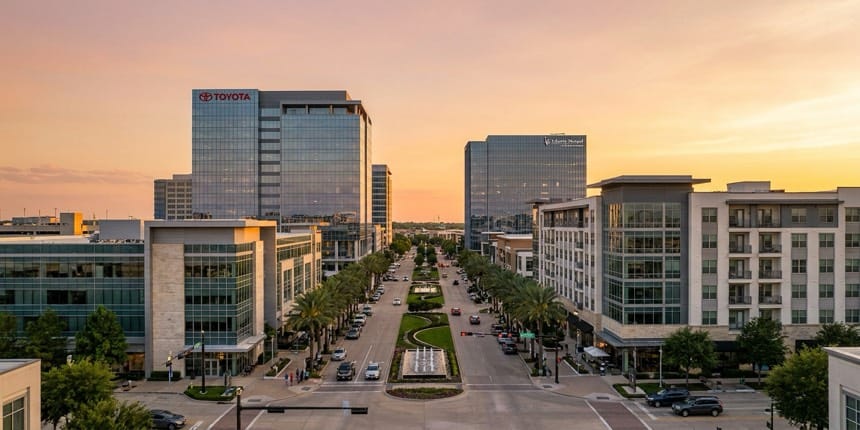
When Toyota relocated its North American headquarters from California to Plano, it didn’t just bring 4,000 jobs — it confirmed what corporate America had been signaling for years. Plano, a city of more than 300,000 just north of Dallas, has become the gravitational center of corporate relocation in the Dallas–Fort Worth metroplex. Toyota and Texas Instruments both run global or North American headquarters here; JPMorgan Chase, Liberty Mutual, Frito-Lay, and a growing roster of arrivals including USAA, Sally Beauty, and Delta Electronics fill out a corporate corridor that draws relocating professionals from across the country. If you’re moving to Plano, you’re likely joining that migration — and this guide covers what you need to know.
Here’s what you need to know at a glance:
Quick Answers
- Median home price: ~$540,000 citywide (West Plano / 75093 commands ~$790,000; entry-level 75074 ~$415,000)
- Average long-distance move cost: $5,000 – $13,000 (2–4 bedroom home, from out of state)
- Schools: Plano ISD — consistently A-rated, one of the strongest districts in Texas
- State income tax: 0% (Texas)
- Best for: Corporate transferees, families prioritizing schools, professionals in the Legacy/SH-121 corridor
This guide takes a practical approach to relocating to Plano — why corporate families choose it, how its neighborhoods differ, the school landscape that drives so many moves, the honest trade-offs, and how to plan a long-distance move that arrives smoothly. For the wider region, see our Texas moving guide and Dallas moving guide.
Why People Are Moving to Plano
Plano’s appeal is built on a rare combination: corporate-headquarters job density, top-tier public schools, and the financial advantages of Texas, all within a planned, well-run suburb. The city was an early innovator in business-friendly development — EDS, JCPenney, and Frito-Lay set roots here decades ago — and that foundation attracted the modern wave. Toyota’s 100-acre campus near Legacy and SH-121 anchors a corridor that now includes Texas Instruments’ global headquarters, JPMorgan Chase’s sprawling regional campus, and Liberty Mutual, with newer arrivals continuing to land.
For a relocating professional, that concentration means something practical: a short commute to a major employer, a deep job market if you change roles, and a community full of people who made the same move. For families, the draw is Plano Independent School District, one of the most consistently high-performing districts in Texas, paired with the absence of state income tax and housing that — while not cheap by Texas standards — buys far more than a comparable budget would in California, the Northeast, or Chicago’s North Shore.
The result is a suburb that functions less like a bedroom community and more like a self-contained corporate city, with the amenities, dining, and shopping (the Legacy West and Shops at Legacy developments in particular) that relocating executives expect.
The Best Neighborhoods in Plano
Plano divides roughly along its ZIP codes and school feeder patterns, and where you land depends on budget, commute, and school priorities.
West Plano (75093 and 75024) is the premium tier, home to neighborhoods like Willow Bend, Stonebriar, and Kings Gate, where larger custom homes push the median toward $790,000. It offers the shortest commute to the Legacy corporate corridor and access to some of Plano ISD’s strongest schools, which is why it’s the most sought-after area for executive transferees.
Central and East Plano (75074, 75075) provide the city’s more accessible entry points, with median prices closer to $415,000–$500,000. These established neighborhoods offer the same school district and city services at a meaningfully lower cost of entry, making them popular with first-time Plano buyers and those prioritizing value.
Many corporate relocations also spill into neighboring Frisco — with its A-rated Frisco ISD and newer construction — and Allen and McKinney to the north, where families find strong schools and more square footage per dollar. A relocation specialist familiar with the corporate corridor can help weigh the commute-versus-value trade-offs across these communities.
Schools and Family Life
For most families relocating to Plano, schools are the deciding factor. Plano ISD serves the bulk of the city and is consistently among the top-rated districts in Texas, with strong academic outcomes, robust extracurriculars, and a long track record of sending graduates to selective universities. Portions of the area feed into the equally regarded Frisco ISD. The district’s reputation is a primary reason corporate transferees with school-age children concentrate here rather than closer to downtown Dallas.
Beyond schools, Plano offers the texture of a mature suburb: extensive parks and trails, the dining and retail of Legacy West, and a calendar of community events that help newcomers settle in quickly. It’s a city designed for families relocating from elsewhere, which shows in how readily new arrivals find their footing.
Cost of Living and the Texas Tax Advantage
Plano is not Texas’s cheapest suburb — its desirability and schools command a premium within the metroplex. But for households relocating from higher-cost states, the comparison still favors the move. A West Plano home that lists near $790,000 would cost well over a million in comparable suburbs of California or the Northeast, and Texas’s zero state income tax adds savings that compound annually — particularly meaningful for the high-earning corporate professionals who make up much of Plano’s inbound population.
The honest caveat, as everywhere in Texas, is property tax: rates are higher than the national average and should be budgeted carefully, especially on higher-value West Plano homes. Factor the annual property-tax bill into any home-price comparison rather than assuming “no income tax” means low total taxes. Even with that adjustment, the math typically lands in Plano’s favor for relocating households.
The Plano Job Market and Corporate Corridor
Plano’s economy is defined by the density of major employers packed into a relatively small footprint. The Legacy and SH-121 corridor in West Plano has become one of the most concentrated corporate clusters in the country, anchored by Toyota’s North American headquarters — a 100-acre campus that brought more than 4,000 jobs from California — and Texas Instruments’ global headquarters. JPMorgan Chase operates one of its largest campuses outside New York here, and Liberty Mutual, FedEx Office, and a long roster of finance, technology, and professional-services firms fill out the corridor. Newer arrivals continue to land, from Sally Beauty’s headquarters to Delta Electronics and major data-center investment.
For a relocating professional, that concentration is the central appeal. The commute to a major employer is often measured in minutes rather than the hour-plus that defines life in many large metros, and if your role or company changes, the surrounding job market is deep enough to absorb the move without uprooting the family a second time. The corporate base also supports the amenities relocating executives expect — the Legacy West and Shops at Legacy developments combine upscale dining, retail, and a walkable density unusual for a Texas suburb. Combined with Texas’s lack of a state income tax, the result is a place where a corporate salary stretches considerably further than it would in the California or Northeast markets many transferees are leaving.
Plano vs. the Neighboring Suburbs
Many corporate relocations weigh Plano against its neighbors, and the trade-offs are worth understanding. Frisco, immediately north, has been one of the fastest-growing cities in the country, offering newer construction and the highly regarded Frisco ISD — popular with families who want the newest homes and don’t mind being slightly farther from the Legacy corridor. Allen and McKinney, also to the north, tend to offer more square footage per dollar and strong schools, appealing to families prioritizing value. Southlake, to the west, is among the metroplex’s most prestigious addresses, with Carroll ISD consistently ranked at the top of the state.
Plano’s edge in this comparison is its balance: an established, mature suburb with excellent schools, the shortest commute to the largest concentration of corporate headquarters, and the amenities of Legacy West — without the brand-new-everything feel and longer corridor commute of Frisco, or the premium of Southlake. A relocation specialist who knows the corporate corridor can help weigh commute, schools, and budget across these communities to find the right fit.
Things to Do and Daily Life in Plano
Plano functions less like a bedroom community and more like a self-contained city. Legacy West and the Shops at Legacy anchor the dining and nightlife scene with a density unusual for suburban Texas, while the Historic Downtown Plano arts district offers a walkable contrast with local restaurants, galleries, and a weekend farmers market. The city maintains an extensive network of parks and more than 85 miles of trails, including the Bluebonnet and Chisholm trails that thread through neighborhoods, plus the Arbor Hills Nature Preserve on the west side.
Daily life is comfortable and convenient, if car-oriented like most of Texas — though Plano’s DART light-rail stations give it more transit access than many metroplex suburbs. The summers are hot, with extended triple-digit stretches that shape outdoor routines from June through September, but the other seasons are mild and pleasant. For families relocating from cooler climates, trading a harsh winter for a hot summer is a deal most come to appreciate. The combination of corporate opportunity, top schools, amenities, and Texas’s financial advantages is what keeps Plano at the center of the metroplex’s relocation story.
The Plano Real Estate Market: What Your Budget Buys
Plano’s housing market spans a wide range, and understanding the tiers helps relocating buyers set expectations. At the top, West Plano (ZIP codes 75093 and 75024) is the premium tier, where established luxury neighborhoods like Willow Bend, Stonebriar, and Kings Gate push the median toward $790,000 and larger custom homes climb well beyond. This is where many corporate executives land, drawn by the shortest commute to the Legacy corridor and access to the strongest Plano ISD schools.
Central and East Plano (75074 and 75075) offer the city’s more accessible entry points, with median prices closer to $415,000–$500,000. These established neighborhoods deliver the same school district, city services, and safety record at a meaningfully lower cost of entry — a strong value for first-time Plano buyers, dual-income professionals, and those who prioritize the Plano address without the West Plano premium. Inventory across the city tends to move quickly in the most desirable areas, so relocating buyers benefit from getting pre-approved and working with an agent before they arrive.
For households selling in a higher-cost market and buying in Plano, the equity often translates into a comparable or larger home with no state income tax going forward — a combination that continues to draw transferees from California, Illinois, and the Northeast. Timing the sale of an origin-state home against a Plano purchase is one of the trickier parts of the move, and a short-term rental or storage-in-transit can bridge the gap when closing calendars don’t align.
Plano Schools in Depth
For most relocating families, Plano Independent School District is the single biggest draw. The district serves the majority of the city and is consistently ranked among the strongest in Texas, with high academic outcomes, a deep slate of Advanced Placement and dual-credit offerings, well-regarded fine-arts and athletics programs, and a long record of sending graduates to selective universities. Plano ISD’s senior high schools — Plano Senior High, Plano East, and Plano West — are well known statewide, and the district’s structure of dedicated senior high schools for upper grades is distinctive.
Portions of the city, particularly in the fast-growing northern and western areas, feed into the equally regarded Frisco ISD, which is worth confirming during a home search since district and feeder-pattern boundaries don’t always follow city lines. Families relocating mid-year should plan school enrollment early, as Texas districts require proof of residency — a lease or closing documents — before placement. The strength and reputation of these districts is a primary reason corporate transferees with school-age children concentrate in Plano rather than closer to downtown Dallas, and it’s a significant part of what supports the area’s home values over time.
What to Know Before You Commit
Plano’s success has brought the same pressures as the rest of fast-growing North Texas. Home prices in the most desirable neighborhoods have climbed steadily, and the premium West Plano commands reflects genuine competition for limited inventory. Traffic along the Legacy corridor and the Dallas North Tollway has grown with the corporate base, and while Plano’s commutes remain shorter than many big-city alternatives, they’re no longer trivial.
Summers are hot, with extended triple-digit stretches that newcomers from cooler climates should plan around — including timing a move outside the peak heat and peak-rate summer window when possible. And like much of suburban Texas, Plano is car-dependent; public transit exists but isn’t the backbone of daily life.
Planning Your Move to Plano
A move to Plano from out of state is a long-distance relocation, and the quality of your moving company shapes the entire experience. When a furnished family home is traveling hundreds or thousands of miles, professional packing, an accurate inventory, transit visibility, and a single accountable point of contact are what separate a smooth arrival from weeks of recovering from damage and delay.
This is the work Nelson Westerberg was built for. As one of Atlas Van Lines’ top agents, we handle full-service interstate relocations into the DFW corporate corridor regularly — including the executive and family moves that Plano’s headquarters relocations generate. We understand the expectations of both the relocating employee and the corporate relocation programs that often coordinate these moves, and our guide to choosing a white-glove moving company explains what to look for.
Start six to eight weeks ahead. Texas gives new residents 30 days to obtain a driver’s license and 90 days to register a vehicle after establishing residency. Our guide to planning an interstate move walks through the sequence, and the moving cost calculator provides an early estimate. You can also see our Plano local moving services for our on-the-ground coverage in the area.
Frequently Asked Questions
How much does it cost to move to Plano, TX?
A full-service, long-distance move to Plano typically costs between $5,000 and $13,000 for a two-to-four-bedroom home from out of state. The final figure depends on the weight of your shipment, the distance, the time of year, and add-on services such as professional packing, vehicle shipping, or temporary storage. Moves from the West Coast or Northeast fall at the higher end of the range.
Is Plano a good place for families?
Yes. Plano is one of the most popular destinations in Texas for relocating families, primarily because of Plano Independent School District — consistently among the highest-rated districts in the state — and the city’s parks, trails, and family-oriented amenities. The combination of strong schools, corporate job density, and Texas’s no-income-tax structure makes it especially attractive to professionals with school-age children.
What are the best neighborhoods in Plano?
West Plano (ZIP codes 75093 and 75024), including Willow Bend, Stonebriar, and Kings Gate, is the premium tier with the shortest commute to the Legacy corporate corridor and median prices near $790,000. Central and East Plano (75074, 75075) offer more accessible entry points around $415,000–$500,000 with the same school district. Many transferees also consider neighboring Frisco, Allen, and McKinney.
Why are so many companies headquartered in Plano?
Plano built a business-friendly reputation decades ago with employers like EDS, JCPenney, and Frito-Lay, which paved the way for major relocations including Toyota’s North American headquarters, Texas Instruments’ global headquarters, JPMorgan Chase, and Liberty Mutual. Texas’s lack of corporate and personal income tax, central location, and skilled workforce continue to attract corporate headquarters to the city.
How far is Plano from downtown Dallas?
Plano sits roughly 20 miles north of downtown Dallas, typically a 30-to-45-minute drive depending on traffic and your exact location. Most Plano residents who work in the area commute to the Legacy/SH-121 corporate corridor within the city or nearby, rather than into downtown Dallas, which keeps daily commutes shorter than the distance suggests.
What salary do you need to live comfortably in Plano?
Plano sits above the Texas average on cost, so a single professional generally wants $80,000–$100,000 to live comfortably, while a family of four typically needs $150,000 or more — higher in West Plano, where home prices run toward $790,000. That said, Texas’s lack of a state income tax stretches those salaries further than the equivalent income would go in California or the Northeast, which is why the corporate professionals relocating here on six-figure packages find the math works in their favor.
Is Plano a safe place to live?
Plano consistently ranks among the safest large cities in the United States, a reputation that — along with its schools — is a major draw for relocating families. Its low crime rates, well-funded municipal services, and planned, well-maintained neighborhoods are part of what justifies the premium prices in the most sought-after areas and keep it a perennial favorite for corporate transferees with children.
Does Plano have good public transportation?
Plano has more transit access than most Texas suburbs thanks to DART (Dallas Area Rapid Transit) light-rail stations, which connect it to downtown Dallas and the broader metro. That said, like most of Texas, Plano is primarily car-oriented, and most residents drive for daily errands and commutes. The DART access is a meaningful convenience but not a substitute for a car the way transit is in a city like Chicago or New York.
Conclusion
Plano represents a specific kind of relocation: the corporate family move, drawn by headquarters jobs, top-rated schools, and the financial advantages of Texas. It’s not the cheapest corner of the metroplex, but for the professionals and families who land here, the combination of opportunity, education, and quality of life justifies the premium.
The move itself is the part you control. A long-distance relocation handled by a full-service professional partner — rather than improvised — is what turns a major corporate transfer into a smooth transition for the whole family. With the right planning and the right partner, getting to Plano can be the easy part.
Related Articles
New York City vs. Austin (2026): What Your Paycheck Really Buys
Few city comparisons produce a gap as wide as New York City versus Austin. By one widely cited 2026 estimate, it takes roughly $11,500 a month in New York to sustain the same standard of living that $6,900 buys in Austin — a difference so large it reshapes not just a budget but a life. […]
Read MoreChicago vs. Charlotte (2026): The Queen City at a Fraction of the Cost

For a Chicago household weighing a move south, Charlotte presents an unusually clean comparison: a real city, with a genuine corporate economy and four mild seasons, at a fraction of Chicago’s cost — and, most strikingly, a fraction of its property-tax burden. A Chicago homeowner paying the metro’s effective property-tax rate near 1.98% on a […]
Read More

Table of Contents

Atlas Van Lines, Inc. U.S. DOT No. 125550 (TM & © 2026 AWGI LLC.) | G.P.S.C. 4917 | IL C.C. 4246 | NJPC 00104 | Cal-T 110193
© 2026 Nelson Westerberg, Inc. All Rights Reserved Worldwide.