Specialty Moving: Pianos, Fine Art & High-Value Items (2026)

Quick Answers
- Specialty moving covers the pieces a standard move can’t safely handle: pianos, fine art, antiques, sculpture, wine collections, chandeliers, and other high-value or fragile items.
- What makes it different: custom-built crates, climate-conscious transport, specialized equipment and trained crews, condition documentation, and proper valuation coverage — applied as standard, not as surprises.
- The risk of getting it wrong: these items are often irreplaceable. A general mover treating a Steinway or an original canvas like a couch is where high-value moves go wrong.
- The right mover: a licensed, accountable carrier with real specialty experience, full-value protection, and in-house crating — not the lowest bidder or a broker.
Some belongings can be replaced if a move goes badly. A grand piano, an original work of art, a collection built over decades, an heirloom passed down through a family — cannot. Specialty moving exists for exactly these items, and it is a fundamentally different discipline from moving a standard household. The difference isn’t a bigger truck; it’s custom crating, climate control, the right equipment, trained hands, and the documentation and protection that treat an irreplaceable object as irreplaceable. This guide explains what specialty moving actually involves, how it works for the most common high-value categories, what it costs, and how to choose a mover you can trust with the things that can’t be bought again.
Nelson Westerberg handles specialty items as core work, not an afterthought — a licensed interstate carrier and top Atlas Van Lines agent, with custom crating, climate-conscious transport, and white-glove handling applied as standard on the pieces that warrant it.
What Counts as a Specialty Item
Specialty moving covers anything whose value, fragility, weight, or irreplaceability puts it beyond standard packing and handling. The most common categories:
- Pianos — uprights, baby grands, and concert grands, each with its own handling requirements.
- Fine art — paintings, prints, and works on paper, where surface, frame, and glazing all demand protection.
- Antiques and heirlooms — furniture and objects whose age and construction make them fragile and their value hard to replace.
- Sculpture and three-dimensional art — awkward, heavy, or delicate pieces that need custom support.
- Wine collections — where temperature stability and careful handling protect both the bottles and their value.
- Chandeliers and lighting — fragile, awkward, and often custom-installed, requiring careful disassembly and reinstallation.
- High-value electronics, mirrors, glass, and stone — items where a single impact means total loss.
If an item would keep you up at night on a moving truck, it belongs in the specialty category — and it should be identified and planned for in advance, not discovered on move day. The common thread is that these items reward being flagged early: the mover can then build the crating, equipment, crew, and timeline around them from the start, survey the access they’ll require, and confirm the right coverage — rather than improvising when the truck is already at the curb. A five-minute conversation at the estimate stage about “the pieces I’m worried about” is the single most valuable thing a client can do for a specialty move.
What Makes Specialty Moving Different
The gap between a standard move and a specialty one comes down to five things, each applied as a matter of course rather than billed as a surprise.
Custom crating. The single most important difference. Rather than blanket-wrapping and hoping, high-value and fragile items are measured and enclosed in crates built to fit them — protecting against impact, pressure, and shifting in transit. A painting, a marble tabletop, or a delicate antique each gets an enclosure designed for it.
Climate-conscious transport. Heat, cold, and humidity swings damage wood, canvas, wine, and electronics. Specialty transport minimizes exposure — climate-controlled options where warranted, and handling protocols that keep temperature-sensitive items out of harm’s way.
Specialized equipment and trained crews. Piano boards and skids, art-handling materials, lifting and rigging gear, and crews who know how to use them. Moving a concert grand down a staircase or a large canvas through a tight doorway is a skill, not a matter of muscle.
Condition documentation and valuation. High-value moves start with a record — photographs and condition notes — and are backed by proper full-value protection rather than the minimal liability coverage a standard move defaults to. If the unthinkable happens, documentation and coverage are what make you whole.
Planning around access. Stairs, elevators, narrow doorways, gated communities, and long carries all shape how a specialty item is handled. The plan is built around the specific piece and the specific property, in advance.
Moving Pianos
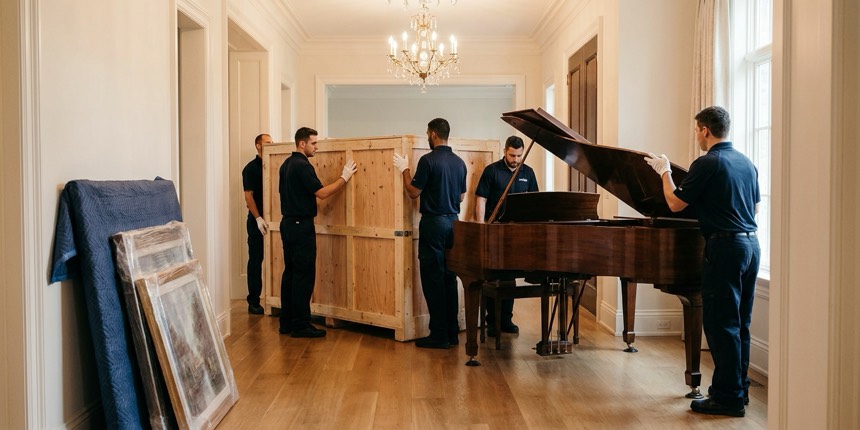
A piano is heavy, awkward, and internally delicate — a combination that makes it one of the most demanding items to move well. Upright pianos are top-heavy and require careful balancing and the right dollies and straps. Grand and baby grand pianos are typically partially disassembled — the legs and lyre removed — and moved on a padded piano board, then reassembled and settled at the destination. Stairs, tight turns, and long carries multiply the difficulty and often call for additional crew and equipment. Beyond the physical move, a piano is sensitive to temperature and humidity, so transport conditions matter, and many owners have the instrument tuned after it settles into its new environment. A crew that moves pianos regularly plans for all of this; a general mover treating a grand like a heavy dresser is exactly how pianos get damaged. The weight compounds the risk: a concert grand can exceed 1,200 pounds, and moving that mass safely through a home — protecting floors, walls, and doorways as well as the instrument — takes the right crew size, dollies, ramps, and sometimes rigging or a hoist for difficult access. Digital and player pianos have their own sensitivities. The goal in every case is the same: the instrument arrives in tune with its surroundings and undamaged, and your home is unmarked in the process.
Moving Fine Art and Antiques
Fine art and antiques share a vulnerability: their value lives in surfaces and construction that are easy to damage and hard to restore. Paintings and framed works need protection for the surface, the frame, and any glazing — typically custom crating with appropriate interior support, and never stacked or leaned carelessly. Works on paper are especially sensitive to humidity and pressure. Antiques carry the added challenge of age: joints, veneers, and finishes that were never built to withstand a modern move, requiring gentle handling and often custom crating rather than standard wrapping. For valuable pieces, a condition report — documenting the state of each item before the move — protects both parties and any insurance claim. The guiding principle is the same throughout: the more valuable and fragile the piece, the more the handling should be engineered around it specifically. For a serious collection, the crating is often bespoke — foam-lined, custom-cut enclosures, sometimes with mounts that immobilize the piece entirely — and the largest or most valuable works may travel in dedicated, climate-controlled conditions. Sculpture and three-dimensional works add their own puzzle: awkward weight distribution, fragile projections, and finishes that can’t be gripped or wrapped conventionally, all of which call for custom bracing inside a crate built for that object alone. None of this is exotic for a mover who does it regularly; it’s simply the standard the pieces demand.
Wine Collections and Other Sensitive Items
Wine collections are as much about stability as fragility — temperature swings and jostling degrade both the wine and its value, so climate-conscious transport and careful handling protect the investment. A serious cellar represents real money and, often, irreplaceable vintages; it should be inventoried, packed in proper wine shippers or custom crates, kept upright and temperature-stable, and moved with the same documentation and coverage as any high-value asset. For long-distance moves especially, the temperature exposure over days on the road is the risk to plan around. Chandeliers and custom lighting are fragile and awkward, usually requiring careful disassembly, custom crating, and reinstallation planning. Mirrors, glass, stone, and large electronics are items where a single impact means total loss, so custom crating and cushioned, secured transport are essential. Across all of these, the theme repeats: identify the sensitive items early, and let the mover build the plan around them.
Storage and Long-Distance Considerations
Two situations raise the stakes further for specialty items, and both reward planning. The first is long-distance transport: a cross-country move means days on the road, more temperature and humidity variation, and more handling — so custom crating and climate-conscious transport matter even more over 1,500 miles than across town, and a licensed carrier that keeps your items on its own network (rather than relaying them through transfer warehouses) is worth insisting on. The second is storage-in-transit: when a sale and purchase don’t line up, or a new home isn’t ready, high-value items may need to be stored between pickup and delivery. For pianos, art, and wine especially, that storage should be secure and climate-appropriate, not a standard warehouse bay — and arranging it in advance, as part of the move plan, avoids a scramble that puts valuable items at risk. A mover experienced with specialty items plans both the transport and any interim storage around what the pieces require.
What Specialty Moving Costs
Specialty moving is priced on the specifics — the item, its size and fragility, the crating required, the access at both ends, and the distance. Because every high-value move is different, a reputable mover quotes it after a survey rather than a generic calculator, and stands behind a binding not-to-exceed estimate so the price you’re given is the maximum you’ll pay. As rough guidance, professional piano moving, custom art crating, and similar specialty services are line items added to a move based on the work involved — a single grand piano, a large custom crate for a painting, or climate-controlled handling each carries its own cost. The right way to think about it: specialty handling is insurance against catastrophic loss on an irreplaceable item, and the cost is modest against the value of what it protects. Skimping here — using a general mover or a broker to save a few hundred dollars on a five- or six-figure piece — is the expensive choice, not the cheap one.
How to Choose a Specialty Mover
The stakes make the choice of mover the most important decision in a high-value move. A few things separate a mover you can trust from one you can’t:
- A licensed, accountable carrier — not a broker. Your items should be handled by the company’s own trained crews from start to finish, not sold to the lowest bidder and handed off to strangers, which is where so many high-value moves go wrong.
- Real specialty experience. Ask directly about pianos, art, and the specific items you’re moving. A mover that does this regularly will talk fluently about crating, climate, and access.
- In-house custom crating and proper protection. Crating built for the piece, and full-value protection rather than minimal default liability.
- Honest, binding pricing. A not-to-exceed estimate after a survey, with no move-day surprises and no leverage games over your belongings.
- Documentation and communication. Condition records, clear scheduling, and a coordinator who treats the move as the high-stakes job it is.
Nelson Westerberg brings all of it — a licensed interstate carrier and top Atlas agent, decades of high-value relocation experience, in-house crating, and full-value protection — to the pieces that can’t be replaced.
Frequently Asked Questions
What is specialty moving?
Specialty moving is the professional handling of items that a standard move can’t safely manage — pianos, fine art, antiques, sculpture, wine collections, chandeliers, and other high-value or fragile pieces. It involves custom crating, climate-conscious transport, specialized equipment and trained crews, condition documentation, and full-value protection, applied as standard rather than as add-ons discovered on move day.
How much does it cost to move a piano?
Piano moving is priced on the type of piano (upright, baby grand, or concert grand), the access at both ends (stairs, tight turns, long carries), and the distance. It’s typically a specialty line item added to a move, quoted after a survey. Because a piano is heavy, awkward, and internally delicate, professional handling — the right equipment, crew, and transport conditions — is what protects both the instrument and your home.
How do you move fine art and paintings safely?
Fine art is moved with custom crating built to protect the surface, frame, and glazing, appropriate interior support, and climate-conscious transport, with a condition report documenting each piece before the move. Works on paper need extra protection from humidity and pressure. The value lives in surfaces that are easy to damage and hard to restore, so the handling is engineered around each piece specifically.
Do I need special insurance for high-value items?
You need proper coverage. A standard move defaults to minimal liability protection, which is insufficient for high-value items. Specialty moves should carry full-value protection, and valuable pieces should be documented with photographs and condition notes before the move to support any claim. Discuss coverage with your mover so it matches the value of what you’re moving.
Can a regular moving company move my piano or art?
They can attempt to, but high-value and fragile items are exactly where general movers — and brokers who subcontract your move — most often cause damage. Pianos, art, and antiques call for specialty experience, custom crating, the right equipment, and full accountability. For irreplaceable pieces, a licensed carrier with genuine specialty capability is worth far more than the cheapest quote.
How should I prepare high-value items for a move?
Identify them early and tell your mover, so the plan is built around them rather than improvised on move day. Photograph and document valuable pieces before the move. For anything genuinely irreplaceable or fragile, request custom crating and confirm your coverage. And insist on an in-home or detailed virtual survey so the mover can plan crating, equipment, and access accurately.
Moving What Can’t Be Replaced
Specialty moving is ultimately about respect for the things that can’t be bought again — the instrument, the collection, the heirloom, the work of art. Done right, it’s methodical and unremarkable: the piece is documented, crated for its specific dimensions, handled by trained crews, transported in conditions that protect it, and delivered exactly as it left. Done wrong, it’s a loss that no refund undoes. The difference is choosing a mover who treats the work as the high-stakes discipline it is.
A trusted partner like Nelson Westerberg handles pianos, fine art, and high-value collections with the crating, the care, and the accountability that irreplaceable items demand.
Related Articles
Military PCS Moves: The Complete 2026 Guide

Quick Answers PCS = Permanent Change of Station — a government-ordered relocation, run through your installation’s transportation office and the Defense Personal Property System (DPS/MilMove). Two main paths: a government-arranged HHG move (a carrier ships your household goods at no cost to you, up to your weight allowance) or a PPM/DITY (you move yourself and […]
Read MoreMoving to North County San Diego (2026): Choosing Your Coastal Town

Quick Answers What it is: the string of coastal towns north of the city of San Diego — Del Mar, Solana Beach, Encinitas, Carlsbad, and Oceanside — each distinct, all within about twenty minutes of one another The decision: not *whether* North County, but *which town* — they differ far more in character and price […]
Read More

Table of Contents

Atlas Van Lines, Inc. U.S. DOT No. 125550 (TM & © 2026 AWGI LLC.) | G.P.S.C. 4917 | IL C.C. 4246 | NJPC 00104 | Cal-T 110193
© 2026 Nelson Westerberg, Inc. All Rights Reserved Worldwide.