Moving Guide to Phoenix (2026): Your Neighborhood Map for the Valley

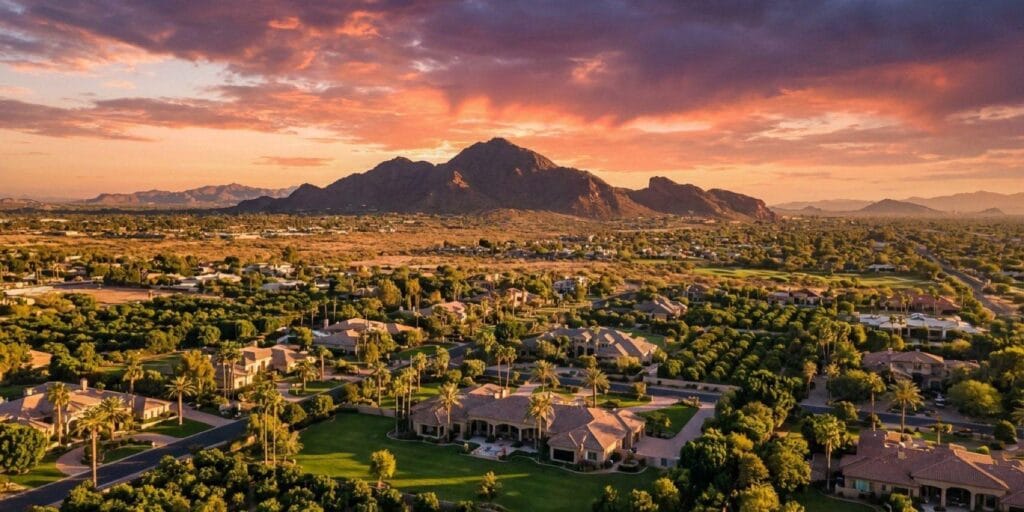
Phoenix is the fifth-largest city in the United States — 500 square miles of city limits, larger than the entire footprint of Houston, sprawling across the Salt River Valley from the South Mountain ridgeline up to the Carefree foothills. Inside that footprint sit eight distinct residential pockets that absorb most of the relocation volume into the metro: Arcadia and its irrigated mature-tree corridor at $1.5 million; Biltmore’s resort-adjacent walkable premium tier; the established old-Phoenix walkable Madison District; Desert Ridge’s master-planned northern frontier; Camelback East’s hillside canyon-edge market climbing into the $5-million-plus tier; downtown’s still-emerging urban revitalization; Ahwatukee’s South Phoenix premium pocket; and the smaller historic enclaves like Encanto-Palmcroft. The eight neighborhoods share a city government and a citywide median home price near $460,000, but they share almost nothing else — different schools, different price tiers, different employer commute profiles, and different long-term resident profiles. The single most important decision in a Phoenix relocation is which of the eight you choose.
Here’s what you need to know at a glance:
Quick Answers
- Citywide median home price (March 2026): $460,000 (down 5.2% YoY, Redfin)
- Premium neighborhood medians: Arcadia $1.5M, Biltmore corridor $1.5M+, Desert Ridge $660K, Paradise Valley adjacency $3M+
- Average long-distance move cost: $6,500 – $22,000 (3-to-5 bedroom, full-service, from California or Texas)
- Phoenix MSA population: ~4.9 million, still growing
- State income tax: 2.5% flat (effective 2023, no 2026 changes)
- Best time to move: October through April — outside the 110°F summer
- Best for: Corporate executives transferring with TSMC, Mayo Clinic, Honeywell, Banner Health, or American Express; retirees from California or the Northeast; families seeking established neighborhoods at California-discount prices
If you’re moving to Phoenix from California, the Northeast, or the Midwest, the question isn’t whether Phoenix works. It’s where in Phoenix works for you. This guide is the neighborhood-by-neighborhood map — what each pocket is, who actually lives there, what you’ll pay, and why the differences matter for the decision you’re making. For broader state context, our moving guide to Arizona covers the full-state picture across Phoenix, Scottsdale, Tucson, Sedona, and beyond.
Why Phoenix Keeps Drawing New Residents in 2026
Four forces are driving the current wave of relocation into the Valley, and each one attracts a slightly different kind of mover.
The semiconductor and advanced manufacturing boom. TSMC’s Phoenix campus represents $165 billion in announced investment — the largest foreign direct investment in U.S. history — across six fabrication plants, two advanced packaging facilities, and a major R&D center on a 2,000-acre site in north Phoenix. Intel’s Ocotillo campus in Chandler employs 11,553 Arizona workers and is in the middle of a multi-billion-dollar expansion. Microchip Technology, NXP, ON Semiconductor, and Amkor all have major Arizona footprints. The engineer, technician, and executive relocations driven by this single industry have measurably reshaped where Phoenix’s housing demand concentrates — particularly in the Chandler-adjacent corners of the East Valley and in the premium North Scottsdale and North Phoenix corridors where senior leadership chooses to live.
The healthcare expansion. Banner Health, headquartered in Phoenix at 2901 N. Central Avenue, is Arizona’s single largest employer with 45,918 in-state employees. Mayo Clinic operates major Phoenix and Scottsdale campuses with 8,630 Arizona employees and just announced a $2 billion Phoenix campus expansion that will materially expand high-skill clinical and research employment over the next five years. HonorHealth (13,004 employees), Dignity Health, and University of Arizona Medical Center round out the healthcare cluster. For physicians, healthcare executives, and clinical research professionals, Phoenix is now one of the most substantial healthcare employment markets in the Mountain West.
The tax migration. Arizona’s 2.5 percent flat income tax — effective 2023 under SB 1828, with no changes for the 2026 tax year — is dramatically lower than California’s top marginal rate of 13.3 percent, New York’s combined state-and-city rate above 14 percent, and Illinois’s 4.95 percent flat rate paired with significantly higher property taxes. For a household earning $500,000 relocating from California, the annual state income tax savings alone exceeds $40,000. Add Arizona’s lack of estate tax, lack of inheritance tax, and 0.62 percent average property tax rate, and the long-term financial math is compelling for retirees, executives, and families thinking in decades rather than years.
The lifestyle equation. Phoenix delivers more than 300 days of sunshine annually. Winter temperatures in the 60s and 70s while Chicago is buried in snow. Hiking from your back door at Camelback Mountain, Piestewa Peak, or the Phoenix Mountains Preserve. Resort-grade community amenities in the master-planned suburbs. World-class healthcare, a serious cultural infrastructure (Heard Museum, Phoenix Art Museum, Musical Instrument Museum), Cactus League spring training, and a dining scene that has matured well past its strip-mall reputation. For retirees and remote-first professionals leaving high-cost markets, the climate-and-lifestyle math is straightforward. The summer heat is the honest tradeoff, and we’ll address it directly.
The Phoenix Neighborhood Map
Phoenix proper is roughly 500 square miles. That is not a typo — the city limits cover an area larger than the entire city of Houston. Within those boundaries sit established neighborhoods over a century old, master-planned communities built in the 2000s, downtown urban revitalization, and hillside enclaves where homes routinely close above $5 million. Knowing which neighborhood matches your move is the single most important decision you’ll make. Here are the eight that matter most.
Arcadia: The Anchor of Premium Phoenix
Arcadia and Arcadia Lite — the residential corridor running between 44th Street and 68th Street, south of Camelback Road — has emerged as the most desirable established neighborhood in Phoenix proper. The defining features are the irrigated mature trees (citrus groves and grass lawns in a desert city, fed by the original Salt River Project canals), the mid-century ranch architecture, walkable proximity to landmark restaurants like LGO and Postino, and direct adjacency to Scottsdale’s Old Town and Fashion Square retail. Arcadia Proper sits east of 56th Street and skews larger lots, original character homes, and the highest price tier. Arcadia Lite to the west offers a tighter footprint at slightly lower prices.
The median home price in Arcadia was $1.5 million in March 2026, with the luxury tier (>$3M) routinely transacting in the $4M to $8M range. The buyer profile is corporate executive, finance and tech professional, healthcare leadership, and increasingly remote-first migrants from coastal California who want a single-family home with mature landscaping at half the cost of equivalent quality in Palo Alto or Manhattan Beach. Schools fall under the Scottsdale Unified or Madison School District boundaries depending on address — both highly rated. Property tax rates run favorable to California originals.
Best for: Corporate executives, finance and healthcare leadership, remote-first professionals, families seeking mature-tree established neighborhoods at California-discount prices.
Biltmore Corridor: Resort Adjacency and Walkable Premium
The Biltmore corridor — anchored by the historic Arizona Biltmore Resort (Frank Lloyd Wright-influenced design, opened 1929) and extending through the Esplanade mixed-use development at Camelback and 24th Street — is Phoenix’s resort-adjacent premium neighborhood. Median home prices exceed $1.5 million, with high-rise condos at the Esplanade running $1M to $5M+, custom hillside homes in the Biltmore Estates gated community closing $3M to $15M, and the Camelback Country Club neighborhood adding mid-century ranch and contemporary architecture in the $2M to $6M range.
The corridor’s defining characteristic is walkability and resort-grade amenity adjacency. Residents can walk to the Biltmore Resort spa, the Esplanade restaurants and shops, and a concentration of professional services (private wealth management, family offices, law firms) that don’t exist at the same density anywhere else in the metro. American Express’s major Phoenix campus is at 24th and Camelback, putting Biltmore residents on a five-minute commute. Sky Harbor Airport is fifteen minutes south.
Best for: Finance and professional services executives, retirees seeking walkable urban amenities, residents wanting Sky Harbor and corporate-corridor proximity, anyone prioritizing resort-grade community infrastructure.
North Central Phoenix: Walkable Old Phoenix
North Central Phoenix — particularly the Madison School District corridor running roughly along 7th Street and Central Avenue from Bethany Home Road north to Northern Avenue — is the established old-Phoenix walkable corridor. The housing stock is largely 1940s through 1970s ranch and territorial-style architecture on quarter-acre to half-acre lots, with mature landscape, irrigated lots in pockets, and a concentration of Phoenix Country Day School, Brophy Prep, Xavier College Prep, and All Saints’ Episcopal Day School families. The Madison School District is one of the highest-rated public elementary districts in the metro.
Median prices in North Central run $700K to $2M depending on the specific corridor and proximity to the school anchors. The neighborhood feels different from Arcadia — older, slightly less polished, with a deeper bench of original character homes — and tends to attract physicians, professors, and second-generation Phoenix professionals who could afford Arcadia but choose North Central for the schools or the architecture.
Best for: Families with school-age children prioritizing top private and public schools, physicians and academic professionals, buyers wanting established walkable old-Phoenix character.
Desert Ridge: New-Construction Master-Planned in North Phoenix
Desert Ridge, in the far north of Phoenix proper near Loop 101 and 56th Street, is the major master-planned community development in North Phoenix. The neighborhood includes the JW Marriott Desert Ridge resort, the Desert Ridge Marketplace shopping district, championship golf courses (Wildfire Golf Club), and a housing stock that ranges from townhomes around $500K to custom estate homes in the $2M+ range. The median was $661,000 in early 2026, down 17.8 percent year over year — reflecting both broader Phoenix market softening and Desert Ridge’s higher exposure to new-construction inventory cycles.
Desert Ridge attracts a specific buyer: family-stage executives and professionals who want resort-grade amenity access (golf, spa, dining), a master-planned community with strong HOA infrastructure, and newer construction at a meaningful discount to Scottsdale equivalents. Mayo Clinic’s main Phoenix campus is fifteen minutes north, and TSMC’s Phoenix gigafab campus sits another ten minutes beyond that — so Desert Ridge has become a natural landing zone for Mayo healthcare leadership and TSMC senior staff.
Best for: Family-stage executives, Mayo Clinic and TSMC professional relocations, buyers wanting resort-grade master-planned amenities and newer construction.
Camelback East and Paradise Valley Adjacency
Camelback East — the band of residential neighborhoods running between Camelback Mountain and Paradise Valley, including the streets climbing into the canyons and ridges of the Camelback Mountain foothills — is Phoenix’s hillside premium tier. This is where the city’s $5M-and-up market concentrates, in custom contemporary homes designed to capture the mountain views. Paradise Valley itself is a separately incorporated town between Phoenix and Scottsdale with a median home price exceeding $3.6 million and a housing stock of large-lot estates, but the Camelback East side of Phoenix proper offers similar character at slightly more accessible (relatively) prices.
The defining feature is mountain access and views. Many Camelback East addresses sit on grades steep enough that a 53-foot moving tractor-trailer cannot navigate the approach roads, and shuttle equipment is standard for moves into the canyon-edge properties. We address the logistics of these moves later in the guide.
Best for: Buyers in the $3M+ tier wanting hillside character with Camelback Mountain views, executives who want estate-scale property without Paradise Valley’s small-town governance and HOA-free character.
Downtown Phoenix: The Urban Revitalization Bet
Downtown Phoenix has spent the past fifteen years in a sustained revitalization push. Arizona State University’s downtown campus added 14,000 students and a serious institutional anchor. The Roosevelt Row arts district built genuine cultural infrastructure. Light rail opened in 2008 and now runs from downtown to the West Valley and east to Tempe and Mesa. New high-rise residential at 44 Monroe, the Stewart, and along Central Avenue brought urban condo and apartment inventory in the $400K to $1.5M range. The result is a downtown that — for the first time in Phoenix’s history — has a credible urban residential lifestyle.
For relocating professionals from genuinely urban origin markets (Manhattan, San Francisco, Chicago Loop), downtown Phoenix offers the only Phoenix-area neighborhood that approximates a walkable urban experience with a serious dining and arts scene. The tradeoff is that it’s still a relatively small footprint, and most residents adapt to the reality that even from downtown, most of Phoenix requires a car. High-rise buildings have COI requirements and elevator-reservation protocols that affect move-in coordination.
Best for: Younger professionals from major-market urban origins, ASU faculty and downtown-employer commuters, buyers prioritizing walkability over square footage.
Ahwatukee Foothills: South Phoenix Premium
Ahwatukee Foothills — physically separated from the rest of Phoenix by South Mountain Park, with primary access via I-10 and Pecos Road — is the often-overlooked premium pocket in South Phoenix. Master-planned communities (Ahwatukee Country Club, Lakewood, Mountain Park Ranch) offer newer construction in the $700K to $2.5M range, top-rated public schools (Kyrene and Tempe Union school districts), and direct access to the Phoenix mountains and South Mountain Park’s hundred-mile trail network. The neighborhood character skews family-stage professional, with significant employer commuter populations going to Chandler tech corridor, Sky Harbor Airport, and the Tempe corporate centers.
For families relocating with school-age children who don’t need the cachet of Arcadia or the resort-grade master-planning of Desert Ridge, Ahwatukee delivers similar housing quality at a meaningful discount and with arguably the strongest school portfolio of any Phoenix submarket.
Best for: Family-stage executives prioritizing schools and value, Chandler tech corridor commuters, buyers wanting outdoor access without paying for North Scottsdale.
Beyond the Eight: Other Phoenix Pockets Worth Knowing
A few additional neighborhoods deserve mention even though they don’t fit neatly into the eight-anchor map. Encanto-Palmcroft in midtown Phoenix offers historic 1920s-1940s craftsman and Spanish Colonial Revival architecture in the $700K to $2M range — a small-footprint historic district that attracts architects, designers, and buyers seeking original character. Moon Valley in north Phoenix offers a country-club-anchored mid-tier neighborhood with $600K to $1.5M housing. Sunnyslope and Phoenix’s foothills along the North Mountain Preserve offer entry-level premium options in the $500K to $900K range with mountain access.
What Phoenix Actually Costs
Phoenix’s overall cost of living runs roughly 2 to 4 percent above the national average, but that aggregate figure hides enormous variation between submarkets. Housing dominates the cost picture. The premium neighborhoods we’ve mapped above run substantially above the national average — though still meaningfully below California, New York, or Massachusetts equivalents at comparable quality.
Beyond housing, the picture shifts. Groceries run close to national average. Dining out costs less than coastal California or the Northeast for comparable quality, with Phoenix’s dining scene having matured significantly over the past decade (Pizzeria Bianco, Quiessence, FnB, Café Monarch, and a serious wine and cocktail infrastructure). Auto insurance runs close to national average. Light rail covers limited corridors but doesn’t replace a car for most Phoenix lifestyles — assume two-car family.
The cost category that genuinely runs above national average is utilities, specifically summer electricity. APS (Arizona Public Service) and SRP (Salt River Project) handle the metro area’s electric service. July and August bills for a Phoenix home running air conditioning continuously routinely exceed $300 to $500 per month, and homes with pools, multiple HVAC zones, or larger square footage can run substantially higher. Pre-purchase HVAC inspections and energy-efficient unit upgrades pay back faster in Phoenix than in any other major American market.
Property taxes are one of Phoenix’s quiet financial advantages. Maricopa County’s average effective rate runs approximately 0.62 percent of assessed value, well below the 0.99 percent national average and dramatically below California’s 0.71 percent applied to substantially higher home prices. For a $1.5M Arcadia home, the annual property tax bill runs approximately $9,300 — compared to $14,000+ on equivalent assessed value in San Francisco County. Multiplied across 20-30 years of ownership, the differential is meaningful.
Income tax is the headline financial advantage for Phoenix newcomers. Arizona’s 2.5 percent flat rate means a household earning $500,000 pays $12,500 in state income tax — compared to roughly $45,000 in California, $40,000 in New York City (combined state-and-city), or $24,000 in Illinois. For retirees drawing from pensions, IRAs, 401(k)s, and investment portfolios, Phoenix is one of the most tax-efficient major markets in the country. Combined with no estate tax, no inheritance tax, and the lower property tax base, the long-term math is compelling.
Phoenix Schools
For families relocating with school-age children, Phoenix’s school landscape rewards precise neighborhood selection. The strongest public school options sit in the Madison School District (North Central Phoenix), Scottsdale Unified School District (Arcadia and east-side Phoenix), Kyrene School District and Tempe Union (Ahwatukee and the Tempe-adjacent corridor), Paradise Valley Unified, and the Cave Creek Unified district that serves portions of north Phoenix.
The private school portfolio is genuinely strong. Phoenix Country Day School is the most established prep school in the metro, with an Arcadia-area campus serving K-12. Brophy College Preparatory is the Jesuit boys’ college-prep school in Central Phoenix. Xavier College Preparatory is the parallel girls’ Catholic prep school. All Saints’ Episcopal Day School anchors the K-8 Episcopal option. Tesseract School and Veritas Preparatory Academy offer additional private options. Phoenix also has a strong charter school ecosystem with national-ranking BASIS schools and Great Hearts Academies.
For families weighing public versus private, the Arcadia and North Central public school options are strong enough that many families opt for public elementary and middle through Madison or Scottsdale Unified, then transition to Brophy / Xavier / Phoenix Country Day for high school.
The Heat and Water Reality
Phoenix has two long-term environmental conditions that newcomers should understand honestly: the summer heat, and the water situation.
The summer heat is real and material. July and August routinely exceed 110°F, with monsoon-season humidity spikes pushing the heat index higher. Phoenix records approximately 110-115 days of 100°F+ temperatures annually, concentrated June through September. Daily routines genuinely shift — outdoor activity at 5-7 AM, indoor life through midday, evening pool and patio time. The heat is hostile rather than just uncomfortable, and acclimatization takes most newcomers 6-12 months. We address summer move scheduling specifically below; for most relocations, October through April is substantially preferable.
The water situation is the more important long-term consideration, and frankly underdiscussed in most Phoenix relocation content. As of April 2026, Phoenix faces a meaningful water-supply environment shaped by three factors. SRP combined storage in the Salt and Verde River reservoir system stands at approximately 52 percent of capacity. The Colorado River is in a Tier 2 Shortage declaration, cutting Arizona’s allocation by 21 percent. Phoenix received only 2.1 inches of rainfall between October 2025 and April 2026 — 4.3 inches below the normal seasonal average. The criteria governing the operation of Glen Canyon and Hoover Dams are scheduled to expire at the end of 2026, with major Colorado River Basin policy negotiations in active progress.
What this means practically: Phoenix is not running out of water in the short term, and the city has strong infrastructure (60 percent SRP-sourced from local watersheds, 40 percent Colorado River-sourced from CAP) and decades of water-rights work behind it. But long-term water sustainability is now a meaningful factor in Phoenix housing decisions in a way it simply wasn’t five years ago. HOAs have shifted xeriscape requirements. New construction in master-planned communities is incorporating water-efficient design. And buyers thinking in 20-year horizons should understand the trajectory.
For retirees and families committing to Phoenix as a long-term residence, the water question is worth a direct conversation with your real estate professional, not a topic to skip.
Choosing a Professional Mover for a Phoenix Relocation
The Phoenix interstate moving market attracts both licensed carriers and brokers — and the distinction matters more than most newcomers realize, particularly for high-value moves.
A licensed carrier (like Nelson Westerberg) operates its own trucks and its own employees. When you hire us, our crew loads your belongings at origin, our truck carries them across the country, and our crew delivers them at destination. One team, one point of accountability, from pickup to delivery.
A broker takes your deposit and then sells your move to a subcontractor whose name you may not know, whose insurance you cannot verify, and whose crew has no direct relationship with you. If something goes wrong — damage, late delivery, lost items, failed coordination at a high-rise or gated community — you’re negotiating with the broker while the actual mover has no relationship with you. The largest category of consumer complaints in interstate moving originates with broker-subcontractor arrangements.
Verify your mover is a licensed interstate carrier by checking their USDOT number with the Federal Motor Carrier Safety Administration. Nelson Westerberg is a licensed interstate carrier and an Atlas Van Lines agent — not a broker. We’ve moved families and executives into and out of Phoenix for decades, with specific experience in the city’s premium-neighborhood logistics, summer-heat scheduling, and the corporate relocation programs run by TSMC, Mayo Clinic, Honeywell, Banner Health, American Express, and the broader employer base.
Full-service interstate pricing covers the inventory survey and binding not-to-exceed estimate, protective materials (floor runners, door-jamb protectors, banister wraps, corner guards, furniture pads), loading labor at origin, long-haul transportation, unloading labor at destination, and standard released-value coverage. Full-service packing, full-value protection, custom crating, climate-controlled transport for art and wine, and enclosed-carrier auto transport for collector vehicles are all available and standard on premium-tier Phoenix moves. For corporate relocation packages, we work directly with HR teams and relocation management companies (Aires, Weichert, Graebel, Cartus) on direct billing, lump-sum coordination, and guaranteed-buyout packages.
Phoenix Moving Logistics: What Premium Moves Actually Involve
Phoenix is not Manhattan. There are no city-issued moving permits required for most addresses, and most properties offer ample driveway and street staging space. But the premium neighborhoods we’ve mapped each have specific logistical constraints that affect the move.
High-rise and luxury condo buildings in the Biltmore corridor, downtown Phoenix, and along the Camelback corridor frequently require certificates of insurance from the moving company, advance elevator reservations, and loading-dock-specific scheduling. The Esplanade, 44 Monroe, the Stewart, and similar buildings have building management protocols that we coordinate before move day. COIs are issued at no charge as standard practice.
Gated communities including Biltmore Estates (24-hour guard), Camelback Country Club, Wrigley Mansion adjacency, the Gainey Ranch corridor in north-central Scottsdale (relevant for Phoenix moves crossing into Scottsdale), and the multiple master-planned community gates in Desert Ridge each have vendor pre-clearance protocols. We submit crew names, driver’s licenses, vehicle information, and certificates of insurance to community management 10-14 days in advance for gated address moves.
Hillside and canyon-edge addresses in the Camelback East corridor, the Biltmore Estates hillside, and the foothills above Lincoln Drive frequently sit on grades steep enough that a 53-foot tractor-trailer cannot safely navigate the approach. For these addresses, we stage the line-haul tractor at a wider arterial (typically 24th Street, Lincoln Drive, or McDonald Drive depending on neighborhood) and shuttle items with a smaller straight truck to the residence. Pre-survey identifies the requirement and prices it transparently — no surprise charges on move day.
Summer scheduling is the most consistent Phoenix-specific logistical factor. We do not load or unload trucks in midday July or August heat without specific protocols: early morning start times (5-7 AM), climate-controlled transport for temperature-sensitive items (fine art, wine, electronics, photographs), pre-arrival air conditioning verification at destination, and crew hydration and rest schedules. Loading furniture into a 110°F unventilated home damages furniture and exhausts crews. For any move arriving May through September, we coordinate AC status and arrival timing with the destination property manager or homeowner.
Monsoon season (July through September) brings dramatic afternoon thunderstorms that can drop inches of rain in an hour and flash-flood streets across the Valley. We monitor National Weather Service alerts and reschedule moves during active flash-flood warnings at no additional charge.
What It Costs to Move to Phoenix
Moving costs depend on three variables: origin market, volume, and service level. For full-service interstate moves into Phoenix from the largest origin corridors:
From California (Los Angeles, San Francisco, San Diego): $6,500 to $22,000 for a 3-to-5-bedroom full-service move. California is Phoenix’s single largest origin market; we run this corridor continuously. Premium origin markets like Beverly Hills, Pacific Palisades, and the Bay Area peninsula trend toward the upper end given typical volume and specialty handling for art and collections.
From Texas (Dallas, Houston, Austin): $7,500 to $24,000 for equivalent scope. The secondary corridor into Phoenix and a substantial source of executive and family relocations.
From Illinois (Chicago metro): $10,000 to $28,000. A consistent corridor driven by tax-motivated retirements and corporate relocations seeking warmer weather.
From the Northeast (New York, New Jersey, Massachusetts): $14,000 to $38,000. Longer distance, higher volume for estate-level moves, and specialty handling for art and wine collections common in this corridor.
Local and intra-Arizona moves are priced separately and typically run $1,500 to $6,500 for a 2-to-4-bedroom home depending on access. All Nelson Westerberg estimates are binding not-to-exceed — the price quoted is the maximum; if the move comes in under estimate, you pay less. No verbal ballparks. No change orders on move day. Estimates are written and itemized after an in-home or virtual survey.
Settling Into Phoenix: Your First 30 Days
The first thirty days in Phoenix matter more than in most relocations because the climate, the neighborhood selection, and the administrative requirements all converge in the same window.
Driver’s license and vehicle registration: Arizona requires new residents to obtain an Arizona driver’s license and register vehicles within 30 days of establishing residency. Walk-in or appointment at any AZ Motor Vehicle Division office. Emissions testing is required for Phoenix and Tucson metro vehicles.
Voter registration: Register through your county recorder’s office (Maricopa County for Phoenix proper, Pinal County for Florence and southeast suburbs).
Utilities: APS or SRP for electric service (the dividing line varies by neighborhood); Southwest Gas for gas; municipal water provider varies by city section. Transfer phone, internet, and streaming services. Arrange HVAC service if you didn’t have it inspected pre-purchase — this is the single most important utility decision in Phoenix.
Tax registration: If you’re self-employed or operate a business, register with the Arizona Department of Revenue. Arizona’s flat 2.5 percent income tax simplifies state return preparation significantly.
Build your Phoenix life: Find your coffee, your grocery store, your gym. Explore the desert — Camelback Mountain, Piestewa Peak, the Phoenix Mountains Preserve, South Mountain Park. The outdoor lifestyle is one of Phoenix’s genuine pleasures; engage with it early rather than waiting for “the right season.” Phoenix communities, particularly the master-planned ones, are unusually social and welcoming to newcomers.
Frequently Asked Questions
Should I move to Phoenix in summer?
Only if your timeline requires it. July and August routinely exceed 110°F in the Valley. Loading and unloading furniture in extreme heat is dangerous for crews and damaging for temperature-sensitive items. If you must move summer, we schedule loading and unloading for early morning hours (5-8 AM) and use climate-controlled transport for temperature-sensitive items. October through April is substantially preferable when possible.
Is Phoenix’s tax picture really that different from California?
Yes. Arizona’s 2.5 percent flat income tax compared to California’s top marginal rate of 13.3 percent creates significant annual savings for higher-income households. Arizona also has no estate tax, no inheritance tax, and lower property tax rates (0.62 percent average vs. 0.71 percent in California — applied to substantially lower assessed values). For households earning above $250,000, the annual state tax savings frequently exceed $10,000, and for retirees the cumulative estate-tax-and-income-tax differential over time can be substantial.
Which Phoenix neighborhood is best for corporate relocations?
The right answer depends on the employer. For TSMC and Intel relocations, the Chandler tech corridor and adjacent North Tempe and South Scottsdale are most common. For Mayo Clinic Phoenix and TSMC senior leadership, Desert Ridge and North Scottsdale are typical. For Banner Health, Honeywell Aerospace, and American Express, the Arcadia, Biltmore, and North Central corridors offer the most established premium neighborhoods within a reasonable commute. Specific neighborhood choice depends on your campus location, your family’s school priorities, and your housing budget.
How do I handle summer air conditioning before my furniture arrives?
Have the AC serviced and confirmed running before the moving truck arrives. Unloading into a 110°F unventilated home damages furniture (wood warping, leather drying, electronics failing) and exhausts crews. Schedule an HVAC inspection immediately on key handover. For any move arriving May through September, confirm AC status with your delivery coordinator. We do not unload at properties without functioning AC during summer months.
What about the long-term water situation in Phoenix?
Phoenix has strong water infrastructure — approximately 60 percent SRP-sourced from local Salt and Verde River watersheds, 40 percent Colorado River-sourced via the Central Arizona Project. The current Colorado River shortage and 2026 reservoir levels are real considerations, particularly for buyers thinking in 20-year horizons. Phoenix is not running out of water in the short term, but the long-term sustainability conversation is now a meaningful factor in housing decisions in a way it wasn’t a decade ago. Worth a direct conversation with your real estate professional, not a topic to skip.
Are you a licensed interstate carrier or a broker?
Nelson Westerberg is a licensed interstate carrier and an Atlas Van Lines agent — not a broker. Your belongings are handled by our employees from pickup to delivery — one truck, one crew, one point of accountability. Verify our USDOT registration with the Federal Motor Carrier Safety Administration.
Making Your Phoenix Decision
Phoenix rewards newcomers who land in the right neighborhood. The aggregate statistics about the Valley — population, growth rate, citywide median home price — are accurate but largely irrelevant to your move. The neighborhoods that matter are eight to ten distinct submarkets with their own characters, schools, employer alignments, and price tiers. Where you land determines whether your Phoenix relocation feels like the upgrade you came for, or the misstep you spend the next two years correcting.
The right Phoenix neighborhood for your relocation depends on your employer’s location, your family’s school priorities, your housing budget, your tolerance for new-construction master-planned versus established old-Phoenix character, and your long-term plans. Our relocation specialists have managed thousands of moves into every Phoenix submarket and can help you think through the fit before you commit to the address.
For the broader regional context, our moving guide to Arizona covers the full-state picture across Phoenix, Scottsdale, Tucson, Sedona, and the rest. Ready to plan your Phoenix move? Request a free binding not-to-exceed estimate and we’ll scope your specific corridor, timeline, and destination in detail.
Related Articles
Cost to Move a 3-Bedroom Home Cross-Country (2026): The Full-Service Price Breakdown

If you’re planning to move a three-bedroom home across the country in 2026, the single most useful number to start with is a range: a full-service, professionally handled move typically runs between $6,500 and $14,500, with a roughly 1,000-mile relocation landing around $8,000 to $11,000. Where your move falls within that band depends on a […]
Read MoreMoving from New Jersey to North Carolina (2026): Leaving the Nation’s Highest Property Taxes
New Jersey has led all fifty states in outbound migration for eight straight years, and once you look at the property-tax bill, it isn’t hard to see why. The Garden State carries the highest effective property-tax rate in the nation — about 2.23%, translating to an average homeowner bill near $9,500 a year — stacked […]
Read More

Table of Contents

Atlas Van Lines, Inc. U.S. DOT No. 125550 (TM & © 2026 AWGI LLC.) | G.P.S.C. 4917 | IL C.C. 4246 | NJPC 00104 | Cal-T 110193
© 2026 Nelson Westerberg, Inc. All Rights Reserved Worldwide.