Moving Guide to Scottsdale (2026): The North Scottsdale Community Map

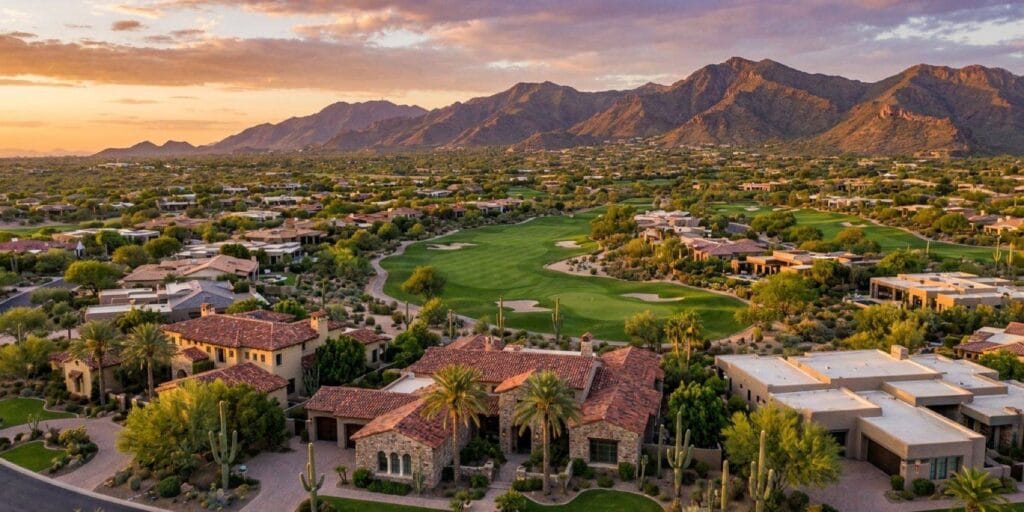
Scottsdale’s citywide median home price was $1.3 million in March 2026. That number tells you very little about your move. The communities that actually shape a Scottsdale relocation — DC Ranch, Silverleaf, Troon, Desert Mountain, Whisper Rock, Estancia, Grayhawk, Mirabel — span median values from $1.4 million for production new-construction in the McDowell Mountain foothills to $30 million for trophy estates in Silverleaf. Each one operates under its own gate protocols, its own architectural review board, its own school district assignment, and its own social fabric. Where you land determines whether your Scottsdale move feels like the upgrade you came for, or the misstep you spend the next three years correcting at significant cost.
Here’s what you need to know at a glance:
Quick Answers
- Citywide median home price (March 2026): $1.3M; average sold $1.73M (Sweep Phoenix AZ / ARMLS)
- Premium community medians: DC Ranch $2.05M, Silverleaf $5M+ closed (active list median $6.94M), Troon mid-$1M to $3M+, Desert Mountain $1.5M–$20M+, Whisper Rock $4M–$8M range
- Average long-distance move cost: $7,500 – $45,000+ (3-to-5 bedroom, full-service, with art and wine)
- Days on market (March 2026): 80 days citywide; 127 days in 85262 (Desert Mountain) — buyer’s market in 2026
- State income tax: Arizona 2.5% flat (effective 2023, no 2026 changes)
- Schools: Scottsdale Unified is #5 best district in Arizona; Cave Creek Unified serves parts of far North Scottsdale — boundary varies by address
- Best for: Corporate executives transferring to TSMC, Intel, Honeywell, or Mayo Clinic; retirees from California or the Northeast; families prioritizing resort-grade community amenities and top-tier schools
Scottsdale rewards buyers who do the community-level homework before they fly out for a weekend of showings. The communities are not interchangeable — they operate under different gate protocols, different school district assignments, different architectural review boards, and different social fabrics. A family choosing between DC Ranch and Silverleaf is making one decision; a family choosing between Scottsdale and Paradise Valley is making a completely different one. This guide maps the communities, who lives in each, what you’ll pay, and the trade-offs that should drive the call. For broader regional context, our moving guide to Arizona covers the full-state picture, and our moving guide to Phoenix maps the Valley’s central neighborhoods.
Why Scottsdale Keeps Drawing New Residents in 2026
Scottsdale’s draw is structural and durable. Four forces are concentrating relocation demand into the city, and each one shapes which community a particular buyer ends up choosing.
The California migration. California is Scottsdale’s single largest origin market, and the migration is meaningfully different from the broader California exodus into Phoenix. The California buyers landing in DC Ranch, Silverleaf, and Troon are bringing equity from the Bay Area and Southern California’s premium markets — Hillsborough, Atherton, Manhattan Beach, Pasadena’s San Marino corridor, and the Hollywood Hills. They’re trading the California taxes (top marginal rate 13.3 percent), the wildfire risk, and the cost-of-everything for Arizona’s 2.5 percent flat income tax, the climate, and the resort-grade community infrastructure they couldn’t replicate at home. Recent United Van Lines data shows 75.9 percent of Arizona inbound migrants earn over $100,000 and 69.5 percent are 55 or older — a profile heavily concentrated in Scottsdale and Paradise Valley.
The corporate relocation pipeline. TSMC’s North Phoenix campus represents $165 billion in semiconductor investment and is in active hiring ramp. Intel’s Ocotillo campus in Chandler employs over 11,000 Arizona workers. Honeywell Aerospace, American Express, Mayo Clinic, and Banner Health all generate consistent executive relocation volume. The pattern is clear and important: senior leadership at these employers typically does not live in North Phoenix or the East Valley near their offices. They commute from Scottsdale because the housing inventory, the schools, the community amenities, and the lifestyle simply don’t exist at comparable quality elsewhere in the metro. A TSMC engineering director moving from Hsinchu, Taiwan or San Jose, California is far more likely to land in DC Ranch than in any neighborhood in Phoenix proper.
The corporate HQ migration. The pattern that drove TSMC and Intel to Arizona is now drawing executive-team headquarters into the Valley. KB Home announced in April 2026 that it is relocating its corporate headquarters from Los Angeles to Tempe by spring 2027. CBRE ranked the Phoenix metro fourth nationally for corporate HQ attraction from 2018 to 2024, with 31 confirmed relocations during that window. Scottsdale Quarter — the mixed-use development in North Scottsdale — was acquired in June 2025 by CrowdStrike founder George Kurtz’s investment firm for $645 million, with $100 million in capital improvements planned to expand Class A office space. Each of these moves brings additional executive households into the Scottsdale residential market.
The lifestyle equation. Scottsdale operates more than 50 luxury resorts, hosts the Cactus League’s Scottsdale Stadium and Salt River Fields, runs the Barrett-Jackson collector car auction every January (1,800 vehicles, all no-reserve), and operates more golf courses per capita than any city in the United States. Old Town’s arts district anchors more than 50 galleries with a weekly Thursday ArtWalk that’s been running since the 1960s. The Western Spirit Museum (Smithsonian Affiliate) opened a 12,000-square-foot expansion in 2025. The dining scene runs from Mastro’s three Scottsdale locations and Steak 44’s seven-consecutive-year best-steakhouse run to Pizzeria Bianco’s Old Town outpost. For buyers leaving high-cost coastal markets, the lifestyle math is straightforward in a way that Phoenix proper simply cannot match.
The Scottsdale Community Map
Scottsdale runs roughly 30 miles north to south. The city’s character changes significantly across that distance, and the buying decisions in North Scottsdale (the eight to ten communities that dominate the premium market) are fundamentally different from buying decisions in McCormick Ranch or Old Town. Here are the communities that matter most for a relocation in 2026.
DC Ranch: The Master-Planned Anchor
DC Ranch is the master-planned community that has defined the modern North Scottsdale residential experience. It runs across roughly 4,400 acres in the McDowell Mountain foothills, with multiple sub-villages, 24-hour guard-gated entries, and a walkable Market Street commercial core that anchors community life around restaurants, fitness, and small retail. The architectural review board is active and enforces a Sonoran Desert aesthetic across all new construction and significant renovations.
DC Ranch homes ranged from $1 million to $4 million in March 2026 for production and semi-custom housing, with the Silverleaf enclave inside DC Ranch reaching $5 million to $30 million for custom estates. The March 2026 median sale price across DC Ranch was $2.05 million; average sale was $2.66 million; median list price ran $3.6 million. Lot sizes range from under 0.2 acres for attached townhome product up to 0.5 to 1 acre for detached estates. Architecture is split between Desert Contemporary and Spanish Colonial Revival, with strong consistency across the master plan.
The community’s school assignment is mixed: most of DC Ranch falls within Scottsdale Unified School District (Niche 2026’s #5 district in Arizona, A overall grade), but addresses on the northern edge can fall into Cave Creek Unified School District (Niche #8 in Arizona). This boundary is consequential — the two districts have different schools, different ratings on specific schools, and different boundary lines that have shifted over time. Address-specific verification is mandatory before committing to a DC Ranch purchase if school district assignment is a deciding factor.
Best for: Family-stage executives who want walkable community infrastructure, top-tier school options, and a balance of social and private living. The default landing zone for TSMC, Intel, and Mayo Clinic family relocations.
Silverleaf at DC Ranch: The Trophy-Tier Enclave
Silverleaf sits inside DC Ranch but operates as its own guard-gated community, with a separate gate, separate access protocols, and a separate architectural review board with notably stricter design standards. Custom and semi-custom estates sit on 0.5 to 5+ acre lots against the McDowell Mountain foothills, with elevated view sites that command meaningful pricing premiums.
The Silverleaf market is genuinely different from anywhere else in DC Ranch. Active listings as of April 2026 ran 48 estates with a median list price of $6.94 million. Closed sales over the past 12 months ran a median in the mid-$5 million range, with individual estates trading from $5 million to $30 million. A notable 2025 sale closed at $22 million for an estate with a private vineyard and helipad. The architecture is more varied than the rest of DC Ranch — Mediterranean, Tuscan, Spanish Colonial Revival, and high-end custom contemporary all sit within the community.
The Silverleaf Club is private and membership is required for access to the golf course, tennis facilities, dining, and pools. Initiation fees and dues add $50,000 to $150,000 or more in annual cost above the home itself, depending on tier. Membership is generally tied to homeownership but is not automatic — separate application is required.
Best for: Buyers in the $5 million-and-up tier who want guard-gated security with private club infrastructure inside a master-planned community. Often the choice for family offices, finance principals, and tech executives selling Bay Area or Manhattan equity into a Scottsdale relocation.
Troon, Troon North, and Troon Village: The Pinnacle Peak Foothills
The Troon area sits in the Pinnacle Peak foothills at 2,400 to 2,800 feet of elevation — meaningfully higher than the Scottsdale floor (around 1,250 feet) and noticeably cooler in peak summer. Troon North Golf Club operates two semi-public courses (Monument and Pinnacle), consistently ranked among the top public courses in Arizona by Golf Digest. Troon Country Club is a separate private club with its own membership and its own gated residential community.
The market splits into multiple distinct sub-areas. Troon proper runs $700,000 to $3 million for typical inventory, with the best view properties closing $3 million to $5 million. Troon Village runs in the mid-$1 million range, with $400 to $500 per square foot for premium pockets. The Troon Country Club enclave is a private gated community with custom homes generally priced in the $2 million to $6 million range.
Architecture skews Desert Contemporary, ranch-style, and hillside custom builds. Lot sizes typically run 0.25 to 1 acre, with larger view sites available in the Country Club enclave and along the foothills. Hillside properties present specific moving logistics challenges — irregular driveways, granite outcrops, and limited turnaround space for full-size moving trucks. We address the logistics specifically later in this guide.
Best for: Golf-first buyers who want elevation, mountain views, and access to one of the top public golf courses in the state. Also a strong choice for retirees from coastal California and the Northeast who want privacy without DC Ranch’s family-community density.
Desert Mountain: Far North Scottsdale’s Private Community
Desert Mountain sits at the far north end of Scottsdale, on the Carefree and Tonto National Forest border. The community spans 8,000 acres of guard-gated private land with six Jack Nicklaus Signature golf courses (plus a seventh par-3 course), seven clubhouses, extensive tennis and fitness infrastructure, and a spa. The community is large enough that internal navigation runs on private roads behind the main gate, and individual neighborhoods within Desert Mountain have their own micro-character.
Property pricing runs from $1.5 million for patio homes and casitas to $20 million-plus for mountaintop custom estates. The slightly elevated terrain means cooler summer nights and more dramatic winter clear-sky views than the Scottsdale floor — a meaningful quality-of-life difference for buyers who care.
Days on market in 85262 (the zip code that includes Desert Mountain and far North Scottsdale) ran 127 days in late 2025 — substantially longer than the 80 days for the city as a whole. This is not a market weakness; it reflects thin inventory, qualified-buyer pools, and longer marketing windows for $5 million-plus estates. For buyers, the longer DOM translates to genuine negotiating leverage and the time to do proper due diligence.
Best for: Buyers prioritizing maximum privacy, golf access at scale, and a far-North Scottsdale lifestyle removed from the central commercial corridors. Frequently the choice for retired executives and family principals who don’t need daily proximity to Phoenix employers.
Grayhawk: The More Accessible Master-Planned Community
Grayhawk is the master-planned community that sits south of Troon and west of DC Ranch. It’s significantly more accessible than Troon or DC Ranch in terms of price point, with two semi-public Gary Panks-designed golf courses (Raptor and Talon) anchoring community life and a strong family-stage population.
Pricing runs across multiple tiers: condos and townhomes from $500,000 to $800,000, single-family homes from $800,000 to $1.5 million, and golf-view properties from $1.5 million to $3 million. Lot sizes typically run 0.12 to 0.4 acre. Some sub-communities within Grayhawk are gated; others are open access. The school assignment is consistently Scottsdale Unified, which simplifies the buyer’s decision in this area.
Best for: Golf-first families with growing children, value-conscious buyers who want master-planned community infrastructure and SUSD schools at a lower price point than DC Ranch, and corporate transferees with budgets in the $1 million to $2 million range.
Whisper Rock: The Maximum-Privacy Enclave
Whisper Rock is a small, bespoke enclave that runs on a different operating principle than DC Ranch or Desert Mountain. The community optimizes for privacy and discretion above scale. Whisper Rock Golf Club is private and member-owned with extremely limited membership availability — purchase of a Whisper Rock home does not include club membership, and waiting lists for membership can extend years.
Median list price ran $5.69 million in February 2026, with average price per square foot of $905.85 — among the highest in the Valley. Active inventory is consistently small (often fewer than 10 homes on the market at any time), which means the median figures can swing significantly based on which specific properties are listed in a given month. The practical price range runs $4 million to $8 million for typical inventory, with custom estates extending higher.
Best for: Professional athletes, entertainment industry residents, and executives who want maximum privacy without the social infrastructure of DC Ranch or the resort-club density of Desert Mountain. Often the choice when discretion is paramount.
Estancia: The Tom Fazio Private-Club Community
Estancia is one of the most exclusive private-club communities in Arizona, with reportedly around 200 total Estancia Club memberships — making it among the most member-limited golf clubs in the state. The Tom Fazio-designed course is the centerpiece, and the surrounding custom homes are designed in coordination with the community’s architectural standards.
Average sales price runs approximately $4.31 million across recent transactions (verify against current ARMLS data with your real estate professional, as listing-aggregator figures can lag actual closings). HOA fees are modest at approximately $100 per month for community maintenance, but the Estancia Club initiation fees and annual dues are substantial and not publicly disclosed — typical for clubs at this exclusivity tier.
Best for: Buyers who specifically want Tom Fazio golf access, ultra-limited membership exclusivity, and a community where the design discipline is consistent across every home. Typically a choice for buyers in the $3 million to $7 million tier who prioritize golf above all else.
Mirabel: The Northern Jack Nicklaus Community
Mirabel sits between Troon and Desert Mountain in terms of both geography and exclusivity, with a Jack Nicklaus-designed golf course (Mirabel Club) anchoring community life. Pricing runs an average of approximately $2.30 million across recent transactions, with custom estates extending into the $4 million-plus tier.
The community is gated and the club is private. The membership tier and initiation fees are between Estancia’s ultra-exclusive tier and Desert Mountain’s larger-scale operation.
Best for: Buyers who want Jack Nicklaus golf access in a smaller-scale community than Desert Mountain, with a more boutique character and slightly more accessible pricing than Estancia.
Mid-Scottsdale: McCormick Ranch, Gainey Ranch, Scottsdale Ranch
Mid-Scottsdale operates on a different timeline and a different price tier than North Scottsdale. McCormick Ranch was developed in the 1970s and 1980s as a master-planned lake community, with two 18-hole courses at McCormick Ranch Golf Club (Quail Run and Palm) and a lagoon system that defines the residential character. April 2026 median sale price ran $1.099 million, with mature landscaping and updated mid-century architecture as the defining features. Gainey Ranch sits adjacent, anchored by the Hyatt Regency Scottsdale at Gainey Ranch resort, with a 12-month median sale price of $1.25 million. Scottsdale Ranch is a similar lake community with a comparable pricing profile.
Best for: Buyers who want established mature-tree neighborhoods with golf and lake access, at meaningful discount to North Scottsdale, with shorter commutes to Camelback Corridor and downtown Phoenix employers. A common choice for executives who don’t need new construction or guard-gated community life.
Old Town Scottsdale and the Waterfront
Old Town Scottsdale is the city’s walkable urban district — arts galleries, restaurant row, Scottsdale Fashion Square (the largest mall in Arizona), the Scottsdale Center for the Performing Arts, and a dense weekend nightlife scene that extends across the Entertainment District. Median home price in Old Town ran $772,000 in March 2026, with an average sale of $930,899 across 63 active condos. The Scottsdale Waterfront Residences high-rise corridor along the Arizona Canal offers one-bedrooms from $825,000 to $998,000 and two-bedrooms ranging from $785,000 (recent sale) to $3.495 million (current active listing).
Notable buildings include Optima Camelview, Optima Kierland, and the Scottsdale Waterfront. High-rise moves require certificates of insurance, advance elevator reservations, and building management coordination — typically 3 to 6 weeks of lead time before the moving truck arrives. We address the logistics specifically later in this guide.
Best for: Younger executives from genuinely urban origin markets (Manhattan, Chicago Loop, San Francisco), professionals prioritizing walkability over square footage, and buyers wanting maximum proximity to Old Town’s restaurant and arts scene.
Schools: SUSD vs. CCUSD and the Scottsdale Decision
For families relocating with school-age children, Scottsdale’s school landscape rewards precise address verification. Two public school districts serve the city: Scottsdale Unified School District (SUSD), which covers most of the city including Old Town, Mid-Scottsdale, and the southern portions of North Scottsdale; and Cave Creek Unified School District (CCUSD), which serves portions of far North Scottsdale, including parts of DC Ranch, Troon, and Desert Mountain.
This boundary matters. SUSD ranks #5 best district in Arizona on Niche’s 2026 rankings, with an A overall grade, 29 schools, and approximately 20,940 students. The district’s spring 2025 state assessment results placed it #1 among all Arizona districts and charters serving more than 10,000 students in both English Language Arts and Math, with math proficiency at 57 percent (versus 34 percent statewide average) and reading proficiency at 61 percent (versus 41 percent). Graduation rate runs 92 percent.
CCUSD ranks #8 in Arizona on the same Niche list, with an average testing score of 9 out of 10. Both districts are strong, but they have different schools, different specific-school ratings, and different boundary lines that have been adjusted over time. The boundary cuts through premium neighborhoods — including portions of DC Ranch — and the assignment for a specific street can differ from the assignment of a property a few blocks away. Address-specific verification through each district’s boundary tool is mandatory before committing if school district assignment is a deciding factor in your move.
Beyond the public option, Scottsdale’s charter and private schools are genuinely strong. BASIS Scottsdale ranks #1 best public high school in Arizona (Niche 2026), #52 nationally, and in the top 1 percent of public schools nationwide. BASIS Charter Schools were named #1 public high school in America by U.S. News and World Report in 2025. Great Hearts Academies — Archway Scottsdale (K-12 charter) tests in the top 5 percent of Arizona public schools, with math proficiency at 73 percent and reading at 78 percent. Great Hearts Scottsdale Preparatory Academy (grades 5-12) recorded an average SAT of 1341 for the Class of 2025 — 313 points above the national mean — with two National Merit Finalists and $10 million in merit scholarships. Notre Dame Preparatory is the co-ed Catholic college-prep with approximately 863 students and a 2022 U.S. Department of Education Blue Ribbon designation. Rancho Solano Preparatory and Phoenix Country Day School (located in adjacent Paradise Valley but serving Scottsdale families) round out the private options.
For families weighing public versus private, the SUSD public schools are strong enough that many North Scottsdale families opt for public elementary and middle through SUSD or CCUSD, then transition to BASIS, Great Hearts, Notre Dame Prep, or Phoenix Country Day for high school.
What Scottsdale Actually Costs
Scottsdale’s overall cost of living runs above the national average, with the spread depending heavily on methodology. RentCafe places the city at 14 percent above national average; ERI’s weighted index runs 35 percent above. The reason for the wide range is that housing dominates the cost picture — Scottsdale housing runs approximately 42 percent above national average, while groceries run roughly 5 percent above and utilities about 7 percent below. The 42 percent housing premium is the figure that actually shapes a relocation budget.
Property taxes are one of Scottsdale’s quiet financial advantages. The city’s combined FY 2025-26 tax rate is $0.9124 per $100 of assessed valuation (primary $0.4891 plus secondary $0.4233), which translates to an effective rate of approximately 0.47 percent of market value. For a $2 million DC Ranch home, the annual property tax bill runs approximately $9,400 — substantially below the equivalent assessed-value tax bill in California ($14,200 in San Francisco County) or New Jersey ($43,200 at New Jersey’s average effective rate of 2.16 percent on equivalent value).
Income tax is the headline financial advantage. Arizona’s 2.5 percent flat rate, effective 2023 and unchanged for 2026, means a household earning $500,000 pays $12,500 in state income tax — compared to roughly $45,000 in California, $40,000 in New York City (combined state-and-city), or $24,000 in Illinois. Arizona has no estate tax and no inheritance tax. Social Security income is exempt. For retirees drawing from pensions, IRAs, 401(k)s, and investment portfolios, the long-term tax math is genuinely compelling.
For the Scottsdale-specific buyer, the combination of the 42 percent housing premium and the favorable tax environment produces a specific calculus: Scottsdale is more expensive than the national average for the home itself, but substantially less expensive than California, New York, or New Jersey for the household’s annual cost of living once income tax, property tax, and estate planning are fully accounted for.
The Water Question: Honest Context for a Long-Term Move
Scottsdale’s water supply situation is the most important long-term consideration for any 2026 buyer thinking in 20-year horizons, and it is genuinely underdiscussed in most Scottsdale relocation content. The city draws approximately 70 percent of its municipal water from the Colorado River via the Central Arizona Project (CAP). The Colorado River is currently in a Tier 2 Shortage declaration that has cut Arizona’s CAP allocation by 21 percent. The federal operating guidelines that govern Glen Canyon and Hoover Dams are scheduled to expire at the end of 2026, with new framework negotiations actively in progress and a likely outcome that will further reduce Arizona’s allocation through the 2040s.
Local expert projections, including those reported by ABC15 in coverage of Scottsdale’s water situation, suggest the city could lose up to 80 percent of its Colorado River water supply over the coming decades if current negotiation trajectories hold. This is not an immediate dealbreaker, and Scottsdale has invested meaningfully in water banking, reclaimed water systems, aquifer recharge programs, and conservation infrastructure — the city is genuinely better positioned than Rio Verde Highlands, which lost municipal water access entirely in 2023.
What this means practically for a 2026 relocation decision: Scottsdale is not running out of water in the short term, and the city has decades of water-rights work behind it. But long-term water sustainability is now a material factor in housing decisions in a way it simply wasn’t a decade ago. Landscaping costs will likely rise. Outdoor water features will face additional regulation. HOAs are already shifting xeriscape requirements. New construction is incorporating water-efficient design. For buyers committing to Scottsdale as a 20-plus-year primary residence, the water question is worth a direct conversation with your real estate professional — not a topic to skip.
Choosing a Professional Mover for a Scottsdale Relocation
The interstate moving market into Scottsdale attracts both licensed carriers and brokers — and the distinction matters more for high-value moves than most newcomers realize. A licensed carrier (like Nelson Westerberg) operates its own trucks and its own employees. When you hire us, our crew loads your belongings at origin, our truck carries them across the country, and our crew delivers them at destination. One team, one point of accountability, from pickup to delivery. A broker takes your deposit and then sells your move to a subcontractor whose name you may not know, whose insurance you cannot verify, and whose crew has no relationship with you. If something goes wrong — damage, late delivery, lost items, failed gate coordination at Silverleaf or Desert Mountain — you’re negotiating with the broker while the actual mover has no relationship with you. The largest category of consumer complaints in interstate moving originates with broker-subcontractor arrangements.
Verify your mover is a licensed interstate carrier by checking their USDOT number with the Federal Motor Carrier Safety Administration. Nelson Westerberg is a licensed interstate carrier and an Atlas Van Lines agent — not a broker. We’ve moved families and executives into and out of Scottsdale for decades, with specific experience in DC Ranch and Silverleaf gate protocols, Desert Mountain access coordination, hillside Troon logistics, Old Town high-rise elevator reservations, and the corporate relocation programs run by TSMC, Intel, Honeywell, Mayo Clinic, and the broader Valley employer base.
Full-service interstate pricing covers the inventory survey and binding not-to-exceed estimate, protective materials (floor runners, door-jamb protectors, banister wraps, corner guards, furniture pads), loading labor at origin, long-haul transportation, unloading labor at destination, and standard released-value coverage. Full-service packing, full-value protection, custom crating for art and wine collections, climate-controlled transport for temperature-sensitive items, and enclosed-carrier auto transport for collector vehicles are all available and standard on premium-tier Scottsdale moves. For corporate relocation packages, we work directly with HR teams and relocation management companies (Aires, Weichert, Graebel, Cartus) on direct billing, lump-sum coordination, and guaranteed-buyout packages.
Scottsdale Moving Logistics: Gate Protocols, COIs, and Hillside Access
Scottsdale’s premium communities each have specific access requirements that affect move-day coordination. Understanding the requirements before booking saves time and prevents move-day surprises.
Silverleaf, DC Ranch, Desert Mountain, Troon Village, Estancia, and Mirabel all operate guard-gated entries with vendor pre-clearance protocols. Security manifests are typically filed 72 hours in advance through community management or platforms like GateAccess.net, with crew names, government-issued IDs, vehicle license plates, and certificates of insurance pre-registered. Premium estate moves in the 85255, 85262, and 85266 zip codes commonly require certificates of insurance with $10 million general liability coverage — substantially above the standard $1 million to $2 million typical of mid-tier moves. We provide certificates of insurance customized to each community’s exact requirements at no additional charge, and we coordinate the gate paperwork as part of standard pre-move planning.
Hillside and custom-home access in Troon Mountain, Pinnacle Peak, and the McDowell Mountain foothills frequently sit on grades steep enough that a 53-foot tractor-trailer cannot safely navigate the approach roads. Driveway turnarounds can be limited or non-existent, and granite outcrops along access roads can create clearance issues for larger equipment. For these addresses, we stage the line-haul tractor at a wider arterial (typically Pima Road, Happy Valley Road, or one of the Loop 101 service roads, depending on the community) and shuttle items with a smaller straight truck to the residence. Pre-survey identifies the requirement and prices it transparently — no surprise charges on move day.
High-rise condos in Old Town Scottsdale, the Waterfront, Optima Camelview, and Optima Kierland require certificates of insurance, advance elevator reservations, and building management coordination. Lead time is typically 3 to 6 weeks before move day. Loading dock access varies by building and may require off-hours scheduling. We handle the building management coordination as part of standard pre-move planning.
Summer scheduling is the single most consistent Scottsdale-specific logistical factor. Peak summer (June through September) brings 100°F-plus daily highs across most of the city, with North Scottsdale running approximately 3 to 5°F cooler than the Scottsdale floor due to elevation. We do not load or unload trucks in midday summer heat without specific protocols: early morning start times (5 to 8 AM), climate-controlled transport for temperature-sensitive items (fine art, wine, electronics, antique wood furniture), pre-arrival air conditioning verification at destination, and crew hydration and rest schedules. For any move arriving May through September, we coordinate AC status and arrival timing with the destination property manager or homeowner before dispatch. Monsoon season (July through September) brings dramatic afternoon thunderstorms with flash flooding risk on hillside and canyon properties; we monitor National Weather Service alerts and reschedule moves during active flash-flood warnings at no additional charge.
What It Costs to Move to Scottsdale
Moving costs depend on three variables: origin market, volume, and service level. Scottsdale moves typically run higher than Phoenix moves on the upper end due to larger homes, more art and wine collections, more outdoor furniture, and a greater density of custom crating requirements. For full-service interstate moves into Scottsdale from the largest origin corridors:
From California (Los Angeles, San Francisco, San Diego): $7,500 to $28,000-plus for a 3-to-5-bedroom full-service move. California is Scottsdale’s single largest origin market; we run this corridor continuously. Premium origin markets like Beverly Hills, Hillsborough, and the Bay Area peninsula trend toward the upper end given typical volume and specialty handling for art and collections. Estate-level moves with $5 million-plus origin homes can extend significantly above $28,000 — Northeast-style premium pricing.
From Texas (Dallas, Houston, Austin): $8,500 to $28,000 for equivalent scope. The secondary corridor into Scottsdale and a substantial source of executive and family relocations.
From the Northeast (New York, New Jersey, Massachusetts): $15,000 to $45,000-plus. Longer distance, higher volume for estate-level moves, and specialty handling for art and wine collections common in this corridor. Moves from Manhattan or Greenwich into Silverleaf or Desert Mountain estates routinely close in the $35,000 to $50,000 range.
From Illinois (Chicago metro): $10,000 to $28,000. Driven by tax-motivated retirements and corporate relocations seeking warmer weather.
Local and intra-Scottsdale moves are priced separately and typically run $1,500 to $7,000 for a 2-to-4-bedroom home depending on access. All Nelson Westerberg estimates are binding not-to-exceed — the price quoted is the maximum; if the move comes in under estimate, you pay less. No verbal ballparks. No change orders on move day. Estimates are written and itemized after an in-home or virtual survey.
Frequently Asked Questions
North Scottsdale or Paradise Valley — which is the right choice for us?
Both are premium tiers, but they operate on different principles. Paradise Valley is a separately incorporated town between Phoenix and Scottsdale, with a median home price above $3.6 million, minimum 1-acre lots in most zoning, no HOAs, and Camelback and Mummy Mountain adjacency. Buyers choose PV when they want a 2-acre-plus custom estate without HOA oversight or community-design enforcement. North Scottsdale (DC Ranch, Silverleaf, Desert Mountain) operates the opposite way: HOA-managed gates, resort-club community infrastructure, walkable Market Street commercial cores, and architectural review boards that enforce design consistency. The North Scottsdale schools are also generally better-rated than the PV schools serving most of the town. North Scottsdale is the right choice when you want resort-grade community life and family infrastructure; PV is the right choice when you want a private estate and you don’t want a community telling you what color your front door can be.
What’s the real difference between DC Ranch and Silverleaf?
DC Ranch is the master plan — 4,400 acres, multiple sub-villages, 24-hour guard-gated entries, walkable Market Street, a mix of production and semi-custom and custom housing from $1 million to $4 million. Silverleaf is the trophy-tier enclave inside DC Ranch with its own separate gate, its own stricter architectural review board, its own private club (the Silverleaf Club, $50,000-plus initiation fees), and a market that runs from $5 million to $30 million. The two communities share the DC Ranch master plan but operate as distinct buying decisions. Most DC Ranch families don’t know Silverleaf residents personally; the social fabric is meaningfully separate.
Which Scottsdale community is best if we have school-age children?
DC Ranch and Grayhawk are the strongest family-stage choices in North Scottsdale. Both feed Scottsdale Unified School District (Niche #5 in Arizona, with the caveat that some DC Ranch addresses fall into Cave Creek Unified instead — verify by address before committing). McCormick Ranch and Gainey Ranch in Mid-Scottsdale offer mature established neighborhoods with the same SUSD assignment at lower prices. For families prioritizing charter access, BASIS Scottsdale (#1 public high school in Arizona) and Great Hearts Scottsdale Prep are non-boundary options that families can drive to from any community in the city. Phoenix Country Day in adjacent Paradise Valley remains one of the strongest private K-12 options in the metro.
Does Scottsdale really have a water problem?
The honest answer is yes, and a sophisticated buyer agent will tell you so. Colorado River allocations have been cut, the federal operating guidelines expire end of 2026, and long-term reductions through the 2040s are likely. Scottsdale has invested in water banking, reclaimed water, and aquifer recharge to buffer the impact, and the city is genuinely better positioned than Rio Verde Highlands. For most 2026 buyers, the water situation does not change the purchase decision — but it is a legitimate long-term consideration that will affect landscaping costs, outdoor water features, and HOA xeriscape requirements over a 10-to-20-year ownership horizon. Worth a direct conversation with your real estate professional.
If I’m commuting to Intel, TSMC, Honeywell, or Mayo Clinic — where should I live?
For TSMC’s North Phoenix campus: North Scottsdale (DC Ranch, Troon, Desert Ridge) is approximately 30 to 40 minutes via Loop 101. For Intel’s Chandler Ocotillo campus: South or Central Scottsdale, McCormick Ranch, or Old Town is closer, with 20-to-25-minute commutes via Loop 202. For Honeywell’s Deer Valley campus: North Scottsdale and DC Ranch are reasonable. For Mayo Clinic’s Scottsdale campus: Almost any North Scottsdale community is a 10-to-15-minute commute. For the Camelback Corridor / Biltmore corporate cluster (American Express, financial services, wealth management): Central Scottsdale, McCormick Ranch, or Gainey Ranch are 15-to-20-minute commutes. The pattern that matters: senior leadership at all of these employers consistently chooses to live in Scottsdale rather than nearer to the office, because the housing inventory and community infrastructure simply don’t exist at comparable quality elsewhere in the metro.
Is now (2026) a good time to buy in North Scottsdale?
The 2026 market has shifted from the 2021-2023 frenzy to a more balanced buyer environment. Days on market have extended to 80-plus days in 85255 and 127 days in 85262 (Desert Mountain). Price reductions are appearing in the sub-$5 million segment. The ultra-luxury tier ($10 million-plus) remains firm, with a 157 percent year-over-year surge in $5 million-plus sales reported in early 2025. For buyers in the $1 million to $5 million range, this is arguably the best buyer’s opportunity since 2019 — meaningful inventory, longer marketing windows, and price flexibility on individual properties.
Are you a licensed interstate carrier or a broker?
Nelson Westerberg is a licensed interstate carrier and an Atlas Van Lines agent — not a broker. Your belongings are handled by our employees from pickup to delivery — one truck, one crew, one point of accountability. Verify our USDOT registration with the Federal Motor Carrier Safety Administration.
Making Your Scottsdale Decision
Scottsdale rewards buyers who do the community-level homework. The aggregate statistics about the city — population, growth rate, citywide median home price — are accurate but largely irrelevant to your move. The communities that actually shape a Scottsdale relocation are eight to ten distinct submarkets with their own characters, gate protocols, school assignments, and price tiers. Where you land determines whether your Scottsdale move feels like the upgrade you came for, or the misstep you spend the next three years correcting at significant cost.
The right Scottsdale community for your relocation depends on your employer’s location, your family’s school priorities, your housing budget, your tolerance for HOA-managed community life versus private custom-estate ownership, and your long-term plans. Our relocation specialists have managed thousands of moves into every Scottsdale community and can help you think through the fit before you commit to the address.
For broader context, our moving guide to Arizona covers the full-state picture, and our moving guide to Phoenix maps the central Valley. Ready to plan your Scottsdale move? Request a free binding not-to-exceed estimate and we’ll scope your specific corridor, timeline, and destination in detail.
Related Articles
Cost to Move a 3-Bedroom Home Cross-Country (2026): The Full-Service Price Breakdown

If you’re planning to move a three-bedroom home across the country in 2026, the single most useful number to start with is a range: a full-service, professionally handled move typically runs between $6,500 and $14,500, with a roughly 1,000-mile relocation landing around $8,000 to $11,000. Where your move falls within that band depends on a […]
Read MoreMoving from New Jersey to North Carolina (2026): Leaving the Nation’s Highest Property Taxes
New Jersey has led all fifty states in outbound migration for eight straight years, and once you look at the property-tax bill, it isn’t hard to see why. The Garden State carries the highest effective property-tax rate in the nation — about 2.23%, translating to an average homeowner bill near $9,500 a year — stacked […]
Read More

Table of Contents

Atlas Van Lines, Inc. U.S. DOT No. 125550 (TM & © 2026 AWGI LLC.) | G.P.S.C. 4917 | IL C.C. 4246 | NJPC 00104 | Cal-T 110193
© 2026 Nelson Westerberg, Inc. All Rights Reserved Worldwide.