Moving Guide to Tucson (2026): The Foothills Decision

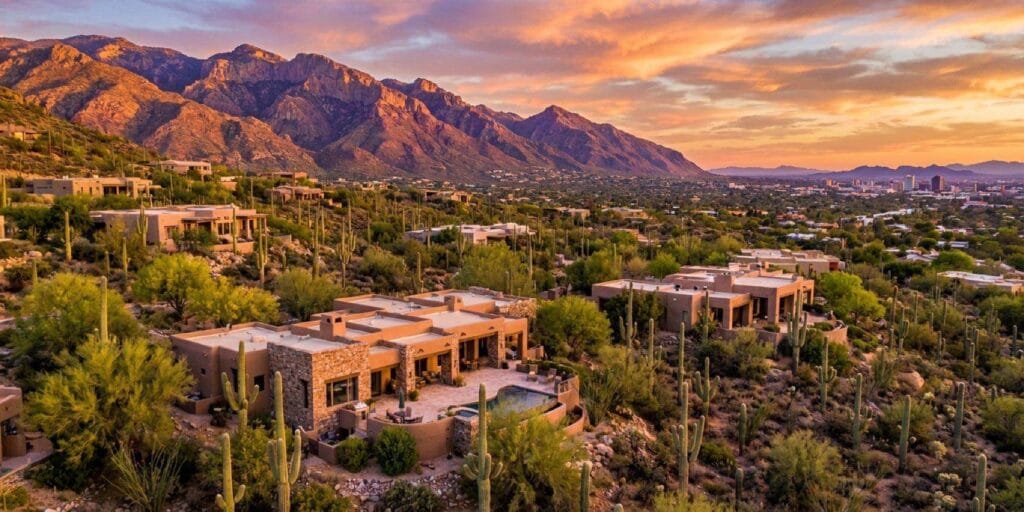
Tucson is not a smaller, cheaper version of Phoenix. It is a fundamentally different city, shaped by a different history, anchored by different institutions, and chosen by people who specifically don’t want Phoenix. Tucson sits at 2,400 feet of elevation against the Santa Catalina Mountains — 1,300 feet higher than the Phoenix valley floor, with summer highs running 7 to 10 degrees cooler. The economy is dominated by Raytheon Missiles & Defense, the University of Arizona, Banner University Medical Center, and Davis-Monthan Air Force Base — a workforce that skews engineering, academic, medical, and military rather than the corporate-tech profile of the Valley. The housing stock runs roughly 20 percent cheaper than Phoenix on average, but the premium tier in the Catalina Foothills, Oro Valley, and Dove Mountain operates with its own market logic and its own neighborhood-by-neighborhood character. Where you land in Tucson determines more about your life there than the city’s aggregate statistics suggest.
Here’s what you need to know at a glance:
Quick Answers
- Citywide median home price (Jan 2026): $365,000 single-family (down 1.9% YoY); ~20% cheaper than Phoenix
- Premium neighborhood medians: Catalina Foothills $704K (luxury tier $1.5M–$5M+); Oro Valley $497K; Dove Mountain $700K–$2.5M (Ritz-Carlton Residences $2M–$5M+); Tanque Verde $640K floor
- Average long-distance move cost: $6,500 – $22,000 (3-to-5 bedroom, full-service, from California or Texas)
- Tucson MSA population: ~1.07 million (HUD Dec 2024); growing +0.6%/year
- Elevation: 2,400 ft (vs. Phoenix 1,100 ft) — 7-10°F cooler summer highs; ~78 days/year ≥100°F vs. Phoenix’s ~122
- State income tax: Arizona 2.5% flat (effective 2023, no 2026 changes)
- Best for: Raytheon engineers and defense executives, University of Arizona faculty and Banner medical leadership, retirees seeking a smaller-metro alternative to the Valley, families prioritizing top schools and outdoor access
Most Tucson newcomers arrive having already weighed the Phoenix-vs-Tucson question. The honest answer to that question shows up in the FAQ later, but it requires understanding what Tucson actually is on its own terms first — not as Phoenix Lite, but as a smaller, cooler, university-anchored city that has chosen its own path for sixty years and isn’t trying to become the Valley. This guide maps the neighborhoods that shape that move into the Old Pueblo — Catalina Foothills, Oro Valley, Dove Mountain, Tanque Verde, Sam Hughes — and what trade-offs each one represents. For broader regional context, our moving guide to Arizona covers the full-state picture, and our moving guide to Phoenix maps the Valley.
Why Tucson Keeps Drawing the People It Draws
Tucson’s relocation market is genuinely different from Phoenix’s, and understanding the difference is the first step toward making a good neighborhood decision. Four forces shape who moves to Tucson and where they land.
The Raytheon expansion. Raytheon Missiles & Defense (RTX) is Tucson’s single largest employer and the engine of its 2025-2026 hiring growth. Raytheon employs approximately 13,000 workers across its Tucson operations, and the company is in active expansion. February 2026 brought five framework agreements with the Department of War to ramp Tomahawk production above 1,000 missiles per year, AMRAAM above 1,900, and SM-6 above 500. April 2026 added a $904.6 million LTAMDS radar contract for low-rate initial production. March 2026 included an $8.41 billion missile defense contract modification for SM-3 interceptors. As of research date, Raytheon is posting more than 1,300 engineering jobs in Tucson on Indeed alone. For engineers, technicians, and defense executives, this is one of the largest sustained hiring expansions in the U.S. defense industry, and the relocations into Tucson reflect that.
The University of Arizona research engine. UA crossed $1.012 billion in research expenditures in fiscal year 2024, ranking #19 among public universities and #35 overall — placing it in the top 4 percent of the more than 900 research institutions tracked nationally. The University of Arizona / Banner Health partnership has invested $2.4 billion together since 2015 in healthcare, medical education, and clinical research. For research faculty, medical school leadership, postdoctoral researchers, and Banner University Medical Center clinical staff, UA is the institutional anchor that drives most professional relocations into central Tucson and the Catalina Foothills.
The retirement migration. Tucson has been one of the steadier retirement destinations in the Sun Belt for decades, drawing buyers who specifically want a smaller-metro alternative to Phoenix. The combination of Arizona’s 2.5 percent flat income tax, no estate tax, no inheritance tax, lower cost of living than the Valley, easier access to outdoor recreation (Saguaro National Park, the Santa Catalinas, Mt. Lemmon), and a calmer pace consistently produces a steady stream of retirement relocations. The buyer profile skews older than Phoenix’s — more equity-rich, more academically oriented, more willing to trade Phoenix’s amenity density for Tucson’s character.
The Davis-Monthan Air Force Base population. Davis-Monthan AFB hosts approximately 11,000 airmen and 46,000 total personnel including families and contractors, with a permanent rotation of military households into and out of Tucson on PCS (Permanent Change of Station) cycles. The 2026 Basic Allowance for Housing (BAH) ranks 38th-highest among Air Force bases nationally. Military relocations operate on their own timeline (PCS season runs roughly May through August) and shape both the rental market and the entry-tier home market across the city.
The Tucson Neighborhood Map
Tucson runs across roughly 542,000 residents in the city proper and 1.07 million across the metro. The neighborhoods that matter for a relocation in 2026 split into three tiers: the premium Foothills tier (Catalina Foothills, Tanque Verde) and the master-planned communities to the northwest (Oro Valley, Dove Mountain); the central university-and-historic district (Sam Hughes, El Encanto, Colonia Solana); and the broader city neighborhoods that serve the working professional and retiree base. Here are the communities that shape the relocation decision.
Catalina Foothills: The Primary Premium Landing Zone
The Catalina Foothills is the unincorporated Pima County area pressed against the Santa Catalina Mountains, immediately north of central Tucson. It is the city’s most established premium residential market and the consistent first choice for executives, physicians, university leadership, and retirees with significant equity. The Foothills median home price ran approximately $704,000 in early 2026, up 4 percent year over year. The premium tier breaks into clear bands: single-family homes on 1+ acre lots from $900,000 to $1.5 million; the premier addresses from $1.5 million to $2.5 million; custom estates from $2.5 million to $5 million; and trophy estates above $5 million. Days on market runs longer than the city average at 68 days, with a 96 percent sale-to-list ratio.
The Foothills has clear sub-neighborhood character. Finger Rock and the Skyline corridor (along Sunrise Drive and Skyline Drive) anchor the established luxury heart of the Foothills. La Paloma is built around the Westin La Paloma resort. Pima Canyon and Canyon Ranch ($2 million to $5 million-plus) offer canyon-edge custom estates. Ventana Canyon ($900,000 to $3 million) is anchored by the Loews Ventana Canyon resort. Catalina Foothills Estates features Spanish Colonial Revival architecture with consistent character. Country club memberships run $15,000 to $25,000 annually for the established clubs. Schools are served by Catalina Foothills School District — the only district in Arizona where every school earned an A rating in the most recent state assessments, with Catalina Foothills High School ranked #30 of 271 Arizona high schools (top 10 percent statewide).
Moving logistics in the Foothills require specific planning. Approach roads off Sunrise Drive and Skyline Drive run on grades steep enough that full-size moving trucks frequently cannot navigate the final approach to canyon-edge homes. We address this specifically later in the guide.
Best for: UA medical leadership and Banner Health executives, established professional households, retirees with significant equity from coastal markets, and anyone who wants the central-Tucson cultural and institutional adjacency that Oro Valley and Dove Mountain trade away for newer construction.
Oro Valley: The Master-Planned Northwest
Oro Valley is a separately incorporated town northwest of central Tucson, with master-planned communities, strong schools, and a defense-industry leadership cluster created by the roughly 20-minute commute south to Raytheon’s Tucson campus. The town median home price was approximately $497,000 in early 2026, up 1.9 percent year over year. Several gated communities define the premium tier: Stone Canyon ($1 million to $3.5 million) anchored by a Jay Morrish-designed golf course; Rancho Vistoso ($500,000 to $1.5 million); Honey Bee Ridge ($700,000 to $1.4 million); plus smaller communities like La Reserve and Canada Hills. HOA fees range from $100 to $300 per month for standard communities to $500 to $900 for amenity-heavy enclaves.
Oro Valley operates on a different vibe than the Catalina Foothills. The Foothills feel established and central; Oro Valley feels newer, more master-planned, more family-oriented, and more affordable on a relative basis. Schools fall under Marana Unified School District for most addresses (with portions feeding Amphitheater Public Schools). The defense-industry executive population is meaningful — many Raytheon program managers and technical leadership choose Oro Valley specifically for the combination of master-planned community life, newer construction, and the manageable Raytheon commute.
Best for: Raytheon technical leadership and program managers, family-stage executives wanting master-planned community amenities at meaningful discount to the Foothills, retirees who prefer newer construction over established character.
Dove Mountain (Marana): The Ritz-Carlton Anchor
Dove Mountain, located just northwest of Oro Valley in the town of Marana, is anchored by The Ritz-Carlton, Dove Mountain — the only Forbes Five Star resort in Arizona, recognized for the fifth consecutive year through 2025 for both the resort and spa. The community spans more than 50 miles of trails, three championship golf courses, and a residential market that has emerged as the newer-construction premium alternative to the established Foothills. The Ritz-Carlton Residences at Dove Mountain offer eight customizable single-family floor plans from $2 million to $5 million-plus. Surrounding non-Residences inventory in Dove Mountain runs $700,000 to $2.5 million typically, with custom estates extending higher.
Dove Mountain is the premium master-planned community for buyers who specifically want resort-grade amenity access integrated into daily life — Ritz-Carlton dining, spa, golf — without the central-Tucson positioning of the Foothills. The buyer profile skews retiree and second-home, with a meaningful share of California and Texas equity-rich households choosing Dove Mountain for the combination of Ritz-Carlton service standards and Sonoran Desert lifestyle. Schools are served by Marana Unified.
Best for: Buyers prioritizing Ritz-Carlton-managed resort lifestyle, retirees seeking newer construction with full amenity infrastructure, second-home buyers from California or Texas, and anyone willing to trade central-Tucson institutional adjacency for a master-planned resort community.
Tanque Verde and the East Foothills
The Tanque Verde area — east of central Tucson, with views of the Rincon Mountains and direct adjacency to Saguaro National Park East — is the eastern sibling to the Catalina Foothills. The neighborhood centers around Tucson Country Club and Forty Niner Country Club, with established custom homes on larger lots and a quieter, more rural-feel residential character than the Foothills. Median pricing in the Tanque Verde area runs from $640,000 (Redfin’s February 2025 baseline) to $900,000-plus for the established estate tier, depending on specific neighborhood and source. The wide range reflects genuine variability across sub-neighborhoods and a smaller transaction sample than the Foothills.
Tanque Verde appeals to buyers who specifically want a quieter, more rural-feeling neighborhood with Saguaro National Park access — hiking, equestrian activity, and a slower pace than the Foothills. Country club gate access is required for most premium addresses, with the same advance-coordination protocols as the Foothills clubs.
Best for: Buyers wanting a quieter, more rural-feeling premium neighborhood than the Catalina Foothills, equestrian-active households, and retirees prioritizing direct outdoor access with country-club community life.
Sam Hughes, El Encanto, and the University-Adjacent Historic Districts
Tucson’s central historic neighborhoods operate on a different logic than the Foothills. Sam Hughes is the historic walkable neighborhood immediately east of UA, with mid-century and earlier architecture, mature trees, a strong professor and academic-staff demographic, and a 12-month median home price of approximately $576,000 to $625,000 (up 7 percent year over year). The neighborhood received historic district designation in 1977 and was recognized as a national historic district in 1994. The character is academic, walkable, and meaningfully different from anywhere else in Tucson — closer in feel to Hyde Park in Chicago or Capitol Hill in Seattle than to anywhere in the Valley.
El Encanto sits adjacent, with Spanish Colonial Revival architecture from the 1920s through 1940s and a more curated historic-architectural character. Colonia Solana was one of Tucson’s earliest planned suburban developments, southeast of campus, and retains established mid-century charm. West University is denser, more bohemian, and trades historic character for younger demographics and lower price points.
Best for: UA faculty and academic staff, professionals who want walkable historic-neighborhood character near central Tucson, families seeking established community feel without the Foothills price tier, and anyone whose priorities skew academic and architectural rather than resort-and-golf.
Tucson Schools
Tucson’s school landscape rewards specific district verification. The premium public option is Catalina Foothills Unified School District (CFSD), the only district in Arizona where every school earned an A rating in the most recent state assessment cycle. Catalina Foothills High School ranks #30 of 271 Arizona high schools, top 10 percent statewide. The district is the primary public-school draw for Foothills families. Tanque Verde Unified School District is a smaller east-side district with strong academic ratings serving the Tanque Verde area. Marana Unified School District serves Oro Valley and Dove Mountain. Amphitheater Public Schools serves portions of north central Tucson and parts of Oro Valley.
Charter and private options are genuinely strong. BASIS Tucson North ranked #1 public high school in the United States in U.S. News & World Report’s 2025 rankings — the second consecutive year for that designation. All of the top-10 Arizona high schools on the U.S. News list are BASIS campuses. Salpointe Catholic is the established private Catholic college-prep with 90 percent four-year college placement and a Niche A rating. St. Gregory College Prep and Green Fields Country Day School round out the private K-12 options. Sonoran Science Academy offers multiple charter campuses across the metro.
For families weighing public versus private, the CFSD public schools in the Foothills are strong enough that many families default to public elementary and middle, then evaluate BASIS, Salpointe, or one of the private options for high school based on individual fit.
What Tucson Actually Costs
Tucson’s cost of living runs at or slightly below national average — within roughly 3 percent in either direction depending on methodology. Multiple sources disagree on the direction: Salary.com places the city 2 percent below national average; Apartment List 3 percent below; Apartments.com 3.3 percent above; PayScale 1 percent above. The honest summary is that Tucson is essentially national-average on the aggregate index, with housing meaningfully below national average and most other categories close to it.
The more useful comparison for buyers thinking about Tucson is the contrast with Phoenix. Tucson homes run approximately 20 percent cheaper than Phoenix across all home types: Phoenix median single-family runs around $407,000 versus Tucson’s $325,000 to $365,000 across recent reporting periods. Rentals show a similar gap: Phoenix one-bedroom averages around $1,294 per month versus Tucson’s $986. For buyers who would otherwise be Phoenix-bound and are evaluating Tucson, the housing math creates roughly $70,000 to $100,000 in saved purchase budget on equivalent homes — meaningful capital that can be redirected to the Foothills premium tier or to long-term investment.
Property taxes are reasonable. Pima County’s effective property tax rate runs approximately 0.84 percent of assessed value, with a median annual property tax bill of approximately $2,088 — roughly $312 below the national median of $2,400. For a $700,000 Foothills home, the annual property tax bill runs approximately $5,900.
Income tax is the headline statewide advantage. Arizona’s 2.5 percent flat rate, effective 2023 and unchanged for 2026, means a household earning $300,000 pays $7,500 in state income tax — compared to roughly $24,000 in California, $20,000 in New York City, or $14,800 in Illinois. Arizona has no estate tax and no inheritance tax. Social Security income is exempt. For UA medical faculty, Raytheon engineering leadership, and retirees drawing from pensions and investment portfolios, the long-term tax math compounds meaningfully over decades.
Climate, Water, and the Long-Term Outlook
Tucson’s climate runs measurably cooler than Phoenix because of the elevation difference: Tucson sits at approximately 2,400 feet, Phoenix at approximately 1,100 feet, and the 1,300-foot gap produces roughly 7 to 10 degrees of summer cooling. Phoenix logs approximately 122 days at or above 100°F annually; Tucson logs approximately 78. Summer highs typically run 98 to 104°F in Tucson versus Phoenix’s 105 to 115°F. The valley occasionally sees rare snow dustings; Mt. Lemmon at the top of the Santa Catalinas sees several snow events annually and is the southernmost ski resort in the United States, operating mid-December through early April. Mt. Lemmon’s summit at 9,157 feet sits 30 miles from downtown Tucson via the Sky Island Scenic Byway and offers a 20-to-30°F cooler summer escape on the same day from the valley.
Monsoon season runs June 15 through September 30 officially, with peak storm activity from mid-July through mid-September. The Sonoran Desert region’s high-based desert thunderstorms produce dramatic visible cloud-to-ground lightning, and the Arizona-Sonora Desert Museum identifies the Tucson area as among the most lightning-active regions in the United States. Monsoon storms drop dramatic rainfall with flash-flooding risk on canyon-edge and washes-adjacent properties — relevant for moving logistics during summer windows.
Water is the long-term factor that matters most for Tucson buyers thinking in 20-year horizons. Tucson holds the strongest water position of any Arizona desert city for two specific reasons. First, Tucson Water has stored approximately six years of CAP water underground through one of the most aggressive aquifer-recharge banking programs in the western United States — a meaningful buffer against Colorado River shortages. Second, Tucson has historically been one of the most water-conservative U.S. cities on a per-capita basis, with conservation infrastructure decades older than most peer cities. The city’s CAP allocation runs approximately 145,000 acre-feet per year, with current Tier 1 shortage status (30 percent reduction to Arizona’s normal CAP supply) reflecting the broader Colorado River drought. The federal operating guidelines that govern Glen Canyon and Hoover Dams expire at the end of 2026, with new framework negotiations actively in progress and a likely outcome that will further reduce Arizona’s allocation through the 2040s.
The honest framing: Tucson has managed water more responsibly than Phoenix, has a meaningful near-term buffer that the Valley does not, and is genuinely better positioned for the next 10 to 15 years. But the post-2026 Colorado River outcome is a material open question that affects all of central and southern Arizona, and a sophisticated buyer thinking about Tucson as a 20-plus-year residence should understand the broader trajectory.
Choosing a Professional Mover for a Tucson Relocation
The interstate moving market into Tucson attracts both licensed carriers and brokers — and the distinction matters more for high-value moves than most newcomers realize. A licensed carrier (like Nelson Westerberg) operates its own trucks and its own employees. When you hire us, our crew loads your belongings at origin, our truck carries them across the country, and our crew delivers them at destination. One team, one point of accountability, from pickup to delivery. A broker takes your deposit and then sells your move to a subcontractor whose name you may not know, whose insurance you cannot verify, and whose crew has no relationship with you. If something goes wrong — damage, late delivery, lost items, failed gate coordination at Stone Canyon or the Ritz-Carlton Residences — you’re negotiating with the broker while the actual mover has no relationship with you. The largest category of consumer complaints in interstate moving originates with broker-subcontractor arrangements.
Verify your mover is a licensed interstate carrier by checking their USDOT number with the Federal Motor Carrier Safety Administration. Nelson Westerberg is a licensed interstate carrier and an Atlas Van Lines agent — not a broker. We’ve moved families and executives into and out of Tucson for decades, with specific experience in Catalina Foothills hillside access, Oro Valley gated community protocols, Dove Mountain Ritz-Carlton residence coordination, Davis-Monthan AFB PCS relocations, and the corporate relocation programs run by Raytheon, Banner Health, and the broader Tucson institutional base.
Full-service interstate pricing covers the inventory survey and binding not-to-exceed estimate, protective materials (floor runners, door-jamb protectors, banister wraps, corner guards, furniture pads), loading labor at origin, long-haul transportation, unloading labor at destination, and standard released-value coverage. Full-service packing, full-value protection, custom crating for art and wine collections, climate-controlled transport for temperature-sensitive items, and enclosed-carrier auto transport for collector vehicles are all available. For corporate relocation packages, we work directly with HR teams and relocation management companies (Aires, Weichert, Graebel, Cartus) on direct billing, lump-sum coordination, and guaranteed-buyout packages.
Tucson Moving Logistics: Hillside Access, Gates, and Summer Scheduling
Tucson’s premium neighborhoods have specific access requirements that affect move-day coordination. Understanding the requirements before booking saves time and prevents move-day surprises.
Catalina Foothills hillside access is the most consistent logistical factor. Many addresses off Sunrise Drive, Skyline Drive, and the canyon roads climbing into the Santa Catalinas sit on grades steep enough that a 53-foot tractor-trailer cannot safely navigate the final approach. Driveway turnarounds can be limited or non-existent on canyon-edge properties. For these addresses, we stage the line-haul tractor at a wider arterial (typically Sunrise Drive proper or one of the Skyline access points) and shuttle items with a smaller straight truck to the residence. Pre-survey identifies the requirement and prices it transparently — no surprise charges on move day.
Oro Valley and Dove Mountain gated community protocols require advance coordination with community management. Stone Canyon (Oro Valley), the Ritz-Carlton Residences at Dove Mountain, and the various smaller gated communities each have their own vendor pre-clearance procedures. We submit crew names, government-issued IDs, vehicle license plates, and certificates of insurance 10 to 14 days in advance. The Ritz-Carlton Residences specifically operate under Ritz-Carlton-managed vendor protocols — lead time for premium-tier moves runs 3 to 4 weeks for full coordination.
Country club gate access for Tucson Country Club, Forty Niner Country Club, and similar clubs requires resident-confirmed appointments and advance vendor notification. We handle the coordination as part of standard pre-move planning.
Davis-Monthan AFB PCS relocations operate under their own protocols. Military households on PCS orders work with on-base housing offices and the Defense Personal Property System (DPS); we coordinate with both as part of standard military relocation handling. Direct billing to the Department of Defense is available for qualifying moves.
Summer scheduling is the most consistent Tucson-specific logistical factor. Peak summer (June through September) brings 100°F-plus daily highs across most of the city, though Tucson’s elevation makes the heat materially more manageable than Phoenix’s — most Tucson summer move days top out in the 98 to 104°F range rather than Phoenix’s 105 to 115°F. We still apply specific protocols: early morning start times (5 to 8 AM), climate-controlled transport for temperature-sensitive items, pre-arrival air conditioning verification at destination, and crew hydration and rest schedules. Monsoon season (mid-June through September) brings dramatic afternoon thunderstorms with flash-flooding risk on canyon-edge and wash-adjacent properties; we monitor National Weather Service alerts and reschedule moves during active flash-flood warnings at no additional charge.
What It Costs to Move to Tucson
Moving costs depend on three variables: origin market, volume, and service level. For full-service interstate moves into Tucson from the largest origin corridors:
From California (Los Angeles, San Francisco, San Diego): $6,500 to $22,000 for a 3-to-5-bedroom full-service move. California is Tucson’s single largest origin market.
From Texas (Dallas, Houston, Austin): $7,500 to $24,000 for equivalent scope. Tucson sits significantly closer to Texas than Phoenix does, so this corridor often runs at favorable economics relative to Phoenix-bound equivalents.
From the Northeast (New York, New Jersey, Massachusetts): $14,000 to $38,000. Longer distance, higher volume for estate-level moves, and specialty handling for art and wine collections.
From Illinois (Chicago metro): $9,000 to $26,000.
Local and intra-Tucson moves are priced separately and typically run $1,500 to $5,500 for a 2-to-4-bedroom home depending on access. All Nelson Westerberg estimates are binding not-to-exceed — the price quoted is the maximum; if the move comes in under estimate, you pay less. No verbal ballparks. No change orders on move day.
Frequently Asked Questions
Phoenix or Tucson — which is the right choice for us?
The honest answer is that they are different cities for different people, and one is not better than the other in a general sense. Phoenix wins on: job diversity (corporate, tech, finance, healthcare), pro sports infrastructure, airport connectivity (Sky Harbor is one of the busiest hubs in the country), luxury amenity density, and the scale of executive-level employer concentration. Tucson wins on: cooler summers (7 to 10°F lower than Phoenix), university culture (UA is the institutional anchor that Phoenix lacks), 20 percent cheaper housing on equivalent inventory, easier outdoor access (Saguaro National Park, Mt. Lemmon, the Catalinas), better water positioning for the long term, and a calmer pace. The decision usually comes down to: Are you driven by employer choice (Phoenix wins), or by lifestyle preference (Tucson often wins)? For Raytheon, UA, Banner medical, or military, Tucson is the natural choice. For TSMC, Intel, Honeywell, finance, or corporate executives, Phoenix is.
Where should I live in Tucson if I work at Raytheon?
The most common choices for Raytheon technical leadership and program managers are Oro Valley (20-minute commute north of campus, master-planned community life, strong schools), Dove Mountain (slightly further north, Ritz-Carlton-anchored, premium tier), and the Catalina Foothills (more central, established luxury, slightly longer commute). For Raytheon engineers earlier in career, the central Tucson neighborhoods and Oro Valley’s mid-tier inventory work well. The campus itself sits on Tucson’s southwest side, so far-east neighborhoods (Tanque Verde, parts of Sahuarita) require longer commutes.
Where should I live if I’m UA faculty or work at Banner Medical Center?
The Catalina Foothills is the consistent first choice for established faculty and medical leadership — short commute to UA Health Sciences and Banner University Medical Center, top-rated CFSD schools, and the established premium neighborhood character. Sam Hughes, Colonia Solana, and El Encanto are the central historic-district options for faculty who specifically want walkable academic-neighborhood character. Postdoctoral researchers and earlier-career faculty often default to Sam Hughes, West University, or the closer-in central Tucson neighborhoods.
Is Tucson safe?
The premium Tucson neighborhoods — Catalina Foothills, Oro Valley, Dove Mountain, Tanque Verde, Sam Hughes — have crime profiles that are comparable to or better than equivalent neighborhoods in Phoenix or Scottsdale. Specific neighborhoods in central and south Tucson have higher crime rates, as in any metro, and the answer to “is Tucson safe” depends entirely on which neighborhood you’re asking about. The Foothills, Oro Valley, and Dove Mountain are not where Tucson’s crime concentration sits.
Does Tucson have a water problem?
Tucson has the strongest water position of any Arizona desert city in the short and medium term — approximately six years of CAP water stored underground, decades of conservation infrastructure, and historically lower per-capita water use than peer Western cities. The longer-term picture (post-2026 Colorado River guidelines, the broader drought trajectory) is a material question that affects all of central and southern Arizona. For most 2026 buyers, this does not change the purchase decision, but it is a legitimate long-term consideration worth a direct conversation with your real estate professional.
What should I know about Tucson summers?
Tucson summers are materially more manageable than Phoenix’s but still hot. July and August daily highs typically run 98 to 104°F, with monsoon humidity spikes pushing the heat index higher. Mt. Lemmon at 9,157 feet sits 30 miles from downtown and offers a 20-to-30°F cooler same-day escape — a meaningful quality-of-life infrastructure that Phoenix simply doesn’t have. Most Tucson newcomers acclimatize within 6 to 12 months. Outdoor activity shifts to early morning (5-7 AM) or evening; midday is indoor time. Monsoon season (mid-June through September) brings dramatic afternoon thunderstorms that are widely considered one of the best parts of Tucson living.
Are you a licensed interstate carrier or a broker?
Nelson Westerberg is a licensed interstate carrier and an Atlas Van Lines agent — not a broker. Your belongings are handled by our employees from pickup to delivery — one truck, one crew, one point of accountability. Verify our USDOT registration with the Federal Motor Carrier Safety Administration.
Making Your Tucson Decision
Tucson rewards buyers who understand what the city actually is, not what they assume it is. The aggregate statistics — population, growth rate, citywide median home price — are accurate but largely irrelevant to your move. The communities that actually shape a Tucson relocation are five or six distinct submarkets with their own characters, schools, employer alignments, and price tiers. Catalina Foothills is the established premium anchor; Oro Valley and Dove Mountain are the master-planned alternatives; Tanque Verde is the quieter eastern option; Sam Hughes and the central historic districts serve UA faculty and academic households. Where you land determines whether your Tucson move feels like the upgrade you came for, or the misstep you spend the next two years correcting.
The right Tucson neighborhood for your relocation depends on your employer’s location, your family’s school priorities, your housing budget, your tolerance for established neighborhood character versus newer master-planned construction, and your long-term plans. Our relocation specialists have managed thousands of moves into every Tucson neighborhood and can help you think through the fit before you commit to the address.
For broader context, our moving guide to Arizona covers the full-state picture, our moving guide to Phoenix maps the Valley, and our moving guide to Scottsdale maps the premium-tier Valley alternative. Ready to plan your Tucson move? Request a free binding not-to-exceed estimate and we’ll scope your specific corridor, timeline, and destination in detail.
Related Articles
Cost to Move a 3-Bedroom Home Cross-Country (2026): The Full-Service Price Breakdown

If you’re planning to move a three-bedroom home across the country in 2026, the single most useful number to start with is a range: a full-service, professionally handled move typically runs between $6,500 and $14,500, with a roughly 1,000-mile relocation landing around $8,000 to $11,000. Where your move falls within that band depends on a […]
Read MoreMoving from New Jersey to North Carolina (2026): Leaving the Nation’s Highest Property Taxes
New Jersey has led all fifty states in outbound migration for eight straight years, and once you look at the property-tax bill, it isn’t hard to see why. The Garden State carries the highest effective property-tax rate in the nation — about 2.23%, translating to an average homeowner bill near $9,500 a year — stacked […]
Read More

Table of Contents

Atlas Van Lines, Inc. U.S. DOT No. 125550 (TM & © 2026 AWGI LLC.) | G.P.S.C. 4917 | IL C.C. 4246 | NJPC 00104 | Cal-T 110193
© 2026 Nelson Westerberg, Inc. All Rights Reserved Worldwide.