Moving to Cherry Hill, NJ: The Complete 2026 Relocation Guide

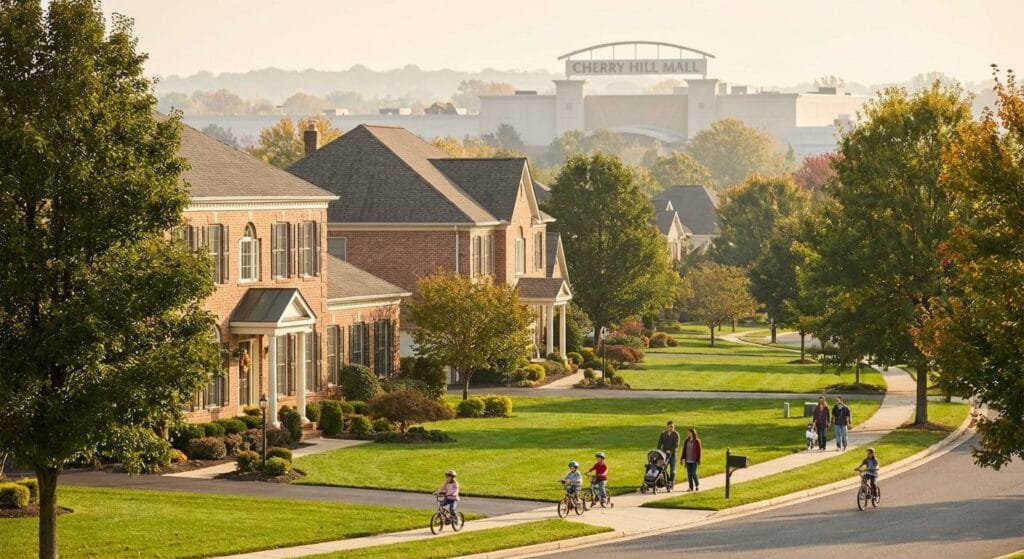
Cherry Hill has been ranked the top community in South Jersey for quality of life — and the data behind that designation is unusually compelling. The township’s public schools graduate 94% of students, compared to New Jersey’s 85% state average. A full 76% of residents own their homes, a figure that reflects deep community stability in a region where renting has become the norm for many suburban areas. Philadelphia’s Center City sits just 12 miles to the west and is reachable by PATCO rail in less than 25 minutes. And despite its suburban refinement, Cherry Hill remains meaningfully more affordable than the northern New Jersey communities that compete for the same professional-class households.
New Jersey’s complete relocation guide covers the full spectrum of Garden State living, but Cherry Hill deserves its own careful treatment — because this is a township with a distinct identity, a particular kind of suburban excellence, and a few logistical nuances that every incoming resident should understand before signing a contract or scheduling a truck.
Here is what you need to know at a glance:
Quick Answers
Average move cost (from Philadelphia): $1,200 – $2,400 (2BR apartment); $2,000 – $3,500 (3BR house)
Median home price: $435,000 – $450,000 (2026)
Median rent: $1,394 – $1,882/month
Property tax rate: 4.348 per $100 assessed value (2025); median bill ~$8,896/year
Philadelphia commute: 15–25 minutes via PATCO High-Speed Line
Best for: Families prioritizing school districts, Philadelphia-area professionals, homebuyers seeking suburban stability
Why People Are Moving to Cherry Hill
The movement toward Cherry Hill from Philadelphia and its surrounding suburbs follows a pattern that has become familiar to anyone tracking where mid-career professionals and young families actually choose to land. Philadelphia offers culture, density, and professional opportunity; Cherry Hill offers the infrastructure to raise a family without sacrificing convenient access to that city’s economy. That bargain — city proximity, suburban execution — explains why Cherry Hill’s homeownership rate has remained at 76% even as renting has grown across Camden County and the broader South Jersey region.
For households relocating from Philadelphia directly, the math is straightforward. A three-bedroom single-family home with a finished basement and a proper backyard in Cherry Hill typically costs between $400,000 and $550,000. A comparable property in Philadelphia’s most family-desirable neighborhoods — Chestnut Hill, Germantown, the Northwest — often runs higher, with the additional complications of city wage tax (3.75% for residents), school district uncertainty, and the urban logistics that come with raising children in a dense environment. Cherry Hill removes those complications. New Jersey has no city-level wage tax. The Cherry Hill school district is a known quantity with documented outcomes. The streets are quiet.
For households relocating from northern New Jersey — from the congested commuter suburbs of Bergen, Morris, or Essex counties — Cherry Hill offers a version of suburban life that costs considerably less and arrives without the psychological overhead of the New York City orbit. Median home prices in Cherry Hill run roughly $150,000 to $200,000 below comparable communities in Morris County, and commute costs shift dramatically when Philadelphia replaces Manhattan as the primary employment center.
The township also draws a meaningful number of retirees and empty-nesters from Philadelphia’s western suburbs in Pennsylvania — families from Havertown, Springfield, and Broomall who have discovered that crossing the Delaware River offers an upgraded school district (for grandchildren), lower overall housing costs, and access to the same restaurants, airports, and healthcare infrastructure they already depend on.
Cherry Hill’s Character: A Planned Suburb With a Particular Identity
Cherry Hill did not evolve organically from a colonial village or a mill town. It was, in the most deliberate sense of the phrase, invented — and understanding that origin explains the township’s character better than any demographic summary can.
The area was known as Delaware Township until 1961, when a resident vote of 5,201 to 3,700 approved a name change. The new name came from the Cherry Hill Inn, which developer Eugene Mori had built on a former cherry orchard owned by Abraham Browning in the 1950s. In the same year as the vote, Cherry Hill Mall opened — one of the first enclosed shopping malls on the East Coast, a landmark development that cemented the township’s identity as a suburban destination rather than simply a bedroom community. Mail had previously been routed through Haddonfield and Merchantville, a bureaucratic inconvenience that had slowed the township’s ability to attract residents and businesses. The name change and the postal independence that followed unlocked years of planned residential growth.
The result is a township that was designed for the family-centered suburban lifestyle rather than one that stumbled into it. Streets in Barclay Farm were laid out with cul-de-sacs and school proximity in mind. Green buffers were built between residential zones. The commercial corridors — Route 38, Route 70, Haddonfield Road — were kept separate from the residential fabric in ways that give the neighborhoods their characteristic quiet. This is not accidental. It is the product of mid-century planning executed with genuine competence, and it has aged remarkably well.
What Cherry Hill lacks in grit and urban texture, it compensates for in something harder to manufacture: functional community infrastructure. Parks are maintained, schools are staffed and funded, roads are in reasonable condition, and the retail ecosystem along the Route 70 corridor is among the most complete in South Jersey. For families who want suburban life to actually work the way suburban life is supposed to work, Cherry Hill is a legitimate answer.
Neighborhoods: Finding Your Fit in Cherry Hill
Cherry Hill is large — roughly 24 square miles with approximately 78,000 residents — and it contains multitudes. The neighborhoods vary meaningfully in character, price point, and school-zone assignment, and matching the right neighborhood to your household’s priorities is one of the most consequential decisions you will make during the relocation process.
Barclay Farm
Barclay Farm sits in the eastern portion of Cherry Hill and is consistently cited as the township’s most desirable neighborhood for families with school-age children. The area feeds into Joseph D. Sharp Elementary, which carries a state performance score of 86.95 — the highest-rated elementary school in the Cherry Hill district — and into Cherry Hill High School East. Parents who moved specifically to be in the Sharp Elementary zone are not unusual; real estate listings in Barclay Farm routinely feature the school assignment as a headline attribute.
The neighborhood itself is characterized by mid-century single-family homes on substantial lots, mature street trees, and the kind of block-association culture that keeps sidewalks shoveled and holiday decorations tasteful. Home prices in the Barclay Farm area range from approximately $370,000 to $639,000 depending on square footage, condition, and whether the property has been significantly renovated. The higher end of that range — renovated colonials with finished basements, updated kitchens, and expanded footprints — reflects genuinely competitive demand from buyers who understand the school-zone premium and are willing to pay it.
The Ashland PATCO station sits near the Barclay Farm and Springdale neighborhoods, placing Philadelphia’s 8th and Market Street station roughly 20 minutes away on the High-Speed Line. For dual-income households where one partner commutes to Center City, this is not incidental — it is often the deciding factor.
Springdale
Springdale occupies the central-eastern portion of Cherry Hill and shares much of Barclay Farm’s appeal without quite the same intensity of school-zone competition. Homes here tend toward Cape Cods, split-levels, and modest colonials built from the late 1950s through the 1970s — the kind of housing stock that offers genuine value for first-time buyers willing to undertake updates and that rewards patient sellers who have invested in their properties over time.
The neighborhood feeds into Cherry Hill East, which carries a state performance score of 69.71 and ranks in the 75th percentile statewide. The East High district designation is a meaningful draw for families, and Springdale buyers understand that they are purchasing into that school zone as much as they are purchasing a specific house. Prices in Springdale generally run $350,000 to $480,000, offering more accessible entry points than Barclay Farm while remaining solidly within Cherry Hill East territory.
Cherry Hill East Zone vs. Cherry Hill West Zone
The school-zone distinction between Cherry Hill East and Cherry Hill West is the single most discussed variable in Cherry Hill real estate, and for good reason. Cherry Hill High School East carries a summative state score of 69.71, placing it in the 75th percentile among all New Jersey high schools. Cherry Hill High School West’s score is 36.95, placing it at the 30th percentile. Both schools sit within the same district and share the same administrative structure, but their academic outcomes diverge in ways that are measurable and documented.
Neighborhoods in the East zone — including Barclay Farm, Springdale, and portions of Erlton South — command a premium over comparable properties in the West zone, and that premium has proven durable across multiple market cycles. Buyers with school-age children or who anticipate having them should treat zone assignment as a primary filter, not an afterthought. The Cherry Hill school district publishes zone maps on its website, and verifying zone assignment for any specific address before making an offer is straightforward and essential.
Erlton and Kingston Estates
For buyers whose budget caps out below the $350,000 threshold — or who prioritize lot size and quiet over top-ranked school zoning — Erlton and Kingston Estates offer legitimate alternatives within Cherry Hill proper. Erlton, one of the township’s earliest neighborhoods, contains some of its most architecturally interesting older housing stock, including period ranches and modest colonials that have appreciated steadily as the broader Cherry Hill market has tightened. Kingston Estates, in the southern portion of the township, offers larger lots and a somewhat more rural character than the densely developed central and eastern neighborhoods.
Both neighborhoods are worth evaluating seriously as value plays within the township — particularly for households whose children are already past the high school selection decision, or for buyers who plan to remain in a property long enough to benefit from the township’s overall market trajectory.
Schools: The Cherry Hill Distinction
The Cherry Hill Public Schools district is the primary reason families choose this township over the many comparable South Jersey suburbs available at similar price points. The district’s five-year graduation rate of 94.6% exceeds New Jersey’s state average of 85% by nearly ten percentage points — a gap that reflects sustained institutional investment rather than favorable demographics alone. Advanced Placement and International Baccalaureate enrollment reaches 54.4% of students, well above the state average of 35.9%, and dual enrollment in college coursework stands at 60.2%, more than double the state average of 26.9%.
These are not statistics that a good marketing team assembled from selective data. They appear in the New Jersey Department of Education’s School Performance Reports and are calculated using consistent methodology across all districts. For families who have spent time evaluating New Jersey’s school landscape — which spans from some of the nation’s best-funded suburban districts to genuinely troubled urban systems — Cherry Hill represents a demonstrably strong outcome at a price point that remains accessible relative to the best districts in Morris or Hunterdon counties.
Cherry Hill East and Cherry Hill West serve the high school population, with zone boundaries roughly dividing the township east to west. East’s performance advantage is real and persistent; the data is not ambiguous. For elementary and middle school, the district operates multiple schools across the township with varying performance levels. Sharp Elementary in the Barclay Farm zone is the district’s highest performer, and the Ashland station–adjacent neighborhoods that feed into it reflect a corresponding premium in home prices. Families serious about optimizing for educational outcomes within Cherry Hill should research elementary and middle school assignments specifically — not just the high school zone — before committing to a neighborhood.
Cherry Hill also sends meaningful numbers of graduates to selective New Jersey universities, including Rutgers and the New Jersey Institute of Technology, as well as to competitive out-of-state institutions. The district’s AP pass rates and college matriculation data have made it a reference point for families relocating from other states who want quantitative assurance about South Jersey school quality before they commit.
Cherry Hill’s Housing Market in 2026
Cherry Hill’s housing market has entered 2026 in a state of moderated competition following several years of intense seller-side conditions. The township’s median home price sits in the $435,000 to $450,000 range — a figure that represents a 4 to 5 percent increase over 2024 levels, consistent with the South Jersey regional forecast. Inventory has expanded modestly, providing buyers with slightly more leverage than the 2022 and 2023 peaks allowed, but the market remains competitive, with a Redfin Compete Score of 70 out of 100 indicating that well-priced homes in desirable zones continue to attract multiple offers.
The 76% homeownership rate in Cherry Hill is the structural foundation of this market’s stability. Unlike communities with high renter concentrations, Cherry Hill’s predominance of owner-occupied homes means that inventory tends to emerge from life transitions — upsizing, downsizing, estate sales, job relocations — rather than from investment cycles. This makes pricing relatively predictable and reduces the volatility that speculative markets introduce.
Within the township, the range of what your budget purchases varies considerably by zone and neighborhood. The $300,000 to $400,000 range yields dated but structurally sound colonials and ranches in Erlton and Kingston Estates, along with entry-level options in Springdale. The $400,000 to $500,000 range is where the Cherry Hill East zone becomes most accessible — solid colonials, updated kitchens, finished basements, and reasonable lot sizes. Above $500,000, you are looking at either premium renovated properties in Barclay Farm or newer construction in the township’s western sections, where lot sizes expand and the suburban character becomes more pronounced.
Rental options in Cherry Hill reflect the township’s homeownership-dominated character. One-bedroom apartments are available in the range of $1,394 to $1,882 per month, primarily in apartment complexes rather than the single-family homes that define most neighborhoods. For households not yet ready to purchase, the rental inventory is thinner and less geographically diverse than in urban or mixed-use markets — which is one more reason that most Cherry Hill residents ultimately buy.
The Financial Picture: Taxes, Income, and What Life Actually Costs Here
New Jersey’s property tax burden is among the highest in the country, and Cherry Hill is not exempt from that reality. The township’s 2025 general property tax rate is 4.348 per $100 of assessed value, with the median tax bill running approximately $8,896 per year. On a $435,000 home, buyers should budget roughly $10,000 to $11,000 annually in property taxes, depending on assessment and exemption status. That is a meaningful carrying cost — one that is included in mortgage calculations and affects affordability calculations significantly.
The property tax breaks down across county (approximately $2,149 per year for the average household), school (approximately $6,140), and municipal (approximately $1,585) components. The school component is the dominant driver, which is simultaneously the reason taxes are high and the reason the school district performs the way it does. Cherry Hill property owners are, in effect, funding a school system that ranks in the top half of New Jersey’s 648 districts — and getting measurable outcomes for that investment.
Against this tax burden, Cherry Hill households carry the income to absorb it. The township’s median household income is $104,249, which compares favorably to New Jersey’s overall median and reflects the professional, dual-income character of most Cherry Hill households. Analysts estimate that a single individual needs approximately $66,400 annually for comfortable Cherry Hill living, while a family of four should plan on $73,080 or more. These figures account for housing, taxes, transportation, food, healthcare, and discretionary spending at a level consistent with the township’s lifestyle expectations.
New Jersey does impose a state income tax, with rates ranging from 1.4% to 10.75% depending on income. For households earning $100,000 to $150,000 — a typical Cherry Hill range — the effective state income tax rate falls in the 6% to 7% range. This stands in contrast to Philadelphia’s 3.75% city wage tax, which Cherry Hill residents do not pay, and it is worth noting that the income tax is offset by the absence of city-level taxation for those who have relocated from Philadelphia proper.
What It Costs to Move to Cherry Hill
Moving costs to Cherry Hill vary significantly based on origin point, home size, and the time of year. The cross-river move from Philadelphia is the most common route, and it presents some specific logistical considerations worth understanding before you begin requesting quotes.
A local move from Philadelphia to Cherry Hill — crossing the Ben Franklin or Walt Whitman Bridge and settling into a Cherry Hill neighborhood — typically runs $1,200 to $2,400 for a two-bedroom apartment and $2,000 to $3,500 for a three-bedroom house. Despite the short distance of approximately 12 miles, this is technically an interstate move (Pennsylvania to New Jersey), which means it is governed by different regulatory rules than a purely local move within a single state. Local NJ movers charge in the range of $120 to $150 per hour, with fuel surcharges, tolls, and any stairs or elevator delays adding to the final bill.
Moves from New York City are longer and proportionally more expensive. Expect $2,500 to $4,500 for a two-bedroom and $3,500 to $6,000 for a three-bedroom when relocating from the five boroughs, depending on origin borough, floor access, parking restrictions, and season. Summer moves (June through August) and end-of-month moves command premium rates; scheduling a mid-month, mid-week move in October or April can reduce costs by 15 to 20 percent.
Moves from other New Jersey cities follow the general logic of distance and home size. From Newark, which is covered in depth by the Nelson Westerberg Newark guide, a Cherry Hill move runs roughly $1,500 to $3,000 for a typical two-bedroom apartment. From Princeton — covered in detail in the Nelson Westerberg Princeton guide — similar moves run $1,200 to $2,500.
Storage needs are relatively uncommon in Cherry Hill compared to urban moves, given the abundance of basement and garage space in the township’s single-family homes. But if your move involves a gap between move-out and move-in dates, local storage facilities along Route 70 and Route 38 offer options at reasonable rates.
Choosing a Professional Moving Company
The Cherry Hill move is deceptively straightforward on paper — a short distance, manageable distances between loading and delivery — and that simplicity sometimes leads households to underinvest in their mover selection process. A few hours of careful research at this stage will reliably save you from the scenarios that generate the moving industry’s most persistent complaints.
What You’re Actually Paying For
Professional moving costs cover more than fuel and labor. What distinguishes a legitimate, licensed mover from a weekend truck rental or an unlicensed operation is the infrastructure that surrounds the physical work: trained crews who handle furniture without damaging walls or floors, proper equipment (dollies, furniture pads, stair climbers, floor runners), liability insurance that actually covers your belongings, and an organizational system that ensures nothing is left behind, misrouted, or delivered to the wrong room.
For a Cherry Hill move from Philadelphia or another nearby point, a professional crew typically takes four to six hours for a two-bedroom apartment and six to nine hours for a three-bedroom house, including travel. The hourly rate covers all of this, but only if the mover you hire actually employs trained staff, carries valid insurance, and operates legally. Unlicensed operations that advertise on classified sites often cut all of these corners, and their pricing reflects it right up until something goes wrong.
The Estimate Game
Moving estimates come in three forms, and the differences matter considerably. A non-binding estimate is the weakest form of protection — it tells you approximately what a mover expects to charge, but the final bill can legally exceed that figure. A binding estimate locks in the price based on the scope of work described; if the job takes longer or the truck is heavier than estimated, you still pay the agreed amount. A binding not-to-exceed estimate is the consumer-friendliest option: if the actual job costs less than the estimate, you pay the lower amount, and if it costs more, the cap holds. For interstate moves — including Philadelphia-to-Cherry Hill — federal regulations require that movers offer binding estimates on request, and consumers are well-advised to request them.
Be cautious about estimates that arrive significantly below competitors’ prices without explanation. Low-ball estimates are the entry point for bait-and-switch tactics in the moving industry: a mover loads your belongings, then presents a revised, inflated bill at delivery and refuses to unload until you pay. This tactic is documented in consumer complaint databases and is more common with unlicensed operators than legitimate companies.
Separating Legitimate Movers from Problems
New Jersey requires all intrastate household goods movers to hold a Public Mover License from the New Jersey Division of Consumer Affairs’ Regulated Business Unit. Interstate movers — including those handling the Philadelphia-to-Cherry Hill crossing — must additionally hold a USDOT number issued by the Federal Motor Carrier Safety Administration. Both of these identifiers are public and searchable.
Before hiring any mover for your Cherry Hill relocation, verify their NJ Public Mover license status at the New Jersey Division of Consumer Affairs website (njconsumeraffairs.gov) and their USDOT registration through the FMCSA’s SAFER database (safer.fmcsa.dot.gov). Legitimate companies will readily provide both numbers. A mover who deflects or cannot produce them should be crossed off your list immediately, regardless of how competitive their price looks. The New Jersey Division of Consumer Affairs maintains a complaint history database as well, which can surface patterns of consumer problems before they become your problem.
Understanding What’s Protected
Your moving company’s liability for your belongings is not the same as your belongings’ actual value, and many households discover this distinction too late. Under the federal minimum standard — released value protection — movers are liable for $0.60 per pound per article. A 50-pound television damaged beyond repair generates a payout of $30. This is the default protection included in most quotes and is essentially no protection at all for items with significant market or sentimental value.
Full value protection requires the mover to repair, replace, or compensate you for the actual replacement cost of any damaged item. It costs more — typically calculated as a percentage of your declared shipment value — but it is the only coverage that provides meaningful financial protection for a household with normal belongings. For a Cherry Hill move involving furniture, electronics, and household goods of real value, full value protection is worth evaluating seriously before you sign.
Your homeowners or renters insurance policy may also provide coverage for goods in transit, which can reduce or eliminate the need to purchase a mover’s full value protection separately. Check with your insurance provider before your move date, not after.
Cherry Hill-Specific Logistics: HOA Moves, PATCO Coordination, and Cross-River Execution
Cherry Hill’s predominantly single-family suburban character means that most moves avoid the elevator waits and narrow-hallway challenges of urban high-rise relocations. But several logistical elements specific to the township deserve attention.
Many of Cherry Hill’s planned communities — particularly the condominium and townhouse developments built in the 1980s and 1990s — operate under HOA governance that imposes specific rules on moving activity. Common requirements include advance notice of 30 to 60 days before your move date, submission of a Certificate of Insurance (COI) naming the HOA as an additional insured party, restrictions on moving hours (typically 8 a.m. to 5 p.m. on weekdays, sometimes restricted on weekends), floor-protection requirements for common hallways, and elevator reservation windows in properties with elevator access. Your mover should be familiar with COI preparation — if they are not, that is a meaningful signal about their experience with residential suburban moves in this region.
For households moving to Cherry Hill from Philadelphia via PATCO-proximate neighborhoods, coordinating vehicle logistics around the Delaware River crossings requires planning that is easy to overlook when you are focused on the move itself. The Ben Franklin Bridge and the Walt Whitman Bridge both experience significant morning rush congestion, and a moving truck attempting a 9 a.m. departure from Philadelphia’s Center City toward Cherry Hill on a weekday will encounter delays that push the schedule. The simplest solution is obvious but frequently ignored: schedule loading in Philadelphia for early morning (7 a.m. departure) or mid-morning (10 a.m., after peak rush), and confirm with your mover that they are accounting for bridge crossing time in their labor estimate.
Why Nelson Westerberg for Your Cherry Hill Move
Cherry Hill’s combination of suburban HOA logistics, cross-river coordination from Philadelphia, and the precise neighborhood-by-neighborhood character differences in the township make local expertise genuinely valuable — not just in the abstract sense that any move benefits from experienced movers, but in the specific sense that Cherry Hill presents logistical variables that a generic national company’s dispatch center in another time zone will not anticipate.
Nelson Westerberg’s teams working the Philadelphia–South Jersey corridor understand the Cherry Hill HOA landscape, carry the insurance documentation that managed communities require, know the Ben Franklin and Walt Whitman bridge schedules, and have completed enough Barclay Farm, Springdale, and Cherry Hill Mall-area moves to know where trucks can park, which streets have access restrictions, and how to protect the hardwood floors that appear in nearly every mid-century Cherry Hill colonial. That local knowledge compresses the time required and reduces the probability of the avoidable complications that drive moving-day stress.
Career and Job Market: The Philadelphia Orbit
Cherry Hill’s employment story is inseparable from Philadelphia’s. The township functions as a residential node within the broader Philadelphia metropolitan labor market, and the majority of Cherry Hill’s working residents are employed somewhere other than Cherry Hill itself — primarily in Center City Philadelphia, the Philadelphia suburbs, and the South Jersey healthcare and professional-services corridor that runs along Routes 38 and 70.
Philadelphia’s economy has diversified meaningfully over the past decade, with healthcare, education, financial services, and an emerging technology sector providing stable professional employment across income levels. The major healthcare systems — Penn Medicine, Jefferson Health, Temple Health, and Children’s Hospital of Philadelphia — collectively employ tens of thousands of professionals, many of whom have discovered that Cherry Hill’s PATCO access makes it a practical home base even for roles that require Center City presence. Cooper University Health Care, based in Camden directly across the Delaware River from Philadelphia, is ranked among Forbes’ best large healthcare employers in New Jersey and employs a substantial number of Cherry Hill residents.
The local South Jersey employment ecosystem along Routes 38 and 70 includes financial services (TD Bank has significant operations in Cherry Hill, ranking among Forbes’ best large employers), law firms (Flaster Greenberg, Duane Morris, Dilworth Paxson), and professional services firms that serve both the Philadelphia metro and the standalone South Jersey market. The Route 38 and Route 70 corridors connecting Cherry Hill to Mount Laurel, Marlton, and Voorhees host a full professional-services ecosystem that reduces the need for Philadelphia commuting for many roles.
For remote workers, Cherry Hill offers a quality-of-life argument that has become more relevant as location flexibility has increased. The combination of spacious homes, excellent schools, and PATCO access to Philadelphia’s restaurant and cultural life — when you choose to use it — makes the township an unusually well-rounded option for households where one or both partners work from home but value proximity to urban infrastructure.
Culture, Recreation, and Daily Life
Cherry Hill’s reputation as a purely residential suburb undersells what the township actually offers as a place to live day-to-day. The combination of Cooper River Park, Cherry Hill Mall, and the dining corridor along Route 70 creates a lifestyle infrastructure that handles most of what residents need without a trip across the river.
Cooper River Park anchors the township’s outdoor recreation, and it is a genuinely impressive resource for a suburban county park. The 346-acre park runs along the Cooper River through Cherry Hill, Pennsauken, Collingswood, and Haddon Township, offering a 2000-meter rowing course used by competitive clubs and a Camden County Boathouse, sailing and kayaking from the Cherry Hill Yacht Club, 3.8 miles of bike paths around the perimeter, a world-class children’s playground following a $2.5 million upgrade, tennis courts, softball fields, picnic facilities, a dog park, and — as of 2025 — a newly opened 2.9-mile water trail along Evans Pond for kayaking and canoeing. Cooper River is not a park that residents tolerate; it is one they actively use, and it is one of the strongest arguments for Cherry Hill that residents make to people considering the move.
Cherry Hill Mall, which opened in 1961 as one of the East Coast’s first enclosed shopping malls, has been renovated and repositioned into a contemporary retail and dining destination rather than a relic of the mall era. The Mall contains full-service restaurants alongside national retail, and the surrounding Route 70 commercial corridor extends the dining and shopping options considerably. For a township of 78,000 people, the retail ecosystem is remarkably complete — residents rarely need to leave Cherry Hill for everyday needs.
The dining scene reflects Cherry Hill’s diverse professional population. The Route 70 corridor offers a genuine range, from family-style restaurants that have been institutions for decades to newer arrivals serving Korean, Indian, Mexican, and Mediterranean cuisine. The township does not have the concentrated neighborhood dining culture of a Philadelphia row-house block or a Manhattan side street — it’s spread across commercial corridors in the way South Jersey suburban dining is spread — but it has enough quality and variety to satisfy residents who care about food without requiring a trip to Philadelphia for every interesting meal.
The Commute Reality
Cherry Hill’s commute story has two chapters, and both are worth reading carefully.
The PATCO High-Speed Line is the better chapter. The Ashland station, near Barclay Farm and Springdale in Cherry Hill’s eastern section, and the Woodcrest station in Cherry Hill’s western section both provide direct service to Philadelphia’s 8th and Market Street station. The trip takes 15 to 25 minutes depending on the station and service pattern. PATCO runs trains at high frequency during peak commute hours, with service extending through the evening — making it genuinely viable for the kind of irregular professional schedules that downtown Philadelphia employment involves. For households with one partner commuting to Center City two or three days per week in a hybrid arrangement, the Ashland or Woodcrest stations are within easy driving or cycling distance, and the parking situations at both are manageable compared to the congestion patterns at major NJ Transit rail stations.
The driving commute is the other chapter, and it requires honest treatment. Cherry Hill to Philadelphia via I-76 or Route 30 across the Ben Franklin Bridge or Walt Whitman Bridge covers roughly 12 miles — a distance that sounds trivial until you encounter it at 8:15 a.m. on a Tuesday in January. The Delaware River crossings become congested during peak hours, and the Philadelphia approaches through I-76 (Schuylkill Expressway) and I-95 carry their own complications. Realistic door-to-door driving time from central Cherry Hill to Center City Philadelphia during peak commute hours runs 30 to 50 minutes. Outside peak hours, the same journey takes 20 to 30 minutes. For drivers commuting in the opposite direction — from Cherry Hill toward Mount Laurel, Marlton, or other South Jersey employment centers — the commute is almost universally easier, with reasonable highway access on Routes 295, 38, and 70.
Cherry Hill also lies approximately 45 minutes from the New Jersey Shore, positioning it as a legitimate year-round community for residents who value beach access during summer months. The shore connection — a reality of South Jersey suburban culture that outsiders sometimes underestimate — is a quality-of-life variable that Cherry Hill residents mention with some regularity when explaining why they chose South Jersey over northern NJ.
For a full picture of what living in New Jersey across different regions looks like, the Nelson Westerberg New Jersey guide covers the state’s commute geography and regional tradeoffs in depth.
Frequently Asked Questions About Moving to Cherry Hill, NJ
How much does it cost to move from Philadelphia to Cherry Hill, NJ?
A professional full-service move from Philadelphia to Cherry Hill typically costs between $1,200 and $2,400 for a two-bedroom apartment and $2,000 to $3,500 for a three-bedroom house. Despite the short distance of approximately 12 miles, the move crosses state lines, which makes it an interstate move governed by federal regulations rather than purely local pricing. Expect additional charges for fuel surcharges ($75 to $150), bridge tolls, and any specialty services like piano moving, packing, or temporary storage.
What salary do you need to live comfortably in Cherry Hill, NJ?
A single person needs approximately $66,400 per year to live comfortably in Cherry Hill, while a family of four should plan on $73,080 or more. Cherry Hill’s median household income is $104,249, reflecting its predominantly professional and dual-income character. The primary cost drivers are housing (median home prices of $435,000 to $450,000) and property taxes (approximately $8,896 to $10,671 per year on an average-assessed home). New Jersey’s state income tax, which ranges from 1.4% to 10.75%, must also be factored into financial planning.
Is Cherry Hill in the Cherry Hill East or Cherry Hill West school zone?
Cherry Hill is divided between the Cherry Hill East and Cherry Hill West high school zones, with boundaries roughly splitting the township east to west. Cherry Hill East (state performance score: 69.71, 75th percentile statewide) is generally considered the stronger school. Neighborhoods like Barclay Farm, Springdale, and portions of Erlton fall within the East zone. The Cherry Hill school district publishes zone maps online, and verifying zone assignment for a specific address before purchasing is essential, as zone assignment directly affects property values.
What are the best neighborhoods in Cherry Hill for families?
Barclay Farm is consistently considered Cherry Hill’s most family-oriented neighborhood, with access to Joseph D. Sharp Elementary (the district’s highest-rated elementary school) and Cherry Hill High School East. Springdale offers similar school-zone access with more affordable entry points. For families prioritizing lot size and a quieter setting, Kingston Estates in the township’s southern section offers larger properties at lower price points. All Cherry Hill neighborhoods offer the township’s characteristic suburban safety, park access, and proximity to Cooper River Park.
How does Cherry Hill compare to other South Jersey suburbs?
Cherry Hill is generally considered the top community in South Jersey for overall quality of life, balancing strong schools, high homeownership rates, excellent retail and dining infrastructure, and PATCO rail access to Philadelphia. Comparable communities include Voorhees, Marlton, and Medford — each of which offers some of Cherry Hill’s attributes at different price points and with different Philadelphia access profiles. Cherry Hill’s combination of PATCO connectivity and district-level school performance is difficult to replicate elsewhere in the South Jersey market, which explains the persistent premium on Cherry Hill real estate relative to similar suburban townships.
Does Cherry Hill have public transit to Philadelphia?
Yes. The PATCO High-Speed Line connects Cherry Hill directly to Philadelphia via two stations: Woodcrest station (serving Cherry Hill’s western neighborhoods) and Ashland station (serving the eastern neighborhoods near Barclay Farm and Springdale). Both stations provide direct service to Philadelphia’s 8th and Market Street station in 15 to 25 minutes, with frequent peak-hour service and reasonable parking. PATCO also connects to Center City’s regional transit hub, providing connections to SEPTA’s broader network for destinations throughout Philadelphia.
What are property taxes like in Cherry Hill, NJ?
Cherry Hill’s 2025 general property tax rate is 4.348 per $100 of assessed value, and the median annual tax bill is approximately $8,896. On a home purchased at Cherry Hill’s median price of $435,000 to $450,000, buyers should budget $10,000 to $11,000 per year in property taxes. The school district component accounts for the largest share of the bill — approximately $6,140 per year for the average household — which reflects the district’s funding and its documented academic outcomes.
Conclusion: Cherry Hill Is a Choice Worth Making
Cherry Hill is the kind of community that earns its reputation through operational excellence rather than marketing. The schools graduate students at rates well above state averages. The parks are maintained. The PATCO line runs on time. The housing stock is solid, the neighborhoods are quiet in the way that families want quiet, and Philadelphia — with all of its cultural, professional, and culinary resources — sits 25 minutes away by train on days when you want it.
The trade-off is real and should be named honestly: New Jersey’s property tax burden is significant, and Cherry Hill’s median tax bill of roughly $9,000 per year is a carrying cost that belongs in every financial calculation before you close on a home. For households earning the township’s median income of $104,000, that cost is manageable and arguably represents good value for the school and park infrastructure it funds. For households at the lower end of the affordability range, it is a number that deserves serious attention.
For most families and professionals considering South Jersey — whether arriving from Philadelphia, from northern New Jersey, or from out of state — Cherry Hill represents a version of suburban life that is hard to improve on at the price points available here in 2026. The township has been getting this right for sixty years. That record of institutional competence is not something you find in every market, and it is worth paying for.
Related Articles
New York City vs. Austin (2026): What Your Paycheck Really Buys
Few city comparisons produce a gap as wide as New York City versus Austin. By one widely cited 2026 estimate, it takes roughly $11,500 a month in New York to sustain the same standard of living that $6,900 buys in Austin — a difference so large it reshapes not just a budget but a life. […]
Read MoreChicago vs. Charlotte (2026): The Queen City at a Fraction of the Cost
For a Chicago household weighing a move south, Charlotte presents an unusually clean comparison: a real city, with a genuine corporate economy and four mild seasons, at a fraction of Chicago’s cost — and, most strikingly, a fraction of its property-tax burden. A Chicago homeowner paying the metro’s effective property-tax rate near 1.98% on a […]
Read More

Table of Contents

Atlas Van Lines, Inc. U.S. DOT No. 125550 (TM & © 2026 AWGI LLC.) | G.P.S.C. 4917 | IL C.C. 4246 | NJPC 00104 | Cal-T 110193
© 2026 Nelson Westerberg, Inc. All Rights Reserved Worldwide.