Moving Guide to Frisco, TX (2026): North Dallas’s Boomtown

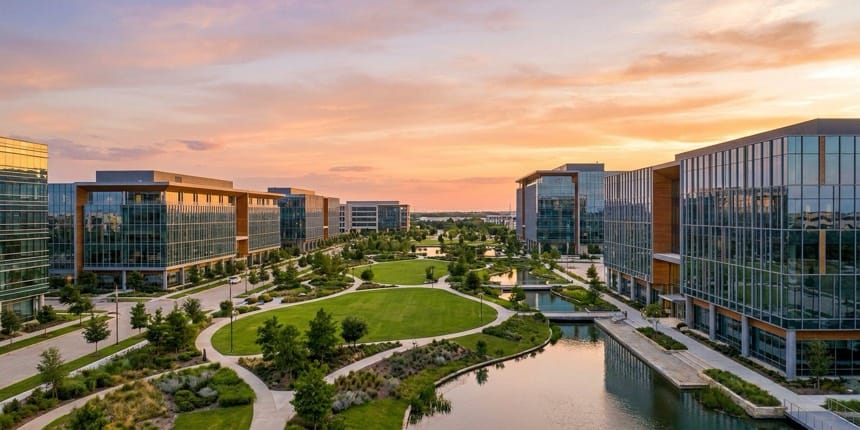
Few American cities have grown like Frisco. A town of 33,000 at the turn of the millennium, it crossed 200,000 by 2020 and now numbers around 250,000 — a more than 500% increase in two decades that ranks it among the fastest-growing cities in the country. That growth isn’t accidental. Frisco has become a magnet for corporate headquarters fleeing high-cost states, the home of the PGA of America and the Dallas Cowboys’ world headquarters, and one of the most sought-after suburbs in the Dallas–Fort Worth metroplex for its master-planned communities and top-rated schools. If you’re considering the move, this guide covers what you need to know.
Here’s what you need to know at a glance:
Quick Answers
- Median home price: ~$740,000 (single-family ~$776,000; luxury communities $1.2M–$1.8M+)
- Average long-distance move cost: $5,000 – $14,000 (2–4 bedroom home, from out of state)
- Schools: Frisco ISD — among the highest-rated districts in Texas, ~98% graduation rate
- State income tax: 0% (Texas)
- Best for: Corporate transferees, executives, families prioritizing schools, and buyers seeking new master-planned communities
This guide takes a practical approach to relocating to Frisco — why the city has boomed, how its master-planned neighborhoods differ, the school district that drives so many family moves, the cost of living, the honest trade-offs, and how to plan a long-distance move that arrives smoothly. For the wider region, see our Texas moving guide, Dallas moving guide, and our guide to neighboring Plano.
Why People Are Moving to Frisco
Frisco’s growth rests on a powerful combination: a flood of corporate jobs, nationally recognized schools, master-planned communities built for modern family life, and the financial advantages of Texas. Dallas–Fort Worth has added more corporate headquarters than any other U.S. metro since 2018, and Frisco has captured an outsized share. Public Storage announced a relocation of its corporate headquarters from California to Frisco; McAfee, TIAA, Toshiba Global Commerce Solutions, and a steady stream of others have moved or expanded here. The result is a deep, growing job base in technology, finance, and corporate operations right in the city or a short drive away in the broader Platinum Corridor.
The financial logic mirrors the rest of the Texas relocation story. Texas levies no state income tax, which means a relocating executive or dual-income household keeps far more of its earnings than it would in California, Illinois, or the Northeast — often enough to offset a meaningful share of Frisco’s premium home prices within a few years. The schools and quality of life seal the decision: Frisco Independent School District is among the highest-rated in Texas, and the city’s master-planned communities offer the parks, trails, amenities, and new construction that relocating families increasingly expect.
Then there’s the sheer spectacle of the place. The PGA of America moved its headquarters to Frisco in 2022, anchoring a 660-acre development with two championship golf courses and a 500-room Omni resort. The Dallas Cowboys built The Star — a 91-acre headquarters and practice facility wrapped in a mixed-use district of shopping, dining, and the Omni Frisco Hotel. A $550 million Universal Kids Resort is opening in 2026. For a city of its size, Frisco offers an unusual concentration of destinations, employment, and amenities that few suburbs anywhere can match.
The Frisco Phenomenon: Corporate Headquarters and Sports
Frisco’s identity has been shaped by an extraordinary run of corporate and sports investment. On the corporate side, the city sits within the broader North Platinum Corridor that has drawn headquarters relocations from high-cost states at a remarkable pace — Public Storage from California being among the most prominent, joined by McAfee, TIAA, Toshiba Global Commerce Solutions, Boingo, Ruiz Foods, and many others. Dallas–Fort Worth led the nation with at least 11 new headquarters arrivals in a single recent year, many from Los Angeles, the Bay Area, New York, and Chicago, and Frisco has been one of the metro’s biggest winners. For a relocating professional, that concentration means a deep and growing job market without the commute into central Dallas.
On the sports-and-lifestyle side, Frisco has become a genuine destination. The Dallas Cowboys’ world headquarters at The Star is the centerpiece — a 91-acre campus with a 12,000-seat indoor stadium, a sports-medicine institute, and a thriving district of restaurants and shops anchored by the Omni Frisco Hotel. The PGA of America’s headquarters and its 660-acre Fields development bring championship golf, a luxury Omni resort, and a conference center. FC Dallas plays at Toyota Stadium, and the city’s reputation as “Sports City USA” is well earned. The arriving $550 million Universal Kids Resort adds a major family attraction. For residents, this means an enormous range of dining, entertainment, and recreation within their own city — a quality-of-life draw that complements the jobs and schools.
The Best Neighborhoods in Frisco
Frisco is a city of master-planned communities, each with its own character, amenities, and price tier. Understanding them is the key to a successful home search.
At the luxury end, Fields in Frisco is the marquee development — a 2,545-acre master-planned community built around the PGA of America headquarters, with homes starting around $1.3 million, eight premium builders, championship golf, the Omni PGA Frisco Resort, and more than 25 miles of trails. Starwood is one of Frisco’s most established luxury enclaves, with a median single-family price near $1.77 million, while Newman Village offers gated, Mediterranean-styled luxury with strong security and prestige.
In the upper-mid tier, Phillips Creek Ranch is among Frisco’s most popular master-planned communities — extensive amenities, walking trails, a fitness center, and an active community calendar, with homes typically running $750,000 to $1.2 million and a strong family appeal. Windsong Ranch is known for its resort-style amenities, including a celebrated lagoon, and draws families wanting a vacation-like community feel. The Trails offers master-planned outdoor amenities, and Chapel Creek delivers a quieter luxury.
For relative value within an expensive city, Panther Creek and the more established central Frisco neighborhoods offer lower entry points, and townhomes (median near $515,000) provide an alternative for buyers who want the Frisco address and schools without a single-family luxury price. A relocation specialist or local agent who knows the master-planned communities can be invaluable, since each has its own builder roster, amenity package, and school-zone assignment.
| Community | Character | Typical price range | Best for |
|---|---|---|---|
| Fields in Frisco | New luxury, PGA, golf | $1.3M+ | Executives, luxury buyers |
| Starwood | Established luxury | ~$1.0M–$2.5M | Executives, prestige |
| Phillips Creek Ranch | Amenity-rich, family | $750K–$1.2M | Families |
| Windsong Ranch | Resort-style, lagoon | $700K–$1.3M | Families |
| Newman Village | Gated luxury | $900K–$2M | Privacy, prestige |
| Panther Creek / central | More accessible | $500K–$750K | Value within Frisco |
Data: local market reports, 2026.
Schools and Family Life
For most families relocating to Frisco, schools are the central draw — and Frisco Independent School District delivers. Frisco ISD serves nearly 67,000 students across some 77 schools and ranks among the highest-rated districts in Texas, with roughly a 98% graduation rate and dozens of National Merit semifinalists each year. Highly regarded high schools like Reedy, Lebanon Trail, and others earn top marks, and the district has built a reputation for academics, athletics, and the kind of well-resourced programs that draw families willing to pay Frisco’s home premium.
Frisco ISD’s approach of building numerous smaller high schools, rather than a few large ones, is a distinctive feature — it keeps schools community-scaled even as the city has exploded in size, and it means school-zone assignment matters in a home search, since boundaries shift with growth. Families relocating mid-year should confirm the current attendance zone for any home they consider, as Frisco ISD periodically redraws boundaries to accommodate new schools and neighborhoods. Beyond academics, the city’s enormous investment in parks, trails, libraries, and recreation — combined with the sports and entertainment destinations — makes Frisco one of the most family-oriented cities in the metroplex.
Cost of Living and the Texas Tax Advantage
Frisco is a premium suburb, and its home prices reflect that — the median sits near $740,000, well above the Texas and national averages, and the luxury master-planned communities climb past a million. For households relocating from California or the Northeast, though, the comparison still frequently favors the move: a Frisco luxury home that lists around $1.2 million would command well over two million in comparable Bay Area or coastal suburbs, and Texas’s zero state income tax adds savings that compound year after year — particularly meaningful for the high-earning corporate professionals and executives who make up much of Frisco’s inbound population.
The honest counterweight, as throughout Texas, is property tax. Rates run higher than the national average, and on a higher-value Frisco home the annual bill is substantial — it should be built into any cost comparison rather than overlooked because “Texas has no income tax.” Even with that adjustment, the total tax-and-housing picture typically favors Frisco for relocating high earners, whose income is untaxed while only their spending and property are. Frisco is not a budget destination; it’s a premium one, and the buyers it attracts are generally trading high-cost-state housing and taxes for a newer, larger home, top schools, and no state income tax.
Daily Life, Climate, and Getting Around
Daily life in Frisco is comfortable, amenity-rich, and car-oriented. The city’s master-planned design means most neighborhoods come with their own parks, trails, pools, and gathering spaces, and the major retail and dining destinations — The Star District, Stonebriar Centre, the Rail District in historic downtown Frisco, and the developments around the PGA and Fields — give residents an unusual amount to do without leaving the city. The Dallas North Tollway is the main artery connecting Frisco to the rest of the metroplex and downtown Dallas, roughly 30 miles south.
The climate is classic North Texas: hot summers with extended triple-digit stretches from June through September that make air conditioning essential and shift outdoor life toward mornings and evenings, paired with mild winters that rarely bring sustained cold. The other seasons are pleasant. As with the rest of suburban Texas, Frisco is built for cars — there’s limited public transit, and most residents drive for daily errands and commutes. The trade most families happily make is a hot summer for a mild winter, more space, and the absence of a state income tax. Commutes within Frisco and to nearby employment corridors are generally manageable, though the Dallas North Tollway can be heavy at peak hours as the area continues to grow.
Frisco vs. Plano, McKinney, and the Other North Dallas Suburbs
Relocating families often weigh Frisco against its neighbors, and the differences are real. Plano, immediately south, is the more established option — a mature, fully built-out suburb with the Toyota and Texas Instruments corporate corridor, top Plano ISD schools, and the amenities of Legacy West, generally at home prices somewhat below Frisco’s newest luxury communities. Families who want a settled, convenient suburb with the shortest commute to the Legacy employers often choose Plano; those who want the newest construction, master-planned amenities, and the buzz of Frisco’s growth choose Frisco. Our Plano moving guide covers that option in depth.
McKinney, to the northeast, offers more square footage per dollar and a charming historic downtown, appealing to families prioritizing value and character. Allen, between Plano and McKinney, splits the difference with strong schools and a more accessible price point. Prosper and Celina, north of Frisco, are the newer frontier — rapidly growing, with newer homes and more land, drawing families willing to trade a longer commute for space and value.
Frisco’s distinct edge is the combination of brand-new master-planned communities, the destination amenities (PGA, the Cowboys’ Star, the coming Universal resort), and Frisco ISD’s reputation — a package that commands a premium but delivers a particular kind of modern, amenity-rich suburban life. A relocation specialist who knows North Dallas can help weigh commute, schools, price, and community feel across these options to find the right fit for your family.
Timing Your Move and the First 90 Days
The strongest interstate moves begin six to eight weeks ahead, which gives you time to secure a reputable mover before peak-season calendars fill, declutter so you aren’t shipping what you won’t keep, and handle the administrative side without a scramble. New Texas residents have 30 days to obtain a Texas driver’s license and 90 days to register a vehicle after establishing residency, and because Texas has no state income tax, there’s no state return to file — one of the simpler aspects of relocating from a high-tax state.
In the first weeks, plan to establish utilities before move-in, update your address with the USPS and your bank and employer, register to vote, and — for families — handle school enrollment early, confirming the current Frisco ISD attendance zone for your specific address since boundaries shift as the district grows. Frisco’s desirable homes and rentals move quickly, so having documentation ready and financing pre-approved matters. The flip side of Texas’s tax structure worth planning for is the property-tax and homestead-exemption process, which is how the state funds itself locally and which you’ll handle in your first year. Beyond the paperwork, the early weeks are when the payoff becomes tangible — a newer, larger home, top schools, world-class amenities, and a paycheck no longer reduced by state income tax. Households that plan the logistics in advance get to enjoy that rather than scramble through it.
What to Know Before You Commit
The trade-offs are worth naming. Frisco is expensive — among the priciest suburbs in the metroplex — and the rapid growth has kept home prices climbing, so buyers should be prepared for a premium and, in the most desirable communities, competition for homes. The same explosive growth that built Frisco’s amenities has also brought construction, traffic on the Dallas North Tollway, and the periodic school-rezoning that comes with a district adding campuses to keep pace. Newcomers should confirm school zones carefully rather than assuming a neighborhood’s current assignment is permanent.
Summers are hot and long, which suits some better than others, and Frisco’s car-dependent, master-planned layout — while convenient — can feel less organic than an older, established town to those coming from walkable urban neighborhoods. None of these outweigh the case for the families and professionals Frisco attracts, but understanding them in advance helps set expectations for a smooth transition.
Things to Do and Entertainment in Frisco
Few suburbs offer the sheer density of destinations that Frisco does, and for many relocating families it’s a genuine quality-of-life draw. The Dallas Cowboys’ Star District anchors the entertainment scene — beyond the team’s headquarters and the 12,000-seat Ford Center, it’s a year-round dining and shopping destination with the Omni Frisco Hotel at its center. The PGA of America development brings two championship golf courses, the Omni PGA Frisco Resort, and a steady calendar of professional golf events, including major championships slated for the coming years. Toyota Stadium hosts FC Dallas soccer and the National Soccer Hall of Fame.
For families, the options keep expanding. The arriving Universal Kids Resort — a $550 million theme park designed for younger children, opening in 2026 — is poised to become a marquee family attraction and a draw for the entire region. The Rail District in historic downtown Frisco offers a walkable contrast to the master-planned developments, with local restaurants, breweries, and shops in a restored historic setting. Stonebriar Centre provides major retail, and the city’s extensive parks, trails, and recreation centers round out daily life.
This concentration means Frisco residents rarely need to leave the city for entertainment, dining, or recreation — a meaningful convenience in a metro as spread out as Dallas–Fort Worth. For relocating families weighing suburbs, the combination of professional sports, championship golf, a coming theme park, major retail, and a historic downtown gives Frisco an entertainment profile that few suburbs anywhere can match, and it’s part of why the city has become a destination as much as a place to live.
Planning Your Move to Frisco
A move to Frisco from out of state is a long-distance relocation, and the quality of your moving company shapes the entire experience. When a furnished family home — often a substantial one, given Frisco’s housing — travels hundreds or thousands of miles, professional packing, an accurate inventory, transit visibility, and a single accountable point of contact are what separate a smooth arrival from weeks of recovering from damage and delay.
This is the work Nelson Westerberg was built for. As one of Atlas Van Lines’ top agents, we handle full-service interstate relocations into the DFW corporate corridor regularly — including the executive and family moves that Frisco’s headquarters relocations and master-planned communities generate. We understand the expectations of both the relocating family and the corporate relocation programs that often coordinate these moves, and our guide to choosing a white-glove moving company explains what to look for.
Start six to eight weeks ahead. Texas gives new residents 30 days to obtain a driver’s license and 90 days to register a vehicle after establishing residency. Our guide to planning an interstate move walks through the full sequence, and the moving cost calculator provides an early estimate. You can also see our Frisco local moving services for our on-the-ground coverage in the area.
What a Move to Frisco Costs
A full-service interstate move of a two-to-four-bedroom home to Frisco generally runs $5,000 to $14,000, shaped by distance, shipment weight, time of year, and the services you choose — and because Frisco homes tend to be larger, shipments often land toward the upper end. Frisco sits roughly 925 miles from Chicago, 1,400 from the New York area, and 1,400 or more from California — and transportation cost scales with the distance. Weight is the single largest driver, so decluttering before the move directly lowers the bill, and timing matters: summer is peak season and peak pricing, while a fall or winter move scheduled mid-week is typically less expensive for the identical shipment. The most reliable budget comes from a survey-based estimate built on your actual belongings rather than a generic online figure.
Frequently Asked Questions
How much does it cost to move to Frisco, TX?
A full-service, long-distance move to Frisco typically costs between $5,000 and $14,000 for a two-to-four-bedroom home from out of state, often toward the higher end because Frisco homes tend to be larger. The final figure depends on the weight of your shipment, the distance, the time of year, and add-on services such as professional packing, vehicle shipping, or temporary storage. West Coast and Northeast origins fall at the higher end of the range.
What are the best neighborhoods in Frisco?
Frisco is built around master-planned communities. At the luxury end, Fields in Frisco (around the PGA headquarters), Starwood, and Newman Village lead, with homes from roughly $1 million to nearly $2 million and beyond. Phillips Creek Ranch and Windsong Ranch are the most popular amenity-rich family communities, typically $700,000 to $1.3 million. Panther Creek and the more established central neighborhoods, along with townhomes, offer relative value within an expensive city.
Is Frisco ISD a good school district?
Yes. Frisco Independent School District is among the highest-rated districts in Texas, serving nearly 67,000 students across about 77 schools with roughly a 98% graduation rate and strong academic, athletic, and extracurricular programs. The district’s strategy of building many smaller high schools keeps campuses community-scaled. Because Frisco is still growing, attendance zones are periodically redrawn, so families should confirm the current school assignment for any home they’re considering.
Why are so many companies moving to Frisco?
Frisco sits within the North Platinum Corridor of Dallas–Fort Worth, which has led the nation in corporate headquarters relocations. Texas’s lack of corporate and personal income tax, a skilled and growing workforce, business-friendly policies, and a high quality of life have drawn relocations and expansions from companies including Public Storage (from California), McAfee, TIAA, and Toshiba Global Commerce Solutions, among many others. That concentration gives residents a deep local job market.
How far is Frisco from downtown Dallas?
Frisco sits roughly 30 miles north of downtown Dallas, typically a 35-to-50-minute drive via the Dallas North Tollway depending on traffic. Many Frisco residents, however, work within Frisco or in the nearby Plano and Legacy corporate corridors rather than commuting downtown, which keeps daily commutes shorter than the distance to Dallas suggests.
What salary do you need to live comfortably in Frisco?
Frisco is among the more expensive suburbs in the metroplex, so a family of four generally wants $180,000 or more to live comfortably and buy in the better neighborhoods, with the luxury communities requiring considerably higher incomes. Texas’s lack of a state income tax stretches those salaries further than the equivalent income in California or the Northeast, which is why the corporate executives and professionals relocating here on substantial packages find the math works in their favor.
Is Frisco a good place to raise a family?
Frisco is consistently ranked among the best places to raise a family in Texas and nationally, thanks to its top-rated Frisco ISD schools, low crime, master-planned communities built around parks and amenities, and an enormous range of family entertainment — from the Cowboys’ Star District to the coming Universal Kids Resort. The combination of strong schools, safety, amenities, and Texas’s tax advantages is exactly what draws so many relocating families to the city.
Should I choose Frisco or Plano?
It depends on what you value. Plano is the more established, fully built-out suburb, with the Toyota and Texas Instruments corporate corridor, mature neighborhoods, top Plano ISD schools, and home prices generally below Frisco’s newest luxury communities — a strong choice for families wanting a settled suburb with a short commute to the Legacy employers. Frisco offers newer master-planned communities, resort-style amenities, destination attractions like the PGA headquarters and the Cowboys’ Star, and the top-rated Frisco ISD, at a premium price. Families wanting the newest construction and amenities lean Frisco; those prioritizing a mature, convenient suburb at a somewhat lower price point often choose Plano. Both rank among the best suburbs in Texas.
When is the cheapest time to move to Frisco?
The most affordable time to move is during the fall and winter, roughly October through April. Summer — June through August — is peak moving season, when demand and pricing rise because of school schedules and weather. Booking several weeks ahead and choosing a mid-week, off-season date typically secures the best rates for the identical shipment.
Conclusion
Frisco’s rise from a town of 33,000 to a city of 250,000 in two decades captures something essential about where Americans are choosing to move: toward opportunity, schools, space, and tax efficiency, all at once. With corporate headquarters arriving from high-cost states, the PGA and the Cowboys anchoring a destination city, Frisco ISD among the best districts in Texas, and no state income tax, the city offers relocating families and executives an unusually complete package — at a premium price that, for many, the math still justifies.
The move itself is what you control. A long-distance relocation handled by a full-service professional partner, rather than improvised, is what turns a major transition into a smooth one — especially for the larger, fully furnished homes that Frisco’s communities are known for. Whether you’re an executive relocating with a corporate package, a family chasing Frisco ISD, or a buyer drawn to a new master-planned community, the right preparation makes the difference between a stressful month and a confident new beginning. With the right planning and the right partner, getting to Frisco can be the easy part of your move.
Related Articles
New York City vs. Austin (2026): What Your Paycheck Really Buys
Few city comparisons produce a gap as wide as New York City versus Austin. By one widely cited 2026 estimate, it takes roughly $11,500 a month in New York to sustain the same standard of living that $6,900 buys in Austin — a difference so large it reshapes not just a budget but a life. […]
Read MoreChicago vs. Charlotte (2026): The Queen City at a Fraction of the Cost
For a Chicago household weighing a move south, Charlotte presents an unusually clean comparison: a real city, with a genuine corporate economy and four mild seasons, at a fraction of Chicago’s cost — and, most strikingly, a fraction of its property-tax burden. A Chicago homeowner paying the metro’s effective property-tax rate near 1.98% on a […]
Read More

Table of Contents

Atlas Van Lines, Inc. U.S. DOT No. 125550 (TM & © 2026 AWGI LLC.) | G.P.S.C. 4917 | IL C.C. 4246 | NJPC 00104 | Cal-T 110193
© 2026 Nelson Westerberg, Inc. All Rights Reserved Worldwide.