Moving to Princeton, NJ: The Complete 2026 Relocation Guide

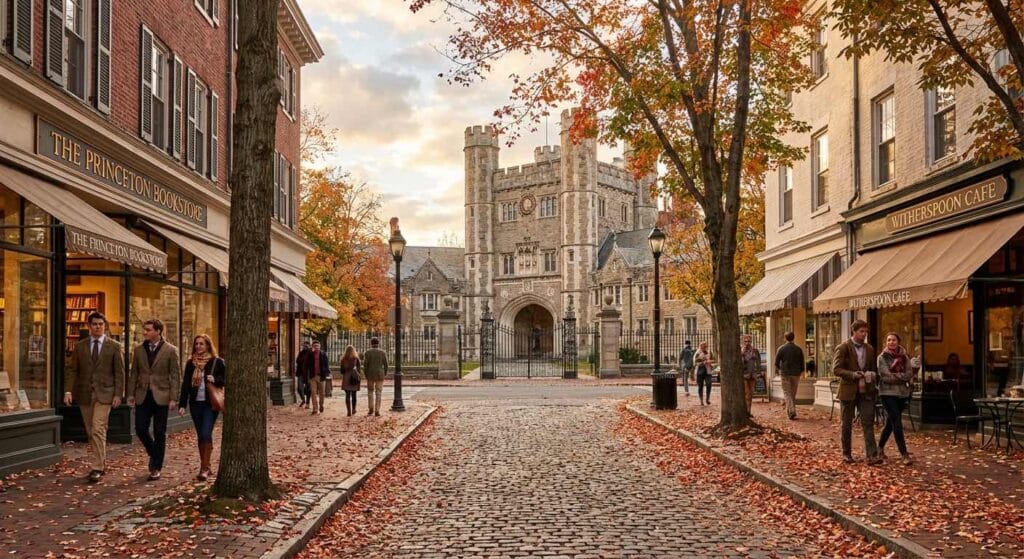
Princeton University generates over $1.7 billion in annual economic impact — but the community that has grown up around it is remarkable not just for the university itself. The Route 1 corridor stretching through Mercer and Middlesex Counties has become one of the most knowledge-intensive stretches of highway in the world, hosting the North American research operations of Bristol-Myers Squibb, Johnson & Johnson, Merck, Novo Nordisk, and Sanofi within a roughly twenty-mile radius. Niche ranks Princeton’s public schools #1 in New Jersey across every major category. And with a median home value near $1.2 million, Princeton sits at the top tier of New Jersey’s already expensive real estate market — a price that a growing number of professionals, academics, and corporate relocatees are willing to pay for what the town consistently delivers.
New Jersey’s complete relocation guide covers the full range of Garden State communities, but Princeton earns dedicated treatment. It is, by most objective measures, one of the finest small cities in America — walkable, intellectually stimulating, exceptionally schooled, and logistically well-positioned between New York and Philadelphia. This guide covers what you actually need to know before making the move.
Quick Answers
Average move cost (from NYC): $500 – $2,500 | From DC: $1,000 – $3,500 | From Chicago: $2,200 – $10,500
Median home price: ~$1.2 million
Median rent (1BR): $2,300 – $2,700/month
Cost of living: ~33% above national average
NYC commute: 70-90 minutes via NJ Transit Northeast Corridor from Princeton Junction
Philadelphia commute: ~45 minutes via NJ Transit
Best for: Pharma and research professionals, academics, families prioritizing schools, NYC/Philly commuters seeking suburban quality
Why People Are Moving to Princeton
Princeton attracts people for several distinct and intersecting reasons, and understanding which one applies to you helps clarify whether this particular town is the right fit.
The most common driver is employment. The Route 1 pharmaceutical and technology corridor — sometimes called the “Medicine Chest of the World” — runs directly through Princeton’s backyard. Bristol-Myers Squibb maintains major research facilities in the area. Merck’s global research campus is in nearby Rahway, with extensive operations throughout the corridor. Johnson & Johnson’s corporate presence extends across multiple sites. Novo Nordisk and Sanofi both have substantial facilities. For scientists, researchers, clinical development professionals, and the lawyers and consultants who serve them, living in Princeton puts you at the geographic center of the industry. The commute to most corridor employers is ten to twenty minutes by car.
The second driver is Princeton University itself. The university employs thousands of faculty, researchers, administrators, and professional staff, and generates an enormous supporting ecosystem of think tanks, research institutes, and spinoff enterprises. The Institute for Advanced Study — the independent research organization where Albert Einstein spent the final twenty-two years of his career — sits just south of the university campus and continues to attract some of the world’s most distinguished mathematicians and physicists. Living in Princeton means living inside this intellectual ecosystem, and many residents describe that ambient quality — the lecture series, the proximity to brilliant people, the campus architecture, the general seriousness of the place — as a meaningful part of their daily life.
The third driver is schools. When Niche ranks a district #1 in New Jersey with straight A-plus grades across academics, teachers, college preparation, and extracurriculars, families take notice. Princeton’s public schools are not just good by New Jersey standards — they are exceptional by any standard. Families relocating from New York City, where school quality varies enormously by neighborhood and the private school alternative can cost $60,000 per year, often find Princeton’s public schools to be a compelling part of the financial case for moving.
Finally, Princeton sits at a genuinely useful geographic crossroads. Commuting to Manhattan is real — NJ Transit’s Northeast Corridor line runs from Princeton Junction with roughly 70 to 90-minute journey times to New York Penn Station — and commuting to Philadelphia is easier still, at around 45 minutes. For dual-career households where one partner works in New York and another in the Philadelphia area, Princeton is one of the only communities in the mid-Atlantic that puts both cities within reasonable reach.
Princeton’s History and Character
Princeton is one of the oldest continuously inhabited communities in New Jersey, with European settlement dating to the 1690s. The town served as a brief capital of the United States in 1783, when the Continental Congress met at Nassau Hall after fleeing Philadelphia — and Nassau Hall still stands, still looks exactly as it did in the 18th century, and still anchors one of the most beautiful university campuses in America.
The Battle of Princeton in January 1777 was one of Washington’s more consequential victories, and the town wears this history with quiet confidence rather than novelty-shop fanfare. Historical markers are genuinely interesting. The Princeton Battlefield State Park preserves the actual ground where the fighting occurred. The town has absorbed three centuries of history without becoming a museum of itself.
The character of Princeton today is shaped by the intersection of Ivy League culture and corporate research. The university brings world-class art exhibitions, theater productions, lectures, and athletic events to a town of roughly 30,700 people — a ratio of cultural amenity to population that is difficult to match anywhere in the country. The town also carries the particular social atmosphere that surrounds elite universities: highly educated, somewhat self-aware about its own prestige, and genuinely committed to civic life. The farmers markets are excellent. The restaurants are diverse and surprisingly good. The conversations at dinner parties involve a lot of people who actually know things.
The Witherspoon-Jackson neighborhood, just east of Nassau Street, is Princeton’s most historically significant African American community. Named for John Witherspoon, the only active clergyman to sign the Declaration of Independence, and for Andrew Jackson (a historical association that the neighborhood has complicated feelings about), the area is home to the Witherspoon Street Presbyterian Church, one of New Jersey’s oldest Black congregations. The neighborhood has been recognized on the National Register of Historic Places and represents a layer of Princeton’s history that sits alongside — and sometimes in tension with — the university’s own narrative.
Princeton’s Neighborhoods: Finding Your Fit
Princeton is not a large city, and the geographic distinctions between neighborhoods are more about density and character than dramatic price differences. The whole community is expensive; the question is what flavor of Princeton life suits you.
Downtown Princeton Borough
The walkable core of Princeton centers on Nassau Street and its surrounding blocks. This is where you find the independent bookstores (Labyrinth Books being the most beloved), the coffee shops where you will overhear fragments of conversations about particle physics and venture capital in the same hour, the restaurants ranging from Thai to French bistro, and the shops that have served the university community for generations. Palmer Square, a planned commercial district from the 1930s, anchors the retail center with a hotel, restaurants, and apartments above street-level shops.
Living in the immediate downtown area typically means condominiums, townhouses, or rental apartments — single-family homes in the borough proper are scarce and command premium prices. The trade is high prices for genuine walkability: the ability to leave your house and reach the university campus, Nassau Street restaurants, the library, and the train connection without a car is a meaningful quality-of-life factor for residents who value it.
Princeton Estates and Constitution Hill
Moving outward from the borough core, the communities of Princeton Estates and Constitution Hill represent the town’s more established residential neighborhoods. Lots are generous, homes are substantial, and the architectural character is primarily colonial and Georgian — the vocabulary of affluent New Jersey suburban development across five decades. These neighborhoods are car-dependent for daily life but sit within minutes of the downtown core.
Constitution Hill in particular carries some of the highest-value residential real estate in the town. The homes are large, the streets are quiet, and the neighbors are typically the senior executives, senior faculty, and established professionals who form Princeton’s residential upper tier. It is comfortable, understated, and expensive.
Princeton Manor and the Eastern Sections
Princeton Manor and the communities along the eastern approaches to town tend toward slightly larger lots and a more purely suburban character. These neighborhoods are popular with families who want genuine yard space and proximity to the best elementary school feeder patterns. Access to Route 1 is relatively quick, making corridor commutes straightforward. These areas also connect naturally with the broader Princeton orbit — the adjacent communities of West Windsor and Plainsboro, which offer their own strong school systems and more accessible price points.
The Adjacent Communities: Princeton Junction, West Windsor, Plainsboro, and Montgomery Township
For many people relocating to the Princeton area, the decision is not specifically Princeton the borough but the broader Princeton orbit. Princeton Junction — technically within West Windsor Township — is home to the NJ Transit station that most commuters use and offers its own residential neighborhoods at meaningfully lower price points than the borough itself. West Windsor and Plainsboro have strong school systems, larger lot sizes, and median home prices in the $600,000 to $900,000 range rather than the $1.2 million borough median. Montgomery Township to the north is more rural in character, with excellent schools and a community that attracts families who want more land.
The distinction matters: if your primary attraction to Princeton is the schools and the commute access, the adjacent communities often deliver both at 20 to 30 percent lower housing costs. If the walkable downtown, the university atmosphere, and the specific social character of Princeton proper matter to you, then the price premium has a clear source.
Housing Market and Costs
Princeton’s housing market is competitive in a way that reflects its unusual combination of constrained inventory and persistent high-income demand. The town is almost entirely built out — there is very little new construction of single-family homes in Princeton Borough — and the buyers competing for available properties are typically well-resourced professionals with strong financing. Median home values near $1.2 million place Princeton among the most expensive communities in New Jersey, which is itself one of the most expensive states in the country.
What that price buys varies considerably. At the lower end of Princeton’s market — homes in the $700,000 to $900,000 range — you’re typically looking at smaller colonials or ranches in good condition with functional but not extravagant spaces. At $1.2 to $1.5 million, you reach the genuine four- or five-bedroom colonials with updated kitchens, finished basements, and good school placement that drive much of the family-buyer demand. Above $2 million, the inventory includes historic homes with genuine architectural character, large lots, and the kind of craftsmanship that doesn’t exist in newer construction.
The rental market runs in the range of $2,300 to $2,700 per month for one-bedroom units in downtown Princeton and somewhat higher for larger apartments or townhouses. The rental inventory is not deep — Princeton is a homeownership community at its core — and competition for desirable rentals can be significant, particularly at the start of academic years when university-affiliated researchers and visiting faculty are searching simultaneously.
A note on the historic housing stock: Princeton has a substantial number of homes dating to the 18th and 19th centuries, and these properties require informed buyers. Narrow doorways, steep staircases, low ceilings in older wing additions, and the physical constraints of genuine historic construction are real logistical factors. When you’re moving into a Princeton historic home, professional movers with experience navigating these properties are not a luxury — they’re a practical necessity.
The Financial Picture
New Jersey’s property taxes are the highest in the nation by most measures, with an average effective rate of approximately 2.26 percent — well above the national average of 0.99 percent. In Princeton, where home values are high, this rate translates to substantial absolute tax bills. On a $1.2 million home, the annual property tax burden will likely run in the range of $18,000 to $25,000 depending on assessed value and local rates. This is not a hidden cost — it’s a central part of the financial calculation for anyone buying in New Jersey.
Princeton’s overall cost of living sits approximately 33 percent above the national average, driven primarily by housing but reflected across childcare, transportation, and services. The cost of living index for Princeton consistently ranks in the 180 to 190 range on a scale where 100 represents the national baseline. Childcare in Princeton runs approximately $1,858 per month for private preschool — roughly 53 percent above the national average. Transportation costs run about 60 percent above the national average, partly reflecting the transit costs associated with NJ Transit commuting.
The state income tax picture in New Jersey is less favorable than neighboring states: New Jersey has a progressive income tax with rates ranging from 1.4 percent to 10.75 percent for high earners. For professionals in the pharma corridor earning $300,000 to $500,000 — not unusual compensation in that sector — New Jersey’s top income tax rates represent a meaningful cost compared to lower-tax alternatives. This is a common calculation among prospective Princeton buyers: the combination of high property taxes and high state income taxes requires that the community deliver genuine value, and most residents conclude that it does.
What It Costs to Move to Princeton
Moving costs to Princeton vary substantially based on origin and move size. For a typical two- to three-bedroom household, the ranges below reflect current market pricing for professional, full-service moves.
| Origin | Estimated Cost (2BR-3BR) |
|---|---|
| New York City | $500 – $2,500 |
| Philadelphia | $800 – $2,200 |
| Washington, D.C. | $1,000 – $3,500 |
| Chicago | $2,200 – $10,500 |
| Los Angeles | $4,500 – $14,000 |
Estimates reflect full-service moves including packing, loading, transport, and unloading. Actual costs depend on shipment weight, time of year, and additional services. Summer months (June-August) typically command 15-25% premium rates.
A few Princeton-specific factors affect pricing. The town’s predominantly suburban, single-family housing stock means most moves involve standard house access — no elevator waits, no freight dock scheduling, no building management approvals. However, Princeton’s historic homes introduce their own complications: narrow front doors, tight staircases, low ceilings in older additions, and architectural details that require careful handling. Moving out of urban high-rise buildings (Manhattan co-ops, for instance) into Princeton houses is a common pattern, and experienced movers who’ve done this transition before are worth seeking out.
HOA communities within the Princeton area often have specific moving rules — designated hours, required elevator reservations in attached communities, or mandatory moving day registration. Confirming these requirements with your HOA before scheduling is essential.
Choosing a Professional Moving Company for Your Princeton Move
What You’re Actually Paying For
A professional moving estimate is not simply a price for truck and labor. When you hire a licensed, insured moving company, you’re paying for a regulated service that includes trained crews, properly maintained equipment, liability coverage, and accountability structures that exist nowhere in the informal moving market. For a move into Princeton — where homes can be worth $1 million or more and furnishings often reflect that investment — understanding what you’re purchasing matters.
The binding components of a professional move include trained labor (movers who know how to navigate stairs, protect door frames, and handle heavy items without damaging floors), a commercial vehicle with appropriate suspension and tie-down systems, professional packing materials if packing is included, and liability coverage for your belongings in transit. For specialty items — artwork, antiques, a grand piano in a historic Victorian home — professional movers have equipment and training that no amount of “friends with a truck” can replicate.
The Estimate Game
Moving companies offer three types of estimates, and the differences are consequential.
A non-binding estimate is the most common and least reliable form. The mover gives you a price, but the actual charge can exceed that estimate by up to 10 percent under federal law. For straightforward moves, non-binding estimates are often fine. For complex Princeton moves — large homes, significant antiques, difficult access — they introduce more risk.
A binding estimate fixes the price regardless of actual weight or time. You know exactly what you’ll pay. The trade-off is that binding estimates tend to run higher, because the mover is absorbing the uncertainty. For anyone who wants a hard budget number, binding estimates provide certainty.
A binding not-to-exceed estimate is the gold standard: the price is capped at the estimate, but if the actual move comes in lower, you pay the lower amount. This is the format that most reputable full-service movers offer to clients moving into higher-value homes. It protects you from surprises while preserving the downside if the move is faster or lighter than expected.
Separating Legitimate Movers from Problems
New Jersey has specific licensing requirements for movers, and verifying them before signing anything is essential. Every legitimate interstate mover must have a USDOT number issued by the U.S. Department of Transportation, which you can verify at the FMCSA website (fmcsa.dot.gov). For intrastate moves within New Jersey, movers must be registered with the New Jersey Division of Consumer Affairs under the Household Movers Act — a registration you can confirm at the Division’s website.
Red flags include: no physical address, a quote significantly lower than every other estimate (bait-and-switch pricing is a documented tactic in the moving industry), requests for large cash deposits before the move, or an unwillingness to provide a written estimate. A mover who won’t put their price in writing is not a mover you want handling your Princeton home.
Understanding What’s Protected
Federal law provides two levels of liability protection for household goods in interstate moves. Released value protection — the default if you sign nothing to the contrary — covers your belongings at $0.60 per pound per article. A 50-pound flat-screen television damaged in transit would yield a $30 settlement. This is not real protection for a Princeton household’s contents.
Full value protection requires the mover to repair, replace, or compensate for damaged or lost items at current market value. It costs more — typically a few hundred dollars added to the estimate — and it is the only option that makes financial sense when you’re moving valuables. Read the liability section of your contract carefully; many disputes arise because customers assumed full coverage when they had accepted released value by default.
Princeton-Specific Moving Logistics
Princeton’s suburban character means the major urban logistics challenges — elevator bookings, freight dock scheduling, building management approvals — are generally not relevant. But the town presents its own considerations. Many of Princeton’s historic homes have access constraints: front doors that predate modern furniture dimensions, staircases with tight turns, and rooms that weren’t designed with a 96-inch sectional sofa in mind. A professional crew will assess these constraints during the in-home estimate, measuring critical pathways and identifying whether any items require special handling — potentially including window removal or crane service for oversized pieces.
If you’re moving into a community with HOA rules, expect requirements around moving hours (typically 8 a.m. to 5 p.m. on weekdays), mandatory elevator reservations in any building with an elevator, and possibly a refundable deposit held against damage to common areas. Downtown Princeton apartments and townhouse communities are the most likely to have formal moving policies; more suburban single-family neighborhoods typically do not.
Parking logistics in Princeton Borough can be complicated on moving day. Nassau Street and the surrounding commercial blocks have limited street parking for large moving trucks, and certain residential streets have parking restrictions that affect where a truck can legally stage. Your moving company should scout the address in advance and have a parking plan — this is a detail that separates professional operations from informal ones.
Why Nelson Westerberg for Your Princeton Move
The same qualities that make Princeton appealing — the historic architecture, the proximity to major metro areas, the mix of high-value furnishings and architectural constraints — are exactly what makes it a move that rewards experience. Nelson Westerberg has been handling residential relocations throughout New Jersey and the mid-Atlantic for decades. Our crews understand the difference between a move into a 1890 Victorian with a winding staircase and a 2015 colonial with a straight shot from the front door to every bedroom — and they’re trained to handle both.
For families relocating from New York City, we handle the full cross-Hudson transition: packing, loading from a Manhattan co-op or Brooklyn brownstone, transportation to Princeton, and delivery that works around your Princeton home’s specific access realities. For long-distance moves from Chicago, Washington, or the West Coast, we coordinate across the full distance with transparent pricing and real-time communication. And because Princeton is an active relocation market for pharmaceutical and research professionals, we regularly partner with corporate HR departments on coordinated moves — making the logistics invisible so that the professional transition can stay in focus.
Career and Job Market
Princeton’s job market is defined by three overlapping ecosystems: the pharmaceutical and biotechnology corridor, the university and its affiliated institutions, and the professional services firms that support both.
The Route 1 corridor — which runs from South Brunswick through West Windsor, Plainsboro, and Lawrence Township before reaching Trenton — has been described as the “Medicine Chest of the World” for good reason. The density of major pharmaceutical research operations along this stretch is without parallel in the United States. Bristol-Myers Squibb has had major research operations in the Princeton area for decades. Merck maintains significant facilities throughout the corridor. Johnson & Johnson’s presence extends across multiple sites. Novo Nordisk and Sanofi operate substantial research and development organizations within commuting distance of Princeton proper. For scientists — particularly those in oncology, immunology, and metabolic disease — the job market within thirty minutes of a Princeton address represents an extraordinary concentration of career opportunity.
The university itself employs thousands of people, from faculty with global reputations to the researchers, lab managers, administrators, and support professionals who make a research university function. The university’s endowment — one of the largest in the world — funds research programs at a scale that creates continuous employment demand in technical and administrative roles.
The Institute for Advanced Study deserves specific mention. Founded in 1930 and initially housed on the Princeton University campus before establishing its own grounds off Einstein Drive, the Institute has been home to some of the most important intellectual work of the 20th and 21st centuries. Einstein, John von Neumann, and Kurt Gödel were all members. Today’s faculty and members work across mathematics, natural sciences, historical studies, and social science. The Institute does not hire at scale, but its presence in Princeton contributes to the intellectual atmosphere of the town in ways that are hard to quantify and easy to feel.
Princeton also sits in the orbit of the Trenton-Princeton-New Brunswick employment corridor, which includes significant state government employment in Trenton, the Rutgers University ecosystem in New Brunswick, and a technology and finance sector that extends throughout central New Jersey.
Schools and Education
Princeton’s public schools have earned their national reputation through consistent, sustained excellence that is difficult to replicate. The Princeton Public Schools district serves approximately 3,800 students across four elementary schools, one middle school (Princeton Middle School), and Princeton High School. Niche’s ranking of #1 public school district in New Jersey — with A-plus grades across academics, teachers, diversity, college preparation, and extracurriculars — reflects a district that takes education seriously at every level.
Princeton High School sends graduates to the nation’s most selective colleges at rates that are genuinely unusual for a public institution. The school’s course offerings include 29 Advanced Placement courses, a comprehensive International Baccalaureate program, and electives that reflect the town’s particular intellectual culture — linguistics, philosophy, and advanced mathematics courses that most high schools don’t offer. The school’s performing arts program, athletic programs, and extracurricular depth are all proportionate to a community that invests heavily in its children’s development.
For families with university connections, the university’s affiliated programs occasionally overlap with the public school environment — visiting faculty children attend the public schools, and the university’s proximity means that distinguished scholars, researchers, and artists regularly interact with the school community in ways that are genuinely enriching.
Private school options in the Princeton area are also strong. The Princeton Day School is an independent PK-12 school with a strong reputation. For families relocating from areas where private school attendance is the norm, New Jersey’s public school quality — particularly in Princeton — often makes the transition to public education straightforward rather than a compromise.
Culture and Quality of Life
Princeton offers a quality of life that is difficult to find elsewhere in the mid-Atlantic: a walkable, intellectually alive, architecturally beautiful small city surrounded by genuine open space, with world-class cultural programming funded by one of the world’s wealthiest universities.
The Princeton University Art Museum — which completed a major expansion in 2023 — is free to the public and houses a collection of over 115,000 works spanning antiquity to the present. The McCarter Theatre Center is a Tony Award-winning regional theater that presents Broadway shows, dance, and experimental work on a par with major urban venues. The university’s Concerts series brings internationally recognized classical and chamber music performers to campus throughout the academic year. These are not satellite events or occasional treats — they are the regular cultural calendar of a town that happens to have a world-class university in it.
Nassau Street, Princeton’s main commercial corridor, has managed to resist the chain-store homogenization that characterizes most American commercial streets of its scale. Independent bookstores, restaurants, wine shops, and specialty retailers coexist with the inevitable national brands, and the overall character of the street reflects the town’s economic and intellectual character. Communiversity — Princeton’s annual arts festival, typically held in April — fills the streets with music, art, and food vendors and functions as a genuine community celebration rather than a marketing exercise.
The Delaware and Raritan Canal State Park runs through the Princeton area, providing a multi-use trail along the historic canal corridor that connects Princeton to communities throughout central New Jersey. The towpath trail is one of the most accessible and genuinely beautiful recreational corridors in the state — flat, tree-lined, and peaceful in a way that’s unusual for a densely populated region. Carnegie Lake, formed by the damming of Millstone River in 1906, is where Princeton’s crew teams train and where residents kayak, canoe, and fish.
The Commute Reality
Princeton sits at a comfortable and slightly inconvenient distance from both New York and Philadelphia — comfortable in the sense that both cities are genuinely accessible, inconvenient in the sense that “accessible” means 70 to 90 minutes, not 30.
The NJ Transit Northeast Corridor line is the primary transit option. The relevant station for most Princeton residents is Princeton Junction (in West Windsor Township), which offers frequent service to New York Penn Station with journey times of roughly 60 to 75 minutes, depending on the train. There is also a shuttle train — the “Dinky” — that runs the 2.7-mile connection between Princeton Station (on the edge of the university campus) and Princeton Junction, offering a convenient transition for those who prefer not to drive or park at the Junction. Monthly NJ Transit passes for the Princeton Junction to New York commute run approximately $199 per month.
To Philadelphia, service on the NJ Transit River Line (connecting to SEPTA at Trenton) or direct NJ Transit to Philadelphia 30th Street Station takes approximately 45 minutes, making Princeton genuinely accessible to Center City Philadelphia employment.
Driving to New York City is a different calculation. The Princeton to Midtown Manhattan distance is approximately 55 miles, but New Jersey Turnpike congestion and Lincoln Tunnel queuing can extend the actual journey to 90 minutes or more during peak hours. For committed transit commuters, the train is the better option. For those who drive regularly to New York, the commute requires honest planning about departure and arrival times.
Within Princeton and its immediate orbit, driving is the practical reality for most errands and activities beyond the immediate downtown core. The town itself is walkable at its center, but the surrounding residential neighborhoods require a car for grocery runs, school pickups, and the general business of suburban life.
Frequently Asked Questions
How much does it cost to move from New York City to Princeton, NJ?
A full-service move from New York City to Princeton typically costs between $500 and $2,500 for a one- to two-bedroom apartment or condo. Larger three- to four-bedroom moves range from $2,000 to $4,500. These estimates include packing, loading, transportation, and unloading. Costs increase during peak summer months (June through August) and at the beginning and end of month periods. A Princeton-area move from Manhattan also often requires navigating building management requirements at the origin — elevator reservations, freight dock scheduling, and certificate of insurance requirements add coordination time that experienced movers factor into their workflow.
What salary do I need to live comfortably in Princeton, NJ?
For a single person renting in Princeton, a comfortable lifestyle typically requires an annual income of at least $110,000 to $130,000, given the combination of high rents (averaging $2,300-$2,700 for a one-bedroom), New Jersey’s high property-related costs, and the state’s income tax structure. For a family of four purchasing a home near the $1.2 million median, comfortable living — with a mortgage, property taxes in the $20,000-plus range, childcare, and general household expenses — requires household income of $250,000 or more. Princeton’s pharmaceutical corridor and university ecosystem do support significant numbers of households at this level, which is part of why the housing market sustains itself.
How are Princeton’s public schools compared to neighboring districts?
Princeton’s public schools are ranked #1 in New Jersey by Niche, with top ratings across academics, teachers, college preparation, diversity, and extracurriculars. Princeton High School’s AP and IB offerings, college placement rates, and program depth are exceptional by public school standards anywhere in the country. Adjacent districts in West Windsor-Plainsboro and Montgomery Township are also highly rated — both consistently appear in the top 20 New Jersey school districts — which is part of why the broader Princeton orbit retains families who can’t afford Princeton Borough pricing.
Is Princeton a good place to live if you work in pharma or biotech?
Princeton is arguably the best-positioned residential community in the United States for pharmaceutical and biotechnology professionals. The Route 1 corridor hosts major research operations for Bristol-Myers Squibb, Merck, Johnson & Johnson, Novo Nordisk, Sanofi, and dozens of smaller biotech and CRO companies. Commutes to most corridor employers are ten to twenty minutes from Princeton. The intellectual and social culture of the town is highly compatible with research professionals — the density of PhDs and MDs in Princeton’s residential population is genuinely unusual, and the social and professional networks that form here have real career value.
What neighborhoods near Princeton offer lower costs while keeping school quality?
West Windsor and Plainsboro offer median home prices in the $600,000 to $900,000 range — meaningfully below Princeton Borough — with school systems that rank in the top 15 to 20 statewide. Montgomery Township to the north has strong schools and a more rural character, with larger lots and slightly lower prices. Princeton Junction (within West Windsor Township) adds the specific advantage of direct NJ Transit Northeast Corridor access, making it particularly attractive for New York commuters who want train access without Princeton Borough’s price premium.
What is the Delaware and Raritan Canal State Park?
The Delaware and Raritan Canal State Park is a 70-mile linear park that follows the route of the historic D&R Canal through central New Jersey, passing through the Princeton area. The towpath trail is one of the most heavily used recreational corridors in the state — flat, wooded, and genuinely beautiful — used for running, cycling, walking, and dog exercise year-round. It connects Princeton to communities throughout Mercer and Middlesex Counties and provides a car-free travel corridor that, in some stretches, runs directly through residential neighborhoods. For families and fitness-focused relocatees, proximity to the towpath trail is a meaningful quality-of-life consideration.
Conclusion: Is Princeton Right for You?
Princeton is not for everyone, and the reasons it isn’t for everyone are largely the same as the reasons it is exceptional for the people it suits. It is expensive — among the most expensive communities in one of the most expensive states in the country. The commute to New York is real and takes time. The social culture carries the particular atmosphere of a community built around elite education, which some people find stimulating and others find a bit much.
But for families who prioritize schools above almost everything else, Princeton delivers at a level that justifies the cost. For pharmaceutical and research professionals who want to live inside the industry’s most productive corridor rather than commuting to it from a compromise community, Princeton makes obvious sense. For people who want genuine walkable downtown character, world-class cultural programming, beautiful historic architecture, and outdoor recreation within minutes of their front door, Princeton provides all of it in a package that is genuinely rare.
New Jersey is full of excellent communities — our complete New Jersey relocation guide covers the full range. If you’re comparing Princeton to other New Jersey destinations, our guides to Newark and Morristown cover two communities with very different characters and price points. But for the combination of intellectual life, school quality, geographic positioning, and small-city character at the highest level of execution, Princeton stands in a class of its own.
When you’re ready to make the move, Nelson Westerberg is ready to make it seamless.
Related Articles
Cost to Move a 3-Bedroom Home Cross-Country (2026): The Full-Service Price Breakdown

If you’re planning to move a three-bedroom home across the country in 2026, the single most useful number to start with is a range: a full-service, professionally handled move typically runs between $6,500 and $14,500, with a roughly 1,000-mile relocation landing around $8,000 to $11,000. Where your move falls within that band depends on a […]
Read MoreMoving from New Jersey to North Carolina (2026): Leaving the Nation’s Highest Property Taxes
New Jersey has led all fifty states in outbound migration for eight straight years, and once you look at the property-tax bill, it isn’t hard to see why. The Garden State carries the highest effective property-tax rate in the nation — about 2.23%, translating to an average homeowner bill near $9,500 a year — stacked […]
Read More

Table of Contents

Atlas Van Lines, Inc. U.S. DOT No. 125550 (TM & © 2026 AWGI LLC.) | G.P.S.C. 4917 | IL C.C. 4246 | NJPC 00104 | Cal-T 110193
© 2026 Nelson Westerberg, Inc. All Rights Reserved Worldwide.