Moving to Morristown, NJ: The Complete 2026 Relocation Guide

KPMG’s decision to relocate its New Jersey headquarters from Short Hills to Morristown in Fall 2026 — 1,000 employees, 76,000 square feet, a 20 to 40 percent expansion from their previous office — tells you something important about what Morris County has become: not a commuter suburb of Manhattan but a genuine corporate destination in its own right. KPMG is taking the top four floors of the west tower at HQ Plaza on Speedwell Avenue, a building complex now undergoing a $32 million renovation that is also home to the Hyatt Regency Morristown and a concourse of restaurants and retail. The firm chose Morristown specifically because of its proximity to New York Penn Station — roughly 50 to 55 minutes on the NJ Transit Morris-Essex Line — and because the Morris County office market offers the quality of environment that a Big Four accounting firm expects, at economics that no longer require a Manhattan or suburban Essex County address.
New Jersey’s complete relocation guide covers the full range of Garden State communities, but Morristown deserves its own treatment. This is a town with one of the more unusual characters in the state: a Revolutionary War capital that became a corporate hub, with a walkable downtown, 5,000 acres of county parkland, a genuine arts scene, and a housing market that offers more range — and more value — than many of its comparably connected counterparts. Whether you’re relocating for a new position in Morris County’s corporate sector, following KPMG or one of the county’s other major employers, or simply looking for the combination of urban walkability and outdoor access that Morris County provides, this guide covers everything you need to know.
Quick Answers
Average move cost (local NJ move): $1,500 – $4,000 | From NYC: $800 – $2,500 | From Chicago: $2,200 – $10,500
Median home price: $655,776 – $1,080,740 (depending on neighborhood and property type)
Average rent: $2,153 – $3,377/month
Median household income: ~$115,409
Cost of living: 7-33% above national average
NYC commute: 50-55 minutes via NJ Transit Morris-Essex Line to Penn Station
Best for: Corporate and finance professionals, outdoor enthusiasts, families seeking walkable suburban quality, NYC commuters
Why People Are Moving to Morristown
Morristown attracts a specific kind of relocatee: someone who wants genuine downtown walkability without city prices, who values outdoor recreation as a serious part of daily life rather than an occasional weekend option, and who needs a credible New York commute without sacrificing the kind of residential quality that a city apartment cannot provide.
The employment driver is the single most important factor for most new arrivals. KPMG’s 2026 move is the most visible recent example of a pattern that has characterized Morristown’s growth for years. The town’s existing corporate roster already includes pharmaceutical companies, financial services firms, law firms, and the kind of professional services ecosystem that clusters around major employers. Deloitte, Sanofi, and Valley Bank have significant presence in Morris County. The healthcare sector, anchored by Atlantic Health System’s Morristown Medical Center — one of the most comprehensive hospitals in New Jersey — employs thousands in the area. Morris County’s diversified professional employment base is one of its most underappreciated assets: residents here are rarely dependent on a single industry, which insulates the community from the boom-and-bust patterns that affect more concentrated markets.
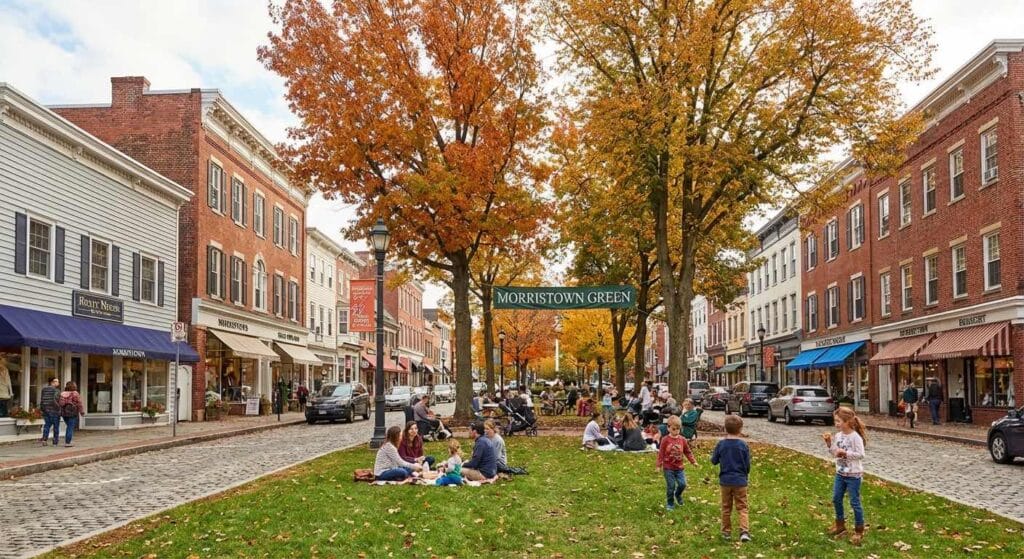
The quality of life argument is equally compelling. Morristown has something genuinely unusual: a walkable, restaurant-and-bar-filled downtown centered on the Morristown Green, surrounded by residential neighborhoods that are a ten-minute walk from that core, which are themselves surrounded by thousands of acres of county and national historical parkland. The geometry of Morristown — urban center, residential ring, wild land — is not something you can replicate in most suburban communities of comparable size.
For families, the schools and the sheer outdoor richness of Lewis Morris County Park and Jockey Hollow make Morristown and its surrounding communities compelling. For young professionals, the downtown restaurant and nightlife scene is the best in Morris County and competes credibly with many larger New Jersey cities. For outdoor athletes, the trail systems available within fifteen minutes of downtown Morristown are extraordinary.
Morristown’s History and Character
Morristown’s claim to Revolutionary War history is not a marketing construct — it is the physical, legal, documented fact that George Washington and the Continental Army used Morristown as their winter headquarters twice, in 1777 and again in the brutal winter of 1779-1780. The second encampment at Jockey Hollow was, by most historical accounts, more severe than Valley Forge: temperatures dropped below zero for weeks, snowfall exceeded six feet, and the army survived in huts built by the soldiers themselves from the local timber. Washington’s headquarters, the Ford Mansion, still stands on Morris Street. The Morristown National Historical Park — established in 1933 as the nation’s first national historical park — preserves the Jockey Hollow site, Washington’s headquarters, and the Fort Nonsense overlook.
This history is not just background. It shapes the physical character of the town, which has maintained its historic commercial core around the Morristown Green — a genuine town common that has served as the center of civic life since the colonial era — and preserved a residential stock that includes some of New Jersey’s most significant 18th and 19th century architecture. Morris County has a strong preservation ethic, and Morristown in particular has maintained the relationship between historic character and contemporary commercial vitality that many towns aspire to and few achieve.
The corporate chapter of Morristown’s story began in earnest in the mid-20th century. For decades, Honeywell International — formed through the 1999 merger of AlliedSignal and the original Honeywell — maintained its global headquarters at the Honeywell Plaza campus on Columbia Road in adjacent Morris Township, a sprawling 170-acre site that was one of the region’s largest corporate presences. The company relocated its headquarters to Charlotte, North Carolina in 2019, but the presence of a major global corporation for half a century shaped Morris County’s professional infrastructure, its residential development patterns, and its professional services ecosystem in ways that persist today. The companies that grew up to serve Honeywell — law firms, accounting practices, management consultants, technology vendors — remain, and they now serve the expanding roster of corporate employers that have followed.
KPMG’s 2026 arrival is the clearest current signal of what Morristown is becoming. HQ Plaza, the complex on Speedwell Avenue where KPMG is establishing its New Jersey headquarters, was previously occupied in part by Riker Danzig, one of New Jersey’s most prominent law firms, which itself relocated to Madison in 2025. The $32 million renovation transforming HQ Plaza’s concourse — linking three office towers, the Hyatt Regency, and expanded retail and restaurant space — is not a small-scale refresh. It is an infrastructure investment that reflects serious confidence in Morristown’s trajectory.
Morristown’s Neighborhoods: Finding Your Fit
Morristown proper is a borough of roughly 18,500 people, compact enough that most neighborhoods maintain some connection to the downtown core. But Morris County offers a broader orbit of communities — Morris Plains, Madison, Chatham, Mountain Lakes — that many people consider when relocating to the area, each with its own character and price point.
Downtown Morristown
The downtown neighborhood surrounding the Morristown Green is the community’s most urban environment. Restaurants range from farm-to-table American to Thai to Italian to Japanese — the density of genuinely good dining options within a ten-minute walk is remarkable for a town of this size. Craft beer bars, cocktail bars, and wine shops occupy storefronts alongside coffee shops, boutiques, and galleries. The Mayo Center for the Performing Arts brings professional theater, comedy, and music to a renovated historic venue steps from the Green.
Living downtown means apartments, condominiums, and townhouses rather than single-family homes — this is the urban core, and the density reflects it. Rents in this zone run toward the higher end of Morristown’s market, generally $2,500 to $3,500 per month for well-appointed one- to two-bedroom units in buildings with modern amenities. The trade is genuine walkability: groceries, dining, entertainment, and the train station all within reach without a car.
The Morristown train station, serving the NJ Transit Morris-Essex Line, is the practical anchor of downtown life. The walk from most downtown apartments to the train is under fifteen minutes, and the service to New York Penn Station — running approximately every 30 minutes during peak hours — makes the 50 to 55-minute commute feel manageable in a way that more complex transit transfers do not.
Western Morristown and Morris Township
The residential neighborhoods west of downtown, transitioning into Morris Township (which surrounds the borough), represent the most classic suburban expression of the Morristown area. Single-family homes on quarter-acre to half-acre lots, primarily built between the 1940s and 1980s, make up most of the housing stock. The character varies: some streets are modestly sized colonials and split-levels oriented toward young families, others carry larger homes with more architectural ambition reflecting their corporate-era development.
Morris Township shares the Morristown School District for public education, and its residential neighborhoods feel organically connected to the borough. Home prices in Morris Township range widely, from starter colonials in the $500,000 range to larger homes approaching $1 million or more in the most established sections near the county park system.
Convent Station
Convent Station, a neighborhood within Morris Township anchored by its own NJ Transit station on the Morris-Essex Line, offers a quieter alternative to downtown Morristown with its own direct train access to New York. The neighborhood has a residential-suburban character, spacious lots, and a mix of architectural styles. Average home prices in Convent Station run in the range of $750,000, making it a practical option for buyers who want train access without downtown density or downtown prices.
The Surrounding Communities: Morris Plains, Madison, Chatham, Mountain Lakes
Many people who say they’re moving to “Morristown” end up in one of the surrounding communities that share the area’s character and access without bearing the Morristown postal code. Morris Plains, directly north, is a quiet residential borough with its own NJ Transit station and a housing stock weighted toward postwar single-family homes. Madison and Chatham, to the southeast along the Morris-Essex Line, are among the most consistently desirable communities in Morris County — both offer excellent schools, walkable downtowns, and a refined residential character that attracts families who want suburban quality at the top of its range. Mountain Lakes, to the north, is a lakeside community with a distinctive architectural character and strong schools in a more rural setting.
Each of these communities is within fifteen to twenty minutes of downtown Morristown and shares the area’s access to Lewis Morris County Park, Jockey Hollow, and the broader Morris County trail system. For families with children, the school district question is often the deciding factor: Madison, Chatham, and Mountain Lakes all have school systems that rank among New Jersey’s best, and each carries its own reputation and community character.
Housing Market and Costs
Morristown’s housing market reflects the range of housing types available in the borough and its surroundings. The borough itself, with its mix of downtown apartments, historic townhouses, and single-family residential neighborhoods, shows median home prices in the $655,776 to $1,080,740 range depending on the specific analysis and neighborhood composition. Average rents across the market run from $2,153 to $3,377 per month, with downtown units at the higher end and more suburban rental properties at the lower.
The market in 2026 reflects sustained demand from corporate relocatees, New York commuters, and families attracted to the school systems. KPMG’s announced move has already generated anticipation among local real estate professionals, as the arrival of 1,000 employees in the market — many of them likely to seek housing in Morristown and surrounding communities — represents a meaningful demand pulse in a market that is not oversupplied.
For buyers, Morris County offers more range than some of its Essex County neighbors. You can buy a solid, well-located four-bedroom colonial with a good school assignment in the Morris Township or Morris Plains area for $650,000 to $850,000 — a price point that provides genuine value given the commute access and quality of life. At the higher end, historic homes in Morristown’s most established residential sections, or larger properties in Mountain Lakes or Madison, can approach $2 million and above. The range gives buyers more real choices than some of New Jersey’s more uniformly expensive markets.
One consideration that affects both buyers and renters in Morristown’s market is the prevalence of older housing stock. Much of Morristown’s residential inventory was built between 1900 and 1970. These homes have character, mature landscaping, and the quality of construction that came from an era when materials were abundant and labor was genuinely skilled. They also have older electrical systems, plumbing that may predate modern standards, and the general maintenance realities of aging infrastructure. A pre-purchase inspection is not optional in this market; it is essential.
The Financial Picture
New Jersey’s property tax environment is the most important financial factor for anyone purchasing in Morris County. The state’s average effective property tax rate is approximately 2.26 percent — among the highest in the nation — and Morris County’s strong home values mean absolute tax bills are substantial. On a $700,000 home, expect annual property taxes in the range of $12,000 to $16,000. On a $1 million home, taxes can reach $20,000 to $25,000 annually. This is not a surprising cost for residents who grew up in New Jersey, but it is frequently a source of sticker shock for relocatees from lower-tax states.
The overall cost of living in Morristown runs approximately 7 to 33 percent above the national average, depending on which components you weight most heavily. The median household income of approximately $115,409 supports a comfortable middle-class lifestyle in this market, but the combination of housing costs, property taxes, and New Jersey’s progressive income tax (which reaches 10.75 percent for high earners) means that the financial profile requires careful planning.
The positive side of the financial picture is that Morristown’s cost structure, while high relative to national averages, compares favorably to comparable communities in Westchester County, New York, or many parts of Connecticut that offer similar commute access and school quality. Morris County consistently offers more home for the dollar than comparable markets across the Hudson River, and the absence of New York City income tax (for those working in New Jersey) is a meaningful advantage for high earners who previously lived in New York.
What It Costs to Move to Morristown
Moving costs to Morristown reflect both its proximity to the New York metropolitan area and its accessibility as a predominantly suburban destination.
| Origin | Estimated Cost (2BR-3BR) |
|---|---|
| Within New Jersey (local move) | $1,500 – $4,000 |
| New York City | $800 – $2,500 |
| Philadelphia area | $1,200 – $3,000 |
| Washington, D.C. | $1,500 – $4,000 |
| Chicago | $2,200 – $10,500 |
| Los Angeles | $4,500 – $14,000 |
Estimates reflect full-service moves including packing, loading, transport, and unloading. Actual costs depend on shipment weight, time of year, and additional services. Summer months (June-August) typically command 15-25% premium rates.
The Morristown area’s predominance of single-family suburban homes simplifies some aspects of the moving logistics — no elevator waits, no freight dock scheduling, no building management approval processes. However, the older housing stock introduces its own set of considerations: older colonials and Victorian homes often have narrower doorways than modern construction, steeper staircases, and rooms positioned in ways that make furniture routing less straightforward than it appears on the floor plan.
Choosing a Professional Moving Company for Your Morristown Move
What You’re Actually Paying For
When you hire a licensed, insured moving company for your Morristown relocation, you are purchasing a regulated service with specific accountability structures that the informal market cannot provide. Professional movers carry commercial liability insurance, operate permitted commercial vehicles, and employ trained crews whose job is to protect your belongings and your home throughout the move. For the typical Morristown household — with furnishings, electronics, and personal property that represent years of investment — the cost difference between professional and informal moving is trivial compared to the risk differential.
The specific value of professional service in a Morris County move goes beyond basic protection. Experienced movers will conduct an in-home survey before the move date, identify challenging items or access constraints, and arrive on moving day with the right equipment: dollies, furniture pads, corner protectors, and the specialty equipment required for items like pianos or large artwork. A crew that has moved dozens of Morristown Victorians and postwar colonials knows where the problems typically arise before they happen.
The Estimate Game
The three types of moving estimates each carry different risk profiles.
A non-binding estimate gives you a price that can legally increase by up to 10 percent above the estimate under federal regulations. For straightforward moves, this is often acceptable. For Morristown moves involving older homes with access uncertainties, large or unusual furniture, or significant quantities of fragile items, the uncertainty of a non-binding estimate can create budget stress at exactly the wrong moment.
A binding estimate locks the price regardless of actual weight or time. The certainty is valuable — you know your budget precisely — but binding estimates typically run higher because the mover absorbs all uncertainty. Compare multiple binding estimates carefully; large variations between them are worth investigating.
A binding not-to-exceed estimate provides the best of both options: your price is capped at the estimate, and if the actual move comes in lighter or faster, you pay the lower amount. This is the preferred format for full-service residential moves and should be your first request when gathering estimates from professional movers.
Separating Legitimate Movers from Problems
Interstate movers must hold a valid USDOT number issued by the Federal Motor Carrier Safety Administration, verifiable at fmcsa.dot.gov. For moves within New Jersey, movers must be registered with the New Jersey Division of Consumer Affairs under the Household Movers Act — a registration you can verify directly on the Division’s website.
In the Morristown market, as in any high-demand relocation corridor, predatory pricing tactics do exist. A quote significantly below every other estimate you’ve received deserves scrutiny: lowball bids are a documented industry tactic that precedes demands for additional payment once your belongings are loaded. A mover who refuses to provide a written estimate, requires a large cash deposit before the move, or cannot provide their USDOT number on request is a mover to avoid. Legitimate companies welcome verification and provide documentation without hesitation.
Understanding What’s Protected
Federal regulations establish two liability frameworks for household goods in interstate moves. Released value protection — the legal default if you do not affirmatively choose otherwise — covers your belongings at $0.60 per pound per article. Under this coverage, a 40-pound television damaged in transit would yield a $24 settlement. This is the minimum possible protection, and it is not adequate for most households.
Full value protection obligates the mover to repair, replace, or compensate at current market value for any item damaged or lost during the move. It costs more — typically a few hundred dollars added to your estimate — and it is the coverage that makes financial sense when moving into a home where your belongings represent substantial value. Review your liability options explicitly with your moving company before signing the contract; this is the section of the agreement that most disputes trace back to.
If you have items of unusually high value — artwork, antiques, instruments, jewelry — consider whether additional third-party moving insurance or scheduling a professional art mover for specific high-value items makes sense. Your homeowner’s or renter’s insurance policy may also provide supplemental coverage during transit; check with your insurance provider before moving day.
Morristown-Specific Moving Logistics
Morristown’s suburban character means most moves involve standard residential access — driveways, front doors, and the straightforward geometry of house-to-house relocation. But several Morristown-specific factors require attention.
The borough’s older housing stock — the Victorians, Edwardians, and early 20th century colonials that give Morristown its architectural character — often features doorways that predate modern furniture dimensions. Interior door widths of 28 to 30 inches (rather than the modern standard of 32 to 36 inches) are common in homes built before 1940. Tight staircase landings, low ceilings in attic-to-living-space conversions, and finished basements with narrow entry points are routine challenges in older Morristown properties. A good moving company will flag these constraints during the in-home estimate rather than discovering them on moving day.
For buyers moving into communities governed by HOAs — which are common in Morristown’s newer condominium and townhouse developments — HOA moving rules typically specify designated hours (weekdays between 8 a.m. and 5 p.m. is the most common window), required elevator reservations for any building with an elevator, and a refundable deposit against damage to common areas. Confirming these requirements with your HOA property manager before scheduling your move date is essential; weekend or evening move requests are frequently denied in managed communities.
Downtown Morristown’s commercial-residential neighborhoods introduce parking logistics that require planning. The streets near the Green and along South and Morris Streets are active commercial corridors during business hours, and large moving trucks need designated staging areas. Experienced movers operating in this market know which blocks allow temporary truck staging and which require parking permits from the borough.
Why Nelson Westerberg for Your Morristown Move
Morristown is a market where the combination of older housing stock, active downtown logistics, and diverse housing types — from downtown condominiums to sprawling Morris Township colonials — rewards moving experience. Nelson Westerberg has been handling residential and commercial relocations throughout New Jersey and the mid-Atlantic for decades. Our crews understand the particular character of Morris County moves: the narrow staircases of downtown Morristown townhouses, the long driveways of Morris Township properties that require shuttle trucks in winter conditions, and the coordination required when you’re moving into a managed building in the downtown corridor.
For corporate relocatees arriving with KPMG, Deloitte, Sanofi, or any of Morris County’s other major employers, we regularly coordinate with corporate HR departments on employee relocation programs — handling the logistics invisibly so that the professional transition stays in focus. For families moving from New York City or other major metros, we manage the full transition: packing and loading from your origin, transportation to Morristown, and delivery that accounts for the specific characteristics of your new home. And for local New Jersey moves — from Short Hills, Summit, or anywhere else in the state — we provide the same standard of care at the shorter distances that characterize intra-state relocation.
Career and Job Market
Morris County’s employment base is one of New Jersey’s most diversified and resilient, built around four overlapping sectors: professional services, healthcare, pharmaceuticals, and financial services.
The professional services sector in Morris County has been accumulating depth for decades, and KPMG’s 2026 arrival accelerates a trend already well underway. The presence of Big Four accounting, major law firms, and management consulting operations creates a self-reinforcing professional ecosystem: clients who need these services prefer proximity to them, which encourages more firms to locate in the area, which attracts more professional talent, which makes the market more attractive to corporate occupiers. Deloitte maintains significant New Jersey operations with Morris County presence. Valley Bank, with operations across the region, is headquartered in Morristown. The financial services ecosystem extends to investment management, insurance, and the full range of financial intermediaries.
Healthcare represents one of Morris County’s largest and most stable employment sectors. Morristown Medical Center, part of the Atlantic Health System, is a comprehensive academic medical center with over 700 beds and a full range of specialty programs. The hospital employs thousands of physicians, nurses, administrators, and support professionals and anchors a broader healthcare ecosystem that includes specialist practices, ambulatory surgery centers, and the full network of services that surround a major regional medical center.
The pharmaceutical sector, while more concentrated in the Route 1 corridor to the south and the Route 202 corridor to the east, extends into Morris County through satellite offices, research facilities, and the consulting and professional services firms that serve the industry. Sanofi has significant operations in the region. The broader drug development and contract research organization (CRO) sector employs thousands in Morris and Mercer Counties combined.
For professionals relocating from New York City in fields like finance, consulting, accounting, and law, Morristown in 2026 offers something that was not true even five years ago: a genuine career-level job market that does not require maintaining a New York City office relationship. The KPMG move signals that firms are confident enough in Morris County’s professional environment to commit their New Jersey headquarters there — not a satellite office, but the primary New Jersey presence.
Schools and Family Life
The Morristown-area school landscape encompasses several distinct districts serving different geographic areas, and understanding which district covers your specific address is a critical part of any housing search.
Morristown’s public school students attend the Morris School District, which is a consolidated district serving Morristown and the surrounding Morris Township area. The district operates multiple elementary schools, a middle school, and Morris Hills Regional High School. The district’s academic profile reflects the diversity of the community it serves — the student body is genuinely economically and ethnically diverse in a way that relatively few Morris County districts are — and the schools have made sustained investments in academic programs that address that diversity.
For families who prioritize private education, the Morristown-Beard School is an independent day school serving grades 6 through 12 with a strong college preparation program and an intellectually serious culture. The school draws students from across Morris County and has a reputation that puts it among New Jersey’s respected independent secondary schools.
The communities immediately surrounding Morristown — Madison, Chatham, and Mountain Lakes — have school districts that consistently rank among the top tier in New Jersey. Madison Borough and Madison Township share the Madison Public School system, which includes Madison High School, a school with excellent academic metrics, strong arts programs, and a culture of genuine scholarship. Chatham’s schools are similarly highly regarded. Mountain Lakes High School has long been recognized for its rigorous academic environment and strong college placement. For families where school quality is the primary relocation criterion, these adjacent communities often generate more attention than Morristown proper.
Outdoor Recreation and Quality of Life
The outdoor recreation available within minutes of downtown Morristown is one of the most underappreciated aspects of living here, and for residents who discovered it during the pandemic years when Manhattan apartment life became unworkable, it was often the decisive factor in their decision to stay.
Lewis Morris County Park is the anchor. At over 5,000 acres, it is the largest park in Morris County — and to put that in context, Central Park in Manhattan is approximately 840 acres. Lewis Morris is not a manicured urban park; it is a genuine woodland, with mountain biking trails that range from beginner-accessible to technically challenging, hiking routes through mature forest, equestrian trails, picnic areas, and access to Sunrise Lake. The park’s trail network connects to the Patriots’ Path, a multi-use trail system that extends across Morris County and links to other parks and open spaces throughout the region.
Jockey Hollow, the Morristown National Historical Park unit where Washington’s Army encamped in the winter of 1779-1780, is simultaneously a significant historical site and an excellent trail system. The 27 miles of trails within the national historical park traverse the same terrain where 10,000 Continental soldiers built the Soldier Huts that sheltered them through one of the coldest winters of the 18th century. The huts have been reconstructed, the historical interpretation is genuinely excellent, and the trails themselves are well-maintained and varied enough to support regular use without repetition.
Downtown Morristown’s quality of life is defined by the Morristown Green, a colonial-era town common that functions as the community’s living room. Seasonal events, outdoor concerts, food truck gatherings, and the general social life of a functioning small city center on the Green in a way that feels organic rather than programmed. The surrounding restaurants and bars — Jockey Hollow Bar & Kitchen, The Grand Cafe, Coltivare, Black Horse Tavern & Pub among the established anchors — represent a dining scene that exceeds what you’d expect from a community of 18,500.
The Mayo Center for the Performing Arts, a 1,200-seat venue in a renovated historic building on South Street, hosts a full season of Broadway shows, comedy, and live music that gives Morristown a cultural calendar comparable to communities several times its size. The Morris Museum in neighboring Normandy Park adds visual arts and a performing arts program that has been operating continuously since 1913.
The Commute Reality
Morristown’s commute profile is one of its most honestly attractive features. The NJ Transit Morris-Essex Line provides direct service to New York Penn Station in approximately 50 to 55 minutes on express trains — a commute that feels manageable in a way that longer New Jersey commutes do not, partly because the Morris-Essex Line runs with enough frequency during peak hours that missing one train doesn’t mean a long platform wait.
The Morristown station itself is well-positioned relative to downtown — a short walk from most downtown apartments and a quick drive-and-park option for residents in more suburban neighborhoods. Parking at Morristown station is available, though high demand during peak commuting periods means that guaranteed spaces often require monthly permit arrangements rather than casual daily parking.
Driving to New York City is the alternative for those with flexible schedules or off-peak travel needs. Interstate 287 runs through Morris County and connects to the Garden State Parkway and the New Jersey Turnpike, with access to the Lincoln Tunnel and George Washington Bridge depending on your destination in New York. Under normal traffic conditions, the drive from Morristown to Midtown Manhattan takes approximately 50 to 60 minutes. During peak commuting hours, that can extend to 90 minutes or more — which is why most Morristown-to-Manhattan commuters default to the train.
Within Morris County itself, driving is the practical mode for most daily errands beyond the downtown core. The county’s geography — suburban and semi-rural, with commercial activity spread across multiple communities — requires a car in a way that a more densely urbanized community does not. For residents living in downtown Morristown proper, daily walkability to restaurants, shops, and the train station makes car use optional much of the time. For residents in Morris Township, Madison, or Mountain Lakes, a car is simply part of the infrastructure of daily life.
Frequently Asked Questions
How much does it cost to move from New York City to Morristown, NJ?
A full-service move from New York City to Morristown typically costs between $800 and $2,500 for a one- to two-bedroom apartment. Larger moves — three to four bedrooms — range from $2,000 to $4,500. These estimates include packing, loading, transportation across the roughly 35-mile distance, and unloading. Moving costs from a Manhattan high-rise to a Morristown suburban home often involve access complexity at the origin — elevator reservations, freight dock scheduling, building management certificate of insurance requirements — that extends the labor component. Summer months command premium rates; spring and fall moves tend to be more competitively priced.
What salary do I need to live comfortably in Morristown, NJ?
For a single person renting in downtown Morristown, comfortable living typically requires an annual income of at least $90,000 to $110,000, accounting for rent in the $2,500 to $3,000 range, New Jersey taxes, transportation costs, and general living expenses. For a family of four purchasing a home in the $700,000 to $900,000 range — a typical range for a well-located three- to four-bedroom in Morris Township or the surrounding communities — comfortable living requires household income of $200,000 or more, accounting for a mortgage, property taxes in the $14,000 to $20,000 range, and the full cost structure of family life in a high-cost state.
How long is the commute from Morristown to New York City?
By NJ Transit on the Morris-Essex Line, the commute from Morristown station to New York Penn Station takes approximately 50 to 55 minutes on express trains. Local trains run slightly longer. The service runs frequently during peak commuting hours (roughly every 20 to 30 minutes in the peak direction) and hourly or less frequently during off-peak periods. By car, the drive to Midtown Manhattan via I-287 and either the Lincoln Tunnel or the George Washington Bridge takes 50 to 60 minutes under normal conditions and can extend to 90 minutes or more during peak traffic.
Is KPMG’s move to Morristown affecting the local housing market?
Real estate professionals in Morris County have noted increased anticipation in the Morristown housing market in advance of KPMG’s Fall 2026 arrival. The relocation of approximately 1,000 professional employees — many of whom will seek housing in Morristown and surrounding communities — represents a meaningful demand pulse in a market with limited new supply. The effect is most likely to be felt in the downtown rental market and in the $600,000 to $900,000 purchase segment that aligns with professional-level household incomes. Buyers who want to establish themselves in Morristown before KPMG’s arrival tend to advise acting before fall 2026.
What are the best neighborhoods near Morristown for families with children?
For families prioritizing school quality, Madison and Chatham consistently rank among Morris County’s top school communities and offer walkable downtowns, strong community character, and NJ Transit access on the Morris-Essex Line. Mountain Lakes appeals to families who want a more residential, lake-community character with excellent schools. Morris Township — directly adjacent to Morristown Borough — offers more housing variety and a solid school district with the advantage of easy access to both downtown Morristown’s amenities and Lewis Morris County Park’s outdoor recreation. Each community has a slightly different personality, and visiting during a weekday is the best way to sense which one fits your family’s character.
What outdoor activities are available near Morristown?
Morristown sits at the center of one of the most accessible outdoor recreation environments in New Jersey. Lewis Morris County Park (over 5,000 acres) offers mountain biking, hiking, equestrian trails, and lake access minutes from downtown. Jockey Hollow at Morristown National Historical Park provides 27 miles of well-maintained trails through historic woodland terrain. The Patriots’ Path multi-use trail system extends across Morris County, connecting multiple parks and open spaces for extended routes. Sunrise Mountain in nearby Stokes State Forest is accessible for day hikes. The combination of county parks, national historical park, and the broader Morris County open space system gives residents trail access that most similarly sized communities cannot match.
Conclusion: Is Morristown Right for You?
Morristown is not a compromise between city and suburb — it is a genuine integration of both, executed unusually well. The downtown is alive in a way that most suburban downtowns are not. The outdoor access is extraordinary in a way that most urban-adjacent communities are not. The commute to New York is honest and manageable. And the professional employment base, already diverse and well-established, is about to become more visible to the national audience with KPMG’s 2026 arrival.
The trade-offs are real: New Jersey’s property taxes are high, the housing market is competitive, and the cost of living requires serious income to navigate comfortably. For families where school quality in the surrounding communities — Madison, Chatham, Mountain Lakes — is the priority, Morristown Borough itself is sometimes a launching point for a search that ends in one of those adjacent communities rather than the borough.
But for professionals seeking a New York-accessible community with genuine downtown character, 5,000 acres of parkland within fifteen minutes, and a job market that no longer requires the city as a prerequisite — Morristown in 2026 is the kind of place that rewards the people who discover it before everyone else does.
New Jersey has no shortage of excellent communities — our complete New Jersey relocation guide covers the full range of options. For comparisons to other state destinations, our guides to Princeton and Newark cover two very different but compelling New Jersey communities. When you’re ready to make the move to Morristown, Nelson Westerberg is ready to make it seamless.
Related Articles
Cost to Move a 3-Bedroom Home Cross-Country (2026): The Full-Service Price Breakdown
If you’re planning to move a three-bedroom home across the country in 2026, the single most useful number to start with is a range: a full-service, professionally handled move typically runs between $6,500 and $14,500, with a roughly 1,000-mile relocation landing around $8,000 to $11,000. Where your move falls within that band depends on a […]
Read MoreMoving from New Jersey to North Carolina (2026): Leaving the Nation’s Highest Property Taxes
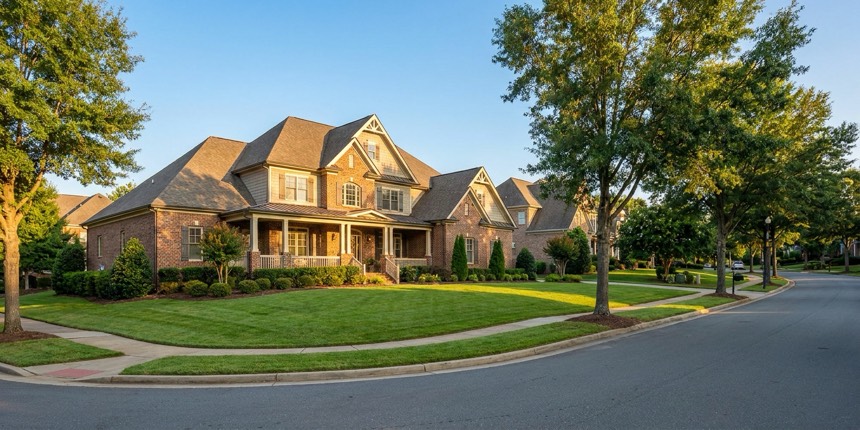
New Jersey has led all fifty states in outbound migration for eight straight years, and once you look at the property-tax bill, it isn’t hard to see why. The Garden State carries the highest effective property-tax rate in the nation — about 2.23%, translating to an average homeowner bill near $9,500 a year — stacked […]
Read More

Table of Contents

Atlas Van Lines, Inc. U.S. DOT No. 125550 (TM & © 2026 AWGI LLC.) | G.P.S.C. 4917 | IL C.C. 4246 | NJPC 00104 | Cal-T 110193
© 2026 Nelson Westerberg, Inc. All Rights Reserved Worldwide.